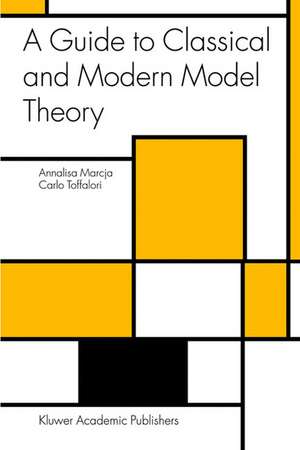
A Guide to Classical and Modern Model Theory: Trends in Logic, cartea 19
Autor Annalisa Marcja, Carlo Toffalorien Limba Engleză Paperback – 30 iun 2003
This volume:
-is easily accessible to young people and mathematicians unfamiliar with logic;
-gives a terse historical picture of Model Theory;
-introduces the latest developments in the area;
-provides 'hands-on' proofs of elimination of quantifiers, elimination of imaginaries and other relevant matters.
A Guide to Classical and Modern Model Theory is for trainees and professional model theorists, mathematicians working in Algebra and Geometry and young people with a basic knowledge of logic.
Din seria Trends in Logic
- 15%
 Preț: 690.20 lei
 - 18%
 Preț: 1263.54 lei
 - 18%
 Preț: 988.90 lei
 - 15%
 Preț: 669.16 lei
 - 15%
 Preț: 666.40 lei
 - 15%
 Preț: 667.07 lei
 -
 Preț: 388.89 lei
 - 18%
 Preț: 958.94 lei
 - 18%
 Preț: 999.09 lei
 - 20%
 Preț: 1275.56 lei
 - 15%
 Preț: 641.11 lei
 - 18%
 Preț: 1847.35 lei
 - 18%
 Preț: 951.85 lei
 - 15%
 Preț: 638.36 lei
 - 18%
 Preț: 922.19 lei
 - 33%
 Preț: 1178.65 lei
 - 15%
 Preț: 664.39 lei
 - 15%
 Preț: 611.27 lei
 - 18%
 Preț: 997.76 lei
 - 18%
 Preț: 961.03 lei
 - 15%
 Preț: 643.63 lei
 - 43%
 Preț: 570.83 lei
 - 15%
 Preț: 641.99 lei
 -
 Preț: 405.58 lei
 - 15%
 Preț: 678.37 lei
 - 18%
 Preț: 815.44 lei
 - 18%
 Preț: 750.89 lei
 - 18%
 Preț: 1375.48 lei
 -
 Preț: 404.57 lei
 - 15%
 Preț: 665.43 lei
 -
 Preț: 407.91 lei
 -
 Preț: 443.13 lei
 - 15%
 Preț: 605.80 lei
 -
 Preț: 404.57 lei
 -
 Preț: 406.64 lei
 - 15%
 Preț: 671.56 lei
Preț: 804.11 lei
Preț vechi: 980.62 lei
-18%
Puncte Express: 1206
Carte tipărită la comandă
Livrare economică 08-22 decembrie
Livrare prin curier în România Termenul estimat este afișat lângă disponibilitate.
Transport gratuit pentru acest produs Plată online sau ramburs, în funcție de opțiunile comenzii.
Retur gratuit în 14 zile Comandă securizată și suport în română.
Specificații
ISBN-13: 9781402013317
ISBN-10: 1402013310
Pagini: 384
Ilustrații: XI, 371 p.
Dimensiuni: 160 x 240 x 20 mm
Greutate: 0.6 kg
Ediția:2003
Editura: SPRINGER NETHERLANDS
Colecția Springer
Seria Trends in Logic
Locul publicării:Dordrecht, Netherlands
ISBN-10: 1402013310
Pagini: 384
Ilustrații: XI, 371 p.
Dimensiuni: 160 x 240 x 20 mm
Greutate: 0.6 kg
Ediția:2003
Editura: SPRINGER NETHERLANDS
Colecția Springer
Seria Trends in Logic
Locul publicării:Dordrecht, Netherlands
V-ar putea interesa
-
 To Mock a Mockingbird: and Other Logic PuzzlesRaymond Smullyan-18%Preț: 83.13 lei100.93 lei
 -
 DefinitionRichard Robinson-32%Preț: 812.45 lei1191.01 lei
 -
 Twenty Five Years of Constructive Type TheoryGiovanni Sambin-37%Preț: 703.45 lei1123.30 lei
 -
 -28%Preț: 471.91 lei659.32 lei
 -
 Notes on Set TheoryYiannis MoschovakisPreț: 472.08 lei
 -
 -36%Preț: 66.83 lei104.45 lei
 -
 -27%Preț: 683.97 lei936.94 lei
 -
 Theory of Computational ComplexityDing-Zhu Du-9%Preț: 850.00 lei934.08 lei
 -
 Preț: 556.88 lei
 -
 Preț: 183.57 lei
 -
 Combinatorial Set Theory: With a Gentle Introduction to ForcingLorenz J. Halbeisen-19%Preț: 557.87 lei688.73 lei
 -
 The Joy of SetsKeith Devlin-15%Preț: 443.91 lei522.24 lei
 -
 Preț: 497.59 lei
 -
 -18%Preț: 1176.29 lei1434.50 lei
 -
 Lattice Theory: Special Topics and ApplicationsGeorge Grätzer-15%Preț: 656.38 lei772.20 lei
 -
 Duality Theories for Boolean Algebras with OperatorsSteven GivantPreț: 405.84 lei
 -
 The Life and Work of Leon HenkinMaría ManzanoPreț: 398.56 lei
Public țintă
Professional/practitionerCuprins
Structures.- 1.1 Structures.- 1.2 Sentences.- 1.3 Embeddings.- 1.4 The Compactness Theorem.- 1.5 Elementary classes and theories.- 1.6 Complete theories.- 1.7 Definable sets.- 1.8 References.- Quantifier Elimination.- 2.1 Elimination sets.- 2.2 Discrete linear orders.- 2.3 Dense linear orders.- 2.4 Algebraically closed fields (and Tarski).- 2.5 Tarski again: Real closed fields.- 2.6 pp-elimination of quantifiers and modules.- 2.7 Strongly minimal theories.- 2.8 o-minimal theories.- 2.9 Computational aspects of q. e.- 2.10 References.- Model Completeness.- 3.1 An introduction.- 3.2 Abraham Robinson’s test.- 3.3 Model completeness and Algebra.- 3.4 p-adic fields and Artin’s Conjecture.- 3.5 Existentially closed structures.- 3.6 DCF0.- 3.7 SCFp and DCFp.- 3.8 ACFA.- 3.9 References.- Elimination of imaginaries.- 4.1 Interpretability.- 4.2 Imaginary elements.- 4.3 Algebraically closed fields.- 4.4 Real closed fields.- 4.5 The elimination of imaginaries sometimes fails.- 4.6 References.- Morley rank.- 5.1 A tale of two chapters.- 5.2 Definable sets.- 5.3 Types.- 5.4 Saturated models.- 5.5 A parenthesis: pure injective modules.- 5.6 Omitting types.- 5.7 The Morley rank, at last.- 5.8 Strongly minimal sets.- 5.9 Algebraic closure and definable closure.- 5.10 References.- ? -stability.- 6.1 Totally transcendental theories.- 6.2 ?-stable groups.- 6.3 ?-stable fields.- 6.4 Prime models.- 6.5 DCF0 revisited.- 6.6 Ryll-Nardzewski’s Theorem, and other things.- 6.7 References.- Classifying.- 7.1 Shelah’s Classification Theory.- 7.2 Simple theories.- 7.3 Stable theories.- 7.4 Superstable theories.- 7.5 ?-stable theories.- 7.6 Classifiable theories.- 7.7 Shelah’s Uniqueness Theorem.- 7.8 Morley’s Theorem.- 7.9 Biinterpretability and Zilber Conjecture.- 7.10 Two algebraicexamples.- 7.11 References.- Model Theory and Algebraic Geometry.- 8.1 Introduction.- 8.2 Algebraic varieties, ideals, types.- 8.3 Dimension and Morley rank.- 8.4 Morphisms and definable functions.- 8.5 Manifolds.- 8.6 Algebraic groups.- 8.7 The Mordell-Lang Conjecture.- 8.8 References.- O-minimality.- 9.1 Introduction.- 9.2 The Monotonicity Theorem.- 9.3 Cells.- 9.4 Cell decomposition and other theorems.- 9.5 Their proofs.- 9.6 Definable groups in o-minimal structures.- 9.7 O-minimality and Real Analysis.- 9.8 Variants on the o-minimal theme.- 9.9 No rose without thorns.- 9.10 References.