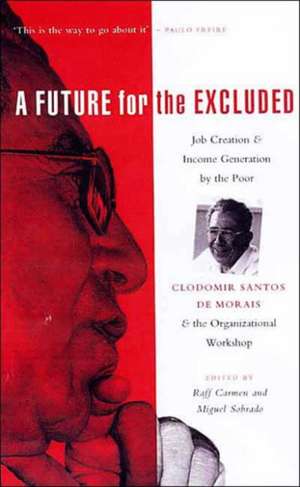
A Future for the Excluded: Job Creation and Income Generation by the Poor: Clodomir Santos de Morais and the Organization Workshop
Editat de Raff Carmen, Miguel Sobradoen Limba Engleză Paperback – mai 2000
This highly distinctive grassroots development approach to empowering socially excluded strata in economic and organizational terms holds out the prospect of becoming a very important factor in the struggle against poverty.
Preț: 243.26 lei
Preț vechi: 294.56 lei
-17%
Puncte Express: 365
Preț estimativ în valută:
43.07€ • 50.15$ • 37.41£
43.07€ • 50.15$ • 37.41£
Carte tipărită la comandă
Livrare economică 23 februarie-09 martie
Preluare comenzi: 021 569.72.76
Specificații
ISBN-13: 9781856497039
ISBN-10: 1856497038
Pagini: 256
Ilustrații: glossary, notes, bibliography, index
Dimensiuni: 138 x 216 x 19 mm
Greutate: 0.33 kg
Editura: Bloomsbury Publishing
Colecția Zed Books
Locul publicării:London, United Kingdom
ISBN-10: 1856497038
Pagini: 256
Ilustrații: glossary, notes, bibliography, index
Dimensiuni: 138 x 216 x 19 mm
Greutate: 0.33 kg
Editura: Bloomsbury Publishing
Colecția Zed Books
Locul publicării:London, United Kingdom
V-ar putea interesa
-
 Pai, H: Chinese WhispersHsiao-Hung PaiPreț: 108.08 lei
 -
 Employment and Economic Performance: Jobs, Inflation, and GrowthJonathan Michie-48%Preț: 447.71 lei862.35 lei
 -
 -19%Preț: 335.03 lei412.96 lei
 -
 -8%Preț: 356.43 lei387.22 lei
 -
 -31%Preț: 379.19 lei545.96 lei
 -
 -15%Preț: 613.00 lei721.18 lei
 -
 Moodle for DummiesRadana DvorakPreț: 161.54 lei
 -
 Closing the Deficit: How Much Can Later Retirement Help?Gary Burtless-19%Preț: 135.61 lei166.69 lei
 -
 Preț: 253.46 lei
 -
 Employment-Based ImmigrationClark M. Butler-30%Preț: 457.82 lei652.67 lei
 -
 -13%Preț: 30.75 lei35.22 lei
 -
 -11%Preț: 32.11 lei36.05 lei
 -
 -7%Preț: 35.21 lei37.93 lei
 -
 Job Quality by Entrepreneurial SpinoffsJohan M Kuhn-12%Preț: 31.35 lei35.59 lei
Cuprins
Preface - Raff Carmen & Miguel Sobrado
Part I: Context and History
1. Setting the Scene: 'Those who don't eat and those who don't sleep' - Raff Carmen and Miguel Sobrado
2. Clodomir Santos de Morais and the Origins of his Largescale Capacitation Theory and Method - Miguel Sobrado
Part II: Theoretical Perspectives
3. The Largescale Capacitation Method and Social Participation: Theoretical Perspectives - Clodomir Santos de Morais
4. From Paulo Freire to Clodomir Santos de Morais: From Critical to Organizational Consciousness - Jacinta Castello Branco Correia
Part III: The Organization Workshop in Practice
5. From Navvies to Entrepreneurs: The Organization Workshop in Costa Rica - Miguel Sobrado
6. Sacked Agricultural Workers Take on the Multinationals in Honduras - Benjamin Erazo
7. The Mexican Experience with Organization Workshops - Juan Jose Rojas Herrera
8. The Organization Workshop in Panama, Colombia, Venezuela, Ecuador and Peru - Miguel Sobrado
9. Three Decades of Work with OWs in Latin America: An Institutional Perspective - Leopoldo Sandoval
10. 'Doing Enterprises' in war-time and post-war Mozambique - Isabel and Ivan de Labra
11. In Angola, Guinea Bissau, Sao Tome and Principe - Paulo Roberto da Silva
12. Hard Learning in Zimbabwe and in post civil-war Mozambique - Isabel and Ivan Labra
13. Organization Development (OD) and Morais's Organization Workshop (OW) - South Africa and Botswana - Gavin Andersson
14. The Potential of the the OW in former Soviet Bloc Countries and Economies in Crisis - Miguel Sobrado
15. In Post-Salazar Portugal - Isabel and Ivan Labra
16. The Crisis of Work in Post-Industrial Western Countries - Raff Carmen
Part IV: From Local OWs to National Employment Generation Systems
17. The Brazilian PROGEI-SIPGEIs - Jacinta C. B. Correia
18. 'More than a Job: A Future': The PAE Self-Employment Programme in Brazil - Walter Barelli
19. The OW and Civil Society Organizations in Brazil - Jacinta C. B. Correia
20. OW's Potential: Concluding Observations - Miguel Sobrado
Part I: Context and History
1. Setting the Scene: 'Those who don't eat and those who don't sleep' - Raff Carmen and Miguel Sobrado
2. Clodomir Santos de Morais and the Origins of his Largescale Capacitation Theory and Method - Miguel Sobrado
Part II: Theoretical Perspectives
3. The Largescale Capacitation Method and Social Participation: Theoretical Perspectives - Clodomir Santos de Morais
4. From Paulo Freire to Clodomir Santos de Morais: From Critical to Organizational Consciousness - Jacinta Castello Branco Correia
Part III: The Organization Workshop in Practice
5. From Navvies to Entrepreneurs: The Organization Workshop in Costa Rica - Miguel Sobrado
6. Sacked Agricultural Workers Take on the Multinationals in Honduras - Benjamin Erazo
7. The Mexican Experience with Organization Workshops - Juan Jose Rojas Herrera
8. The Organization Workshop in Panama, Colombia, Venezuela, Ecuador and Peru - Miguel Sobrado
9. Three Decades of Work with OWs in Latin America: An Institutional Perspective - Leopoldo Sandoval
10. 'Doing Enterprises' in war-time and post-war Mozambique - Isabel and Ivan de Labra
11. In Angola, Guinea Bissau, Sao Tome and Principe - Paulo Roberto da Silva
12. Hard Learning in Zimbabwe and in post civil-war Mozambique - Isabel and Ivan Labra
13. Organization Development (OD) and Morais's Organization Workshop (OW) - South Africa and Botswana - Gavin Andersson
14. The Potential of the the OW in former Soviet Bloc Countries and Economies in Crisis - Miguel Sobrado
15. In Post-Salazar Portugal - Isabel and Ivan Labra
16. The Crisis of Work in Post-Industrial Western Countries - Raff Carmen
Part IV: From Local OWs to National Employment Generation Systems
17. The Brazilian PROGEI-SIPGEIs - Jacinta C. B. Correia
18. 'More than a Job: A Future': The PAE Self-Employment Programme in Brazil - Walter Barelli
19. The OW and Civil Society Organizations in Brazil - Jacinta C. B. Correia
20. OW's Potential: Concluding Observations - Miguel Sobrado
Recenzii
One of the few books to cross the boundary between social and organizational change, and a 'must' for all organization and social development practitioners.
The kind of book that comes only once in a while. Important for progressive educators, community organizers, and all those concerned with non-formal education.
In the link de Morais establishes between autonomy, self-organization, and creative
The success of these worker-owned enterprises makes this book essential reading for anyone concerned with issues of poverty and development.
At last a book that offers the English-speaking world a window into a startling body of theory and practice on building democratic forms of economic organization.
The kind of book that comes only once in a while. Important for progressive educators, community organizers, and all those concerned with non-formal education.
In the link de Morais establishes between autonomy, self-organization, and creative
The success of these worker-owned enterprises makes this book essential reading for anyone concerned with issues of poverty and development.
At last a book that offers the English-speaking world a window into a startling body of theory and practice on building democratic forms of economic organization.