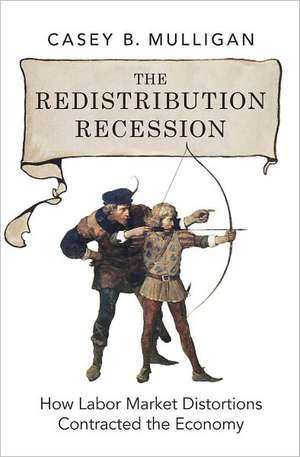
The Redistribution Recession: How Labor Market Distortions Contracted the Economy
Autor Casey B. Mulliganen Limba Engleză Hardback – 29 noi 2012
Preț: 418.63 lei
Preț vechi: 579.20 lei
-28%
Puncte Express: 628
Carte tipărită la comandă
Livrare economică 19-25 noiembrie
Livrare prin curier în România Termenul estimat este afișat lângă disponibilitate.
Transport gratuit pentru acest produs Plată online sau ramburs, în funcție de opțiunile comenzii.
Retur gratuit în 14 zile Comandă securizată și suport în română.
Specificații
ISBN-13: 9780199942213
ISBN-10: 0199942218
Pagini: 364
Ilustrații: 60 two-color line illustrations
Dimensiuni: 157 x 236 x 25 mm
Greutate: 0.75 kg
Editura: Oxford University Press
Colecția OUP USA
Locul publicării:New York, United States
ISBN-10: 0199942218
Pagini: 364
Ilustrații: 60 two-color line illustrations
Dimensiuni: 157 x 236 x 25 mm
Greutate: 0.75 kg
Editura: Oxford University Press
Colecția OUP USA
Locul publicării:New York, United States
V-ar putea interesa
-
 RinsedGeoff WhitePreț: 85.83 lei
 -
 Applied Economics: Thinking Beyond Stage OneThomas SowellPreț: 246.70 lei
 -
 Preț: 106.23 lei
 -
 Essays in Applied EconomicsArthur Cecil Pigou-9%Preț: 1326.43 lei1457.62 lei
 -
 Modern Labor Economics: Theory and Public PolicyRonald G. Ehrenberg-14%Preț: 1143.99 lei1330.21 leiRecomandat
 -
 Modern Labor EconomicsKevin F. Hallock-8%Preț: 457.94 lei497.76 lei
 -
 Just One More Hand: Life in the Casino EconomyEllen MutariPreț: 233.53 lei
 -
 The Bailout State - Why governments rescue banks, not peopleMartijn KoningsPreț: 140.33 lei
 -
 In This Economy?Kyla Scanlon-18%Preț: 112.75 lei137.94 leiRecomandat
 -
 -27%Preț: 1000.08 lei1362.78 lei
 -
 -27%Preț: 1023.10 lei1395.50 lei
 -
 -27%Preț: 1022.64 lei1395.20 lei
 -
 Employment Is DeadDeborah Perry PisconePreț: 187.60 lei
 -
 The General Theory of Employment, Interest, and MoneyJohn Maynard KeynesPreț: 60.13 lei
 -
 Who Needs More Cuts?Barry KushnerPreț: 71.44 lei
 -
 Free Lunch ThinkingTom Bergin-18%Preț: 63.87 lei78.35 lei
 -
 Capital OffencePaul MussonPreț: 144.42 lei
 -
 Another WayDave WhortonPreț: 188.37 lei
Recenzii
Much of the policy reaction to the Great Recession emphasized Keynesian effects on aggregate demand and downplayed individual incentives to work, produce, and invest. In contrast, Casey Mulligan's research focuses on how an expanded array of U.S. safety-net programs-food stamps, unemployment insurance, Medicaid, and housing/mortgage assistance programs-raised effective marginal income-tax rates especially for poor families. These diminished incentives to work help to explain the weakness of the U.S. economic recovery since the end of the recession in 2009 and also explain why Barack Obama is justifiably called the 'Food-Stamp President.' Hopefully, future government policymakers will deliver better results by learning from this important book.
Notă biografică
Professor of Economics, University of Chicago, author of Parental Priorities and Economic Inequality, weekly contributor to Economix blog for the New York Times