
A First Course in Statistical Learning: Statistics and Computing
Autor Johannes Ledereren Limba Engleză Hardback – 26 feb 2025
The book consists of three parts: The first one presents data in the framework of probability theory, exploratory data analysis, and unsupervised learning. The second part on inferential data analysis covers linear and logistic regression and regularization. The last part studies machine learning with a focus on support-vector machines and deep learning. Each chapter is based on a dataset, which can be downloaded from the book's homepage.
In addition, the book has the following features:
- A careful selection of topics ensures rapid progress.
- An opening question at the beginning of each chapter leads the reader through the topic.
- Expositions are rigorous yet based on elementary mathematics.
- More than two hundred exercises help digest the material.
- A crisp discussion section at the end of each chapter summarizes the key concepts and highlights practical implications.
- Numerous suggestions for further reading guide the reader in finding additional information.
Din seria Statistics and Computing
- 20%
 Preț: 594.53 lei
 - 18%
 Preț: 920.45 lei
 -
 Preț: 418.19 lei
 -
 Preț: 490.51 lei
 - 18%
 Preț: 960.76 lei
 - 15%
 Preț: 695.37 lei
 - 19%
 Preț: 539.23 lei
 - 15%
 Preț: 664.29 lei
 - 18%
 Preț: 1123.42 lei
 - 20%
 Preț: 884.74 lei
 - 20%
 Preț: 569.32 lei
 - 15%
 Preț: 645.49 lei
 - 15%
 Preț: 699.21 lei
 - 18%
 Preț: 1051.28 lei
 - 20%
 Preț: 648.33 lei
 -
 Preț: 211.88 lei
 - 18%
 Preț: 1041.97 lei
 - 15%
 Preț: 465.98 lei
 - 20%
 Preț: 1220.52 lei
 -
 Preț: 387.31 lei
 - 20%
 Preț: 1216.26 lei
 - 18%
 Preț: 1176.18 lei
 - 20%
 Preț: 477.10 lei
 -
 Preț: 388.17 lei
 - 20%
 Preț: 617.67 lei
 - 18%
 Preț: 1018.98 lei
 - 20%
 Preț: 1627.30 lei
 - 20%
 Preț: 1458.98 lei
 -
 Preț: 403.31 lei
 - 20%
 Preț: 815.16 lei
 -
 Preț: 362.88 lei
 - 15%
 Preț: 675.09 lei
 - 15%
 Preț: 651.89 lei
 - 20%
 Preț: 1315.83 lei
 - 15%
 Preț: 611.13 lei
Preț: 612.09 lei
Preț vechi: 765.11 lei
-20%
Puncte Express: 918
Carte tipărită la comandă
Livrare economică 01-07 decembrie
Livrare prin curier în România Termenul estimat este afișat lângă disponibilitate.
Transport gratuit pentru acest produs Plată online sau ramburs, în funcție de opțiunile comenzii.
Retur gratuit în 14 zile Comandă securizată și suport în română.
Specificații
ISBN-13: 9783031302756
ISBN-10: 3031302753
Pagini: 296
Ilustrații: XIV, 294 p. 104 illus., 95 illus. in color.
Dimensiuni: 160 x 241 x 21 mm
Greutate: 0.61 kg
Ediția:1st ed. 2024
Editura: Springer
Colecția Statistics and Computing
Seria Statistics and Computing
Locul publicării:Cham, Switzerland
ISBN-10: 3031302753
Pagini: 296
Ilustrații: XIV, 294 p. 104 illus., 95 illus. in color.
Dimensiuni: 160 x 241 x 21 mm
Greutate: 0.61 kg
Ediția:1st ed. 2024
Editura: Springer
Colecția Statistics and Computing
Seria Statistics and Computing
Locul publicării:Cham, Switzerland
V-ar putea interesa
-
 Preț: 218.53 lei
 -
 Just Enough Data Science and Machine LearningMark LevenePreț: 352.28 lei
 -
 Machine LearningKevin P. Murphy-20%Preț: 731.65 lei918.37 lei
 -
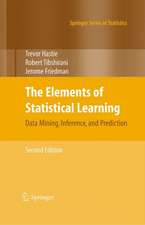 The Elements of Statistical LearningTrevor Hastie-20%Preț: 582.77 lei728.46 lei
 -
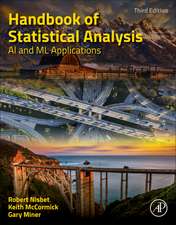 Handbook of Statistical Analysis: AI and ML ApplicationsRobert Nisbet-31%Preț: 589.12 lei859.83 lei
 -
 -39%Preț: 394.79 lei646.62 lei
 -
 -31%Preț: 607.05 lei885.58 lei
 -
 -18%Preț: 744.18 lei907.54 lei
 -
 An Introduction to Statistical LearningGareth James-15%Preț: 416.05 lei489.47 lei
 -
 R-ticulateMartin Bader-23%Preț: 653.46 lei848.65 lei
 -
 Statistical Analysis with Python For DummiesJoseph SchmullerPreț: 197.44 lei
 -
 Machine Learning: An Algorithmic Perspective, Second EditionStephen Marsland-20%Preț: 625.22 lei781.53 lei
 -
 Practical Deep Learning, 2nd Edition: A Python-Based IntroductionRonald T. Kneusel-35%Preț: 333.73 lei515.68 lei
 -
 An Introduction to Statistical LearningGareth James-13%Preț: 542.61 lei623.00 lei
 -
 Preț: 462.84 lei
 -
 Materials Data ScienceStefan Sandfeld-19%Preț: 624.52 lei771.02 lei
 -
 Statistics for ScientistsUmberto Michelucci-20%Preț: 279.62 lei349.53 lei
 -
 Mathematical Introduction to Data ScienceSven A. Wegner-20%Preț: 574.81 lei718.51 lei
 -
 Multivariate Analysis and Machine Learning TechniquesSrikrishnan Sundararajan-20%Preț: 569.31 lei711.63 lei
Cuprins
Part I: Data.- Chapter 1: Fundamentals of Data.- Chapter 2: Exploratory Data Analysis.- Chapter 3: Unsupervised Learning.- Part II: Inferential Data Analyses.- Chapter 4: Linear Regression.- Chapter 5: Logistic Regression.- Chapter 6: Regularization.- Part III: Machine Learning.- Chapter 7: Support-Vector Machines.- Chapter 8: Deep Learning.
Notă biografică
Johannes Lederer is a Professor and the Chair of Mathematics for Data-Driven Methods at the Department of Mathematics, Computer Science, and Natural Sciences, University of Hamburg, Germany. Previously, he was a Professor of Statistics at the Ruhr-University Bochum. He received his PhD in mathematics from the ETH Zürich and subsequently held positions at UC Berkeley, Cornell University, and the University of Washington. He has taught statistical learning and related courses in the US, Belgium, Hong Kong, and Germany to applied and mathematical audiences alike.
Textul de pe ultima copertă
This textbook introduces the fundamental concepts and methods of statistical learning. It uses Python and provides a unique approach by blending theory, data examples, software code, and exercises from beginning to end for a profound yet practical introduction to statistical learning.
The book consists of three parts: The first one presents data in the framework of probability theory, exploratory data analysis, and unsupervised learning. The second part on inferential data analysis covers linear and logistic regression and regularization. The last part studies machine learning with a focus on support-vector machines and deep learning. Each chapter is based on a dataset, which can be downloaded from the book's homepage.
In addition, the book has the following features:
The book consists of three parts: The first one presents data in the framework of probability theory, exploratory data analysis, and unsupervised learning. The second part on inferential data analysis covers linear and logistic regression and regularization. The last part studies machine learning with a focus on support-vector machines and deep learning. Each chapter is based on a dataset, which can be downloaded from the book's homepage.
In addition, the book has the following features:
- A careful selection of topics ensures rapid progress.
- An opening question at the beginning of each chapter leads the reader through the topic.
- Expositions are rigorous yet based on elementary mathematics.
- More than two hundred exercises help digest the material.
- A crisp discussion section at the end of each chapter summarizes the key concepts and highlights practical implications.
- Numerous suggestions for further reading guide the reader in finding additional information.