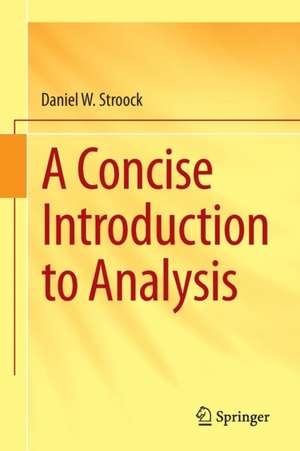
A Concise Introduction to Analysis
Autor Daniel W. Stroocken Limba Engleză Paperback – 10 noi 2015
Notăm cu interes apariția lucrării A Concise Introduction to Analysis, o resursă care se plasează strategic la granița dintre cursurile de calcul avansat și analiza matematică riguroasă pentru studenții din primii ani de licență. În contextul programelor de studiu actuale, volumul servește drept punte de legătură, eliminând fragmentarea tradițională dintre variabilele reale și cele complexe prin prezentarea lor într-un cadru conceptual unificat. Reținem abordarea hibridă a autorului Daniel W. Stroock, care alege să nu trateze analiza complexă ca pe o disciplină izolată, ci ca pe o extensie firească a rezultatelor din analiza reală.
Structura cărții reflectă o progresie logică, pornind de la analiza pe dreapta reală și elemente de analiză complexă, continuând cu o dezvoltare detaliată a integrării în dimensiuni superioare. Considerăm remarcabil modul în care capitolele despre teorema lui Fubini și teorema divergenței pregătesc terenul pentru demonstrarea formulei lui Cauchy în ultimul capitol. Această metodă oferă o perspectivă coerentă asupra analizei, transformând concepte adesea abstracte în instrumente de lucru aplicate. A Concise Introduction to Analysis reprezintă o alternativă viabilă la From Real to Complex Analysis de R. H. Dyer pentru cursurile de analiză integrată, având avantajul unei structuri mai condensate și al unei legături mai strânse cu calculul multivariat.
Poziționată în contextul operei lui Daniel W. Stroock, lucrarea păstrează rigoarea analitică regăsită în Probability Theory sau Elements of Stochastic Calculus and Analysis, dar adaptează limbajul pentru un public aflat la începutul specializării. Spre deosebire de monografiile sale de cercetare, acest curs pune un accent deosebit pe exemplele pedagogice și pe exercițiile finale, care nu sunt simple anexe, ci elemente esențiale pentru consolidarea înțelegerii teoretice.
Preț: 367.57 lei
Carte tipărită la comandă
Livrare economică 01-07 decembrie
Specificații
ISBN-10: 3319244671
Pagini: 232
Ilustrații: XII, 218 p.
Dimensiuni: 155 x 235 x 13 mm
Greutate: 0.36 kg
Ediția:1st edition 2015
Editura: Springer
Locul publicării:Cham, Switzerland
V-ar putea interesa
-
 -19%Preț: 502.40 lei620.25 lei
 -
 -19%Preț: 653.68 lei807.01 lei
 -
 Functions, Spaces, and ExpansionsOle Christensen-15%Preț: 606.07 lei713.02 lei
 -
 Partial Differential Equations for ProbabilistsDaniel W. StroockPreț: 334.49 lei
 -
 Fractal GeometryKenneth FalconerPreț: 426.81 lei
 -
 -18%Preț: 896.42 lei1093.19 lei
 -
 -15%Preț: 569.40 lei669.87 lei
 -
 Hypergeometric SummationWolfram Koepf-15%Preț: 502.35 lei591.01 lei
 -
 Quadratic and Higher Degree FormsKrishnaswami Alladi-18%Preț: 929.01 lei1132.94 lei
 -
 Decay of the Fourier TransformAlex Iosevich-15%Preț: 724.89 lei852.80 lei
 -
 -15%Preț: 606.90 lei714.01 lei
 -
 -18%Preț: 830.45 lei1012.74 lei
 -
 Geometric Aspects of Functional AnalysisBo'az KlartagPreț: 383.37 lei
Public țintă
Lower undergraduateDe ce să citești această carte
Recomandăm această carte studenților de la facultățile de matematică și fizică care caută o introducere riguroasă, dar concisă, în analiza modernă. Cititorul câștigă o înțelegere unitară a legăturii dintre analiza reală și cea complexă, fiind scutit de parcurgerea unor manuale separate. Este un instrument excelent pentru auto-studiu sau ca suport de curs datorită modului în care derivă proprietățile funcțiilor analitice din teoreme fundamentale de integrare.
Despre autor
Dr. Daniel W. Stroock este profesor emerit de matematică (Simons Professor) la Massachusetts Institute of Technology (MIT). Renumit pentru contribuțiile sale fundamentale în teoria probabilităților și analiza stochastică, Stroock este co-autorul teoriei proceselor de difuzie multidimensionale, lucrare care i-a adus recunoașterea internațională. Experiența sa vastă în cercetare se reflectă în cele șase cărți publicate, printre care Probability Theory: An Analytic View și Partial Differential Equations for Probabilists. În A Concise Introduction to Analysis, autorul își folosește expertiza în analiză pentru a oferi o viziune pedagogică proaspătă asupra fundamentelor matematicii.
Descriere scurtă
Cuprins
Recenzii
“Goal of this book is to establish the principles of mathematical analysis both for functions of real variables and for functions of a complex variable in the shortest possible way. … book can be read and understood without resorting to any external reference since the author provides detailed proofs of all results. … in each chapter one can find several examples of the theory discussed as well as a list of working exercises that will be useful to the reader.” (Julià Cufí, zbMATH 1337.26001, 2016)