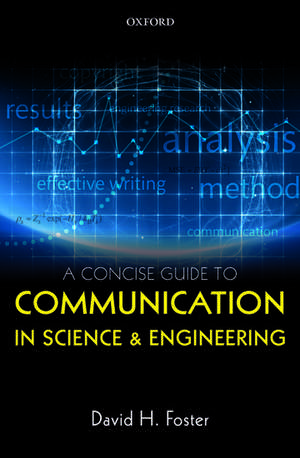
A Concise Guide to Communication in Science and Engineering
Autor David H. Fosteren Limba Engleză Paperback – 9 noi 2017
Preț: 268.19 lei
Preț vechi: 303.64 lei
-12%
Puncte Express: 402
Carte tipărită la comandă
Livrare economică 27 noiembrie-08 decembrie
Livrare prin curier în România Termenul estimat este afișat lângă disponibilitate.
Transport gratuit de la 400.00 lei Plată online sau ramburs, în funcție de opțiunile comenzii.
Retur gratuit în 14 zile Comandă securizată și suport în română.
Specificații
ISBN-13: 9780198704249
ISBN-10: 0198704240
Pagini: 408
Dimensiuni: 156 x 233 x 22 mm
Greutate: 0.61 kg
Editura: OUP OXFORD
Colecția OUP Oxford
Locul publicării:Oxford, United Kingdom
ISBN-10: 0198704240
Pagini: 408
Dimensiuni: 156 x 233 x 22 mm
Greutate: 0.61 kg
Editura: OUP OXFORD
Colecția OUP Oxford
Locul publicării:Oxford, United Kingdom
V-ar putea interesa
-
 Race and IQM. F. Ashley Montagu-16%Preț: 159.63 lei189.72 lei
 -
 A Life of Sir Francis Galton: From African Exploration to the Birth of EugenicsNicholas Wright Gillham-10%Preț: 368.01 lei410.21 lei
 -
 -16%Preț: 203.04 lei241.40 lei
 -
 How the Laser Happened: Adventures of a ScientistCharles H. Townes-13%Preț: 293.68 lei337.63 lei
 -
 Knowing: The Nature of Physical LawMichael Munowitz-19%Preț: 276.08 lei342.68 lei
 -
 Are We Hardwired?: The Role of Genes in Human BehaviorWilliam R. ClarkPreț: 304.78 lei
 -
 -17%Preț: 142.89 lei171.37 lei
 -
 Ludwig Boltzmann: The Man Who Trusted AtomsCarlo Cercignani-26%Preț: 362.07 lei486.76 lei
 -
 A Passion for DNA: Genes, Genomes and SocietyJames D. Watson-15%Preț: 112.03 lei131.95 lei
 -
 Toxin: The cunning of bacterial poisonsAlistair J. Lax-19%Preț: 375.36 lei462.38 lei
 -
 Portals to the UniverseCommittee on NASA Astronomy Science CentersPreț: 334.65 lei
 -
 Hot HouseRobert G StromPreț: 172.64 lei
 -
 High School Confidential: Secrets of an Undercover StudentJeremy Iversen-47%Preț: 110.81 lei210.18 lei
 -
 Habitable Planets for ManStephen H DolePreț: 156.51 lei
 -
 The Story of the StarsGeorge F. ChambersPreț: 81.51 lei
 -
 Einsteins SpukAnton ZeilingerPreț: 107.31 lei
 -
 Warum Vögel singenDavid RothenbergPreț: 151.24 lei
 -
 Preț: 316.23 lei
Recenzii
This book is a joy to read and a treasure trove to keep and share with junior and senior colleagues and students... this book is an outstanding resource. Spanning a wide range of communications topics, across a wide range of specialized types of writing, in language that is accessible, sometimes funny, and always useful, this book has the ingredients to make any reader into a much better communicator.
This book is a great asset for any PhD student or a fresh researcher in one of the STEM disciplines, and there should be a book like this on the (virtual) shelf of the library.
Provides helpful advice to scientists and engineers in both oral and written communication of their research in a single, concise volume. [An] indispensable guide.
I used to teach a course on scientific writing: oh how I wish David Foster's wonderful text, A Concise Guide to Communication in Science and Engineering had been available then. However, the book goes well beyond just writing, providing sage advice, replete with examples, on graphing, statistical inference, publication and giving lectures and talks. This is the ultimate users' manual for scientific communication, from soup to nuts! As a highly experienced author, reviewer and editor, Foster provides important insights into navigating the confusing (and rapidly changing) world of scientific publication: how to choose the right journal, what to expect of the peer review system and even how to promote your article. The book includes a thoughtful and comprehensive chapter on "Ethical Issues" which includes sections on "Authorship" and "Salami Slicing". This amazing book should be mandatory reading for graduate students and post-docs.
Communication in everyday life refers to sharing thoughts by means of language. This process naturally leads to ambiguities of interpretation, which are usually resolved by a dialog between the speaker and the listener. Communication in science and engineering by means of publications and presentations is much more difficult because it takes place on a one-way road: the author is rarely available to answer the reader's questions. The author of a publication is forced to anticipate all questions and resolve all ambiguities before they arise. This guide teaches us how to do this, and how to do this very well. Native English authors will surely benefit from Foster's lectures, and authors, whose native language is not English, will benefit even more.
An 'Elements of Style' for scientists at all levels. Essential reading and reference material that will not only improve writing but also sharpen thinking.
This is an amazing book for all of us who want to present scientific research clearly and efficiently. Real examples and thoughtful advice make the text a practical tool for everyday science. Read it and add value to your research!
The ideal resource for any PhD student about to write their thesis, the 'Concise Guide' gives detailed specific guidance for scientific writing and just as importantly great advice on how to tackle this daunting task. An essential reference for native English speakers and for those trying to write like one.
Foster's textbook on communication in science & technology is a comprehensive guide that will be of use to anyone who is involved in technical communication from junior PhD students to the most senior of professors. It covers all aspects of technical communication including theses, journal papers, books, and presentations. Although it covers the theoretical and technical aspects of communication, I am most impressed by the use of hundreds of examples of imperfect communication, taken from real papers and theses, along with improved versions of many of them. I am recommending this book to all of my doctoral students and postdocs and I anticipate a huge time saving. This is an incredibly valuable resource that I expect to consult on a regular basis.
In an age of information overload, this guide provides a Strunk and White for clarity in scientific reporting, a veritable vade mecum that should be required reading for students and colleagues, alike.
This is the book I needed right next to my desk when I first set out to publish, and would still be using today. Full of practical advice, thoroughly structured, and lightened by occasional asides, for example, on rejection: 'Complaining to the editor [...] is unlikely to lead to a different decision'. An excellent read.
Foster's A Concise Guide to Communication will definitely help anyone actively involved in scientific research to write and present more clearly and effectively. The many examples of bad and good writing and graphing, taken from real papers and theses, not only illustrate how and where communication can fail but also clearly explain why it fails and how to improve the structure, logic, and clarity of the exposition.
This book is a great asset for any PhD student or a fresh researcher in one of the STEM disciplines, and there should be a book like this on the (virtual) shelf of the library.
Provides helpful advice to scientists and engineers in both oral and written communication of their research in a single, concise volume. [An] indispensable guide.
I used to teach a course on scientific writing: oh how I wish David Foster's wonderful text, A Concise Guide to Communication in Science and Engineering had been available then. However, the book goes well beyond just writing, providing sage advice, replete with examples, on graphing, statistical inference, publication and giving lectures and talks. This is the ultimate users' manual for scientific communication, from soup to nuts! As a highly experienced author, reviewer and editor, Foster provides important insights into navigating the confusing (and rapidly changing) world of scientific publication: how to choose the right journal, what to expect of the peer review system and even how to promote your article. The book includes a thoughtful and comprehensive chapter on "Ethical Issues" which includes sections on "Authorship" and "Salami Slicing". This amazing book should be mandatory reading for graduate students and post-docs.
Communication in everyday life refers to sharing thoughts by means of language. This process naturally leads to ambiguities of interpretation, which are usually resolved by a dialog between the speaker and the listener. Communication in science and engineering by means of publications and presentations is much more difficult because it takes place on a one-way road: the author is rarely available to answer the reader's questions. The author of a publication is forced to anticipate all questions and resolve all ambiguities before they arise. This guide teaches us how to do this, and how to do this very well. Native English authors will surely benefit from Foster's lectures, and authors, whose native language is not English, will benefit even more.
An 'Elements of Style' for scientists at all levels. Essential reading and reference material that will not only improve writing but also sharpen thinking.
This is an amazing book for all of us who want to present scientific research clearly and efficiently. Real examples and thoughtful advice make the text a practical tool for everyday science. Read it and add value to your research!
The ideal resource for any PhD student about to write their thesis, the 'Concise Guide' gives detailed specific guidance for scientific writing and just as importantly great advice on how to tackle this daunting task. An essential reference for native English speakers and for those trying to write like one.
Foster's textbook on communication in science & technology is a comprehensive guide that will be of use to anyone who is involved in technical communication from junior PhD students to the most senior of professors. It covers all aspects of technical communication including theses, journal papers, books, and presentations. Although it covers the theoretical and technical aspects of communication, I am most impressed by the use of hundreds of examples of imperfect communication, taken from real papers and theses, along with improved versions of many of them. I am recommending this book to all of my doctoral students and postdocs and I anticipate a huge time saving. This is an incredibly valuable resource that I expect to consult on a regular basis.
In an age of information overload, this guide provides a Strunk and White for clarity in scientific reporting, a veritable vade mecum that should be required reading for students and colleagues, alike.
This is the book I needed right next to my desk when I first set out to publish, and would still be using today. Full of practical advice, thoroughly structured, and lightened by occasional asides, for example, on rejection: 'Complaining to the editor [...] is unlikely to lead to a different decision'. An excellent read.
Foster's A Concise Guide to Communication will definitely help anyone actively involved in scientific research to write and present more clearly and effectively. The many examples of bad and good writing and graphing, taken from real papers and theses, not only illustrate how and where communication can fail but also clearly explain why it fails and how to improve the structure, logic, and clarity of the exposition.
Notă biografică
David H. Foster is Professor of Vision Systems at the University of Manchester and Director of Research in the School of Electrical & Electronic Engineering. He began his academic career as a lecturer in physics at Imperial College London and went on to hold personal chairs at several UK universities. He has served as journal editor or editor in chief for over thirty years and has taught communication in science and engineering at undergraduate, postgraduate, and postdoctoral levels in the UK and elsewhere. He is a Fellow of the Institute of Physics, the Institute of Mathematics and its Applications, and the Optical Society of America.