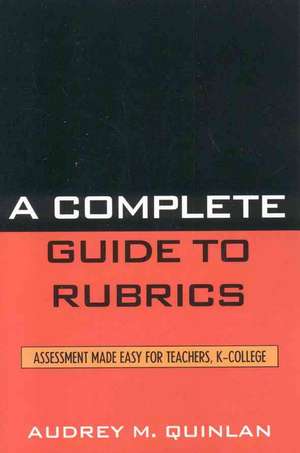
A Complete Guide to Rubrics: Assessment Made Easy for Teachers, K-College
Autor Audrey M. Quinlanen Limba Engleză Paperback – 19 aug 2006
Preț: 314.50 lei
Preț vechi: 389.00 lei
-19%
Puncte Express: 472
Carte tipărită la comandă
Livrare economică 20 noiembrie-04 decembrie
Livrare prin curier în România Termenul estimat este afișat lângă disponibilitate.
Transport gratuit de la 400.00 lei Plată online sau ramburs, în funcție de opțiunile comenzii.
Retur gratuit în 14 zile Comandă securizată și suport în română.
Specificații
ISBN-13: 9781578864713
ISBN-10: 1578864712
Pagini: 217
Dimensiuni: 148 x 226 x 14 mm
Greutate: 0.35 kg
Editura: Bloomsbury Publishing
Colecția R&L Education
Locul publicării:New York, United States
ISBN-10: 1578864712
Pagini: 217
Dimensiuni: 148 x 226 x 14 mm
Greutate: 0.35 kg
Editura: Bloomsbury Publishing
Colecția R&L Education
Locul publicării:New York, United States
Cuprins
Chapter 1 Background: What is a Rubric and Why Bother?
Chapter 2 Checklists, Performance Lists, or Rubrics: Which Tool is Right for Me?
Chapter 3 Using Rubrics in Primary Grades
Chapter 4 Using Rubrics in the Intermediate Grades
Chapter 5 Using Rubrics in Middle School or Junior High School
Chapter 6 Using Rubrics in High School
Chapter 7 Rubrics with Adult Learners
Chapter 8 Rubrics for Computer Products and Presentations
Chapter 9 Rubrics for Online Activities
Chapter 10 How to Create Your Own Rubrics
Chapter 11 Student-Generated Rubrics
Chapter 12 Teaching Others to Use Rubrics
Chapter 13 Using Rubrics in the Real World
Chapter 14 Rubric Websites
Chapter 2 Checklists, Performance Lists, or Rubrics: Which Tool is Right for Me?
Chapter 3 Using Rubrics in Primary Grades
Chapter 4 Using Rubrics in the Intermediate Grades
Chapter 5 Using Rubrics in Middle School or Junior High School
Chapter 6 Using Rubrics in High School
Chapter 7 Rubrics with Adult Learners
Chapter 8 Rubrics for Computer Products and Presentations
Chapter 9 Rubrics for Online Activities
Chapter 10 How to Create Your Own Rubrics
Chapter 11 Student-Generated Rubrics
Chapter 12 Teaching Others to Use Rubrics
Chapter 13 Using Rubrics in the Real World
Chapter 14 Rubric Websites
Recenzii
Audrey Quinlan has created a unique instrument that focuses on a developmental perspective of the use of rubrics to assess student work. This teacher-friendly text allows the educator to create a unique and informative assessment for children's work through the rubric process. Additionally, each chapter provides a wealth of information that teachers can successfully use in the classroom. This is an amazing effort to make assessment of student work reliable and useful for the busy professional.
I highly recommend this book for new as well as experienced educators and anyone interested in discovering more about rubrics.
Quinlan provides numerous examples of checklists and rubrics used by real teachers in real classrooms, as well as sound advice on how to create and find rubrics. Unlike other books about rubrics, however, this book draws on children's developmental characteristics and common curricular benchmarks to recommend useful approaches to assessment. This book can help teachers at every grade level, from kindergarten through college, craft a variety of ways to fairly assess student work.
A Complete Guide to Rubrics is a practical approach for students, teachers, administrators, and parents to begin the process of incorporating meaningful techniques for assessing student learning processes and products. Examples and explanations of developmental levels make this a valuable resource for all grade levels. Moreover, attention to products and projects created for online activity, software assessment, and web page evaluation contribute to the timeliness of the approaches contained in this work. A Complete Guide to Rubrics provides a framework for communicating expectations of learning outcomes and their alignment with established goals or standards with all stakeholders. Additional resources are provided through web sites and resources listed at the end of each chapter. In an age of high-stakes testing, it is critical to provide evidence of learning that cannot be assessed solely through multiple choice or short essay questions. This book shows us how to make this type of assessment a part of our personal and professional practice.
I highly recommend this book for new as well as experienced educators and anyone interested in discovering more about rubrics.
Quinlan provides numerous examples of checklists and rubrics used by real teachers in real classrooms, as well as sound advice on how to create and find rubrics. Unlike other books about rubrics, however, this book draws on children's developmental characteristics and common curricular benchmarks to recommend useful approaches to assessment. This book can help teachers at every grade level, from kindergarten through college, craft a variety of ways to fairly assess student work.
A Complete Guide to Rubrics is a practical approach for students, teachers, administrators, and parents to begin the process of incorporating meaningful techniques for assessing student learning processes and products. Examples and explanations of developmental levels make this a valuable resource for all grade levels. Moreover, attention to products and projects created for online activity, software assessment, and web page evaluation contribute to the timeliness of the approaches contained in this work. A Complete Guide to Rubrics provides a framework for communicating expectations of learning outcomes and their alignment with established goals or standards with all stakeholders. Additional resources are provided through web sites and resources listed at the end of each chapter. In an age of high-stakes testing, it is critical to provide evidence of learning that cannot be assessed solely through multiple choice or short essay questions. This book shows us how to make this type of assessment a part of our personal and professional practice.