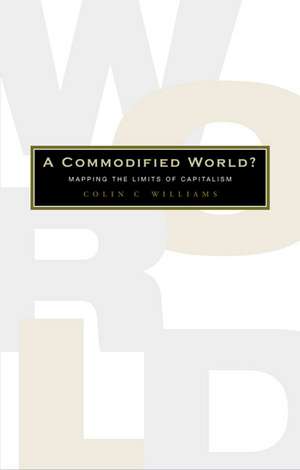
A Commodified World: Mapping the Limits of Capitalism
Autor Colin C. Williamsen Limba Engleză Paperback – 4 mar 2005
Preț: 262.76 lei
Preț vechi: 341.47 lei
-23%
Puncte Express: 394
Carte disponibilă
Livrare economică 07-21 noiembrie
Livrare prin curier în România Termenul estimat este afișat lângă disponibilitate.
Transport gratuit de la 400.00 lei Plată online sau ramburs, în funcție de opțiunile comenzii.
Retur gratuit în 14 zile Comandă securizată și suport în română.
Specificații
ISBN-13: 9781842773550
ISBN-10: 1842773550
Pagini: 320
Dimensiuni: 138 x 214 x 16 mm
Greutate: 0.44 kg
Editura: Bloomsbury Publishing
Colecția Zed Books
Locul publicării:London, United Kingdom
ISBN-10: 1842773550
Pagini: 320
Dimensiuni: 138 x 214 x 16 mm
Greutate: 0.44 kg
Editura: Bloomsbury Publishing
Colecția Zed Books
Locul publicării:London, United Kingdom
V-ar putea interesa
-
 The Economic Theory of Agrarian InstitutionsPranab Bardhan-28%Preț: 480.96 lei670.05 lei
 -
 The Chinese Economy under Deng XiaopingRobert F. Ash-19%Preț: 331.42 lei408.98 lei
 -
 Managing the Global EconomyJonathan Michie-25%Preț: 204.11 lei271.46 lei
 -
 -20%Preț: 535.11 lei667.29 lei
 -
 -22%Preț: 473.81 lei610.78 lei
 -
 -28%Preț: 392.52 lei547.62 lei
 -
 African Development Report 2005: Public Sector Management in AfricaThe African Development Bank-18%Preț: 122.38 lei149.89 lei
 -
 -19%Preț: 354.70 lei437.40 lei
 -
 Zambia: Building Prosperity from Resource WealthChristopher Adam-31%Preț: 937.21 lei1358.40 lei
 -
 Development as FreedomAmartya SenPreț: 115.46 lei
 -
 -15%Preț: 534.35 lei628.65 lei
 -
 Development FinanceStephen Spratt-15%Preț: 526.64 lei619.58 lei
 -
 Culture and DevelopmentSchech-23%Preț: 507.85 lei659.54 lei
 -
 -23%Preț: 525.11 lei681.96 lei
 -
 Australia 2034: Luckier by DesignPeter Munroe-12%Preț: 126.61 lei143.16 lei
Cuprins
1. Introduction
Part 1: The Penetration of Commodification: A Critical Evaluation
2. The Commodification Thesis
3. Subsistence Work
4. Non-Monetised Exchange
5. Not-for-Profit Monetised Exchange
Part 2: The Uneven Contours of Commodification
6. Socio-Economic Disparities
7. The Uneven Geographies of Commodification
8. Gender and Commodification
9. Beyond the Advanced Economies
Part 3: Future Options and their Implications
10. Towards a Commodified World
11. Doing Nothing
12. Fostering Plural Economies
Part 4: Beyond a Commodified World
13. Cultivating Work beyond the Commodity Economy
14. Conclusions
Part 1: The Penetration of Commodification: A Critical Evaluation
2. The Commodification Thesis
3. Subsistence Work
4. Non-Monetised Exchange
5. Not-for-Profit Monetised Exchange
Part 2: The Uneven Contours of Commodification
6. Socio-Economic Disparities
7. The Uneven Geographies of Commodification
8. Gender and Commodification
9. Beyond the Advanced Economies
Part 3: Future Options and their Implications
10. Towards a Commodified World
11. Doing Nothing
12. Fostering Plural Economies
Part 4: Beyond a Commodified World
13. Cultivating Work beyond the Commodity Economy
14. Conclusions
Recenzii
A remarkable book that should be read by anyone interested in bringing our notions about modern capitalism in line with data and events.
This is a bold and engaging book that demonstrates the uneven progress of commodification across the so-called developed and developing worlds. Marshalling powerful evidence of the persistence of subsistence work, non-monetised and not-for-profit forms of exchange, Colin Williams challenges the "commodification thesis". Far from being a foregone conclusion, commodification is revealed as an incomplete and deeply contested process. A Commodified World? rejects the linear narrative of ever-deeper capitalist penetration, inviting readers to imagine and strive towards a future in which work is no longer defined in purely monetary terms.
In this book, Colin Williams seeks to puncture the taken-for-granted assumption that capitalism and its associated practices have successfully colonised every vestige of modern life. Drawing on evidence from the everyday lives of individuals and households in Britain and beyond, Williams reveals the persistence of a wide range of non-commercial and non-commodified practices that account for a large proportion of both working time and "output". In other words, capitalism has a much weaker purchase on everyday life than is too commonly assumed. In making this argument, Williams builds upon and extends a burgeoning inter-disciplinary interest in the possibility of "diverse and proliferative" ways of making a living and ensuring social and economic reproduction that seek to nail once and for all the neo-liberal myth that "there is no alternative".
In this impressive new book, Colin Williams makes a beautifully argued case against the narrative (dare we say logic?) of increasing commodification. He also inspires us to unleash our economic imaginations and embrace the possibility of creating "plural," "fully engaged" economies.
This is a bold and engaging book that demonstrates the uneven progress of commodification across the so-called developed and developing worlds. Marshalling powerful evidence of the persistence of subsistence work, non-monetised and not-for-profit forms of exchange, Colin Williams challenges the "commodification thesis". Far from being a foregone conclusion, commodification is revealed as an incomplete and deeply contested process. A Commodified World? rejects the linear narrative of ever-deeper capitalist penetration, inviting readers to imagine and strive towards a future in which work is no longer defined in purely monetary terms.
In this book, Colin Williams seeks to puncture the taken-for-granted assumption that capitalism and its associated practices have successfully colonised every vestige of modern life. Drawing on evidence from the everyday lives of individuals and households in Britain and beyond, Williams reveals the persistence of a wide range of non-commercial and non-commodified practices that account for a large proportion of both working time and "output". In other words, capitalism has a much weaker purchase on everyday life than is too commonly assumed. In making this argument, Williams builds upon and extends a burgeoning inter-disciplinary interest in the possibility of "diverse and proliferative" ways of making a living and ensuring social and economic reproduction that seek to nail once and for all the neo-liberal myth that "there is no alternative".
In this impressive new book, Colin Williams makes a beautifully argued case against the narrative (dare we say logic?) of increasing commodification. He also inspires us to unleash our economic imaginations and embrace the possibility of creating "plural," "fully engaged" economies.