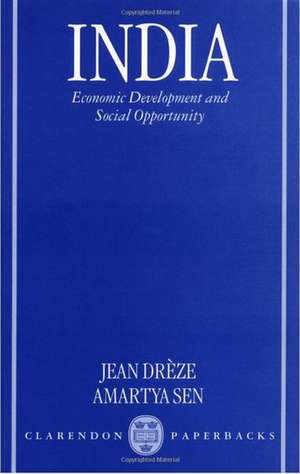
India: Economic Development and Social Opportunity
Autor Jean Drèze, Amartya Senen Limba Engleză Paperback – 28 ian 1999
Preț: 535.11 lei
Preț vechi: 667.29 lei
-20%
Puncte Express: 803
Carte tipărită la comandă
Livrare economică 03-09 decembrie
Livrare prin curier în România Termenul estimat este afișat lângă disponibilitate.
Transport gratuit pentru acest produs Plată online sau ramburs, în funcție de opțiunile comenzii.
Retur gratuit în 14 zile Comandă securizată și suport în română.
Specificații
ISBN-13: 9780198295280
ISBN-10: 0198295286
Pagini: 306
Ilustrații: 1 map
Dimensiuni: 138 x 217 x 18 mm
Greutate: 0.36 kg
Editura: Clarendon Press
Colecția Clarendon Press
Locul publicării:Oxford, United Kingdom
ISBN-10: 0198295286
Pagini: 306
Ilustrații: 1 map
Dimensiuni: 138 x 217 x 18 mm
Greutate: 0.36 kg
Editura: Clarendon Press
Colecția Clarendon Press
Locul publicării:Oxford, United Kingdom
V-ar putea interesa
-
 The Third PillarRaghuram RajanPreț: 108.24 lei
 -
 Left BehindPaul CollierPreț: 93.10 lei
 -
 An Uncertain GloryAmartya Sen-18%Preț: 78.08 lei94.73 lei
 -
 Economics: A Very Short IntroductionPartha Dasgupta-19%Preț: 57.73 lei71.46 lei
 -
 Development as FreedomAmartya Sen-19%Preț: 93.38 lei114.70 lei
 -
 -21%Preț: 168.24 lei211.99 lei
 -
 Indian Cities: Oxford India Short IntroductionsAnnapurna ShawPreț: 97.47 lei
 -
 -15%Preț: 81.90 lei96.61 lei
 -
 -23%Preț: 886.99 lei1151.94 lei
 -
 Development: A Very Short IntroductionIan Goldin-19%Preț: 57.65 lei71.42 lei
 -
 The Country of First Boys: And Other EssaysAmartya Sen-17%Preț: 91.00 lei109.83 lei
 -
 -14%Preț: 84.79 lei98.71 lei
 -
 Social Security in Developing CountriesEhtisham Ahmad-21%Preț: 259.19 lei327.42 lei
 -
 -18%Preț: 301.78 lei370.21 lei
 -
 State Without Honour: Women Workers in India's AnganwadisM.S. SreerekhaPreț: 309.25 lei
 -
 How Not to Die (Too Soon)Devi SridharPreț: 159.77 lei
 -
 Preț: 483.55 lei
 -
 Preț: 383.42 lei
 -
 Preț: 385.07 lei
 -
 Preț: 384.36 lei
Recenzii
As a compendium of data on India's education system and, to a lesser extent its record on eliminating basic health problems and gender inequality, the book is without recent peer.
As a compendium of data on India's education system ... the book is without recent peer.
The disappointing social statistics from India are today familiar matter, but nowhere will you find as intensive a collation of a number of them as in India: Economic Development and Social Opportunity, by Jean Dreze and Amartya Sen ... writtin throughout in a fine, journalistic style; and it will be a starting point of subsequent discussions on social life in India.
They offer a commentary on data at the level of Indian state governments.
important book
In a broad comparative analysis of India's economic development, Dreze and Sen have dealt with a wide range of issues in this book. ... A significant merit of this book lies in the link that the authors establish between economic development and social opportunity. ... A rich selection of statistical data prefaced with a succinct explanatory note, a copious selection of appropriate bibliographical references, and meticulously drawn up indexes (by name and by subject), together constitute material of inestimable value. The strength of this book lies in the facility with which the authors handle complex philosophical and economic issues in an interpenetrating manner. This makes the book a crucially important addition to the literature on India's experience of economic development which students of social science can ill afford to ignore.
As a compendium of data on India's education system ... the book is without recent peer.
The disappointing social statistics from India are today familiar matter, but nowhere will you find as intensive a collation of a number of them as in India: Economic Development and Social Opportunity, by Jean Dreze and Amartya Sen ... writtin throughout in a fine, journalistic style; and it will be a starting point of subsequent discussions on social life in India.
They offer a commentary on data at the level of Indian state governments.
important book
In a broad comparative analysis of India's economic development, Dreze and Sen have dealt with a wide range of issues in this book. ... A significant merit of this book lies in the link that the authors establish between economic development and social opportunity. ... A rich selection of statistical data prefaced with a succinct explanatory note, a copious selection of appropriate bibliographical references, and meticulously drawn up indexes (by name and by subject), together constitute material of inestimable value. The strength of this book lies in the facility with which the authors handle complex philosophical and economic issues in an interpenetrating manner. This makes the book a crucially important addition to the literature on India's experience of economic development which students of social science can ill afford to ignore.
Notă biografică
Jean Drèze is a Visiting Professor at the Delhi School of Economics and an international authority on development economics. His association with India goes back more than twenty years during which time he has studied the issues in India minutely and has authored many books, research papers, and newspaper articles on education, poverty, development, nuclear doctrine, freedom of information, and the Narmada Struggle.; Amartya Sen is the Master of Trinity College, Cambridge, and the winner of the 1998 Nobel Prize in Economic Science. He has been President of the Indian Economic Association, the American Economic Association, the International Economic Association, and the Econometric Society. He has taught at Calcutta, Delhi, Oxford, Cambridge, the London School of Economics, and Harvard.