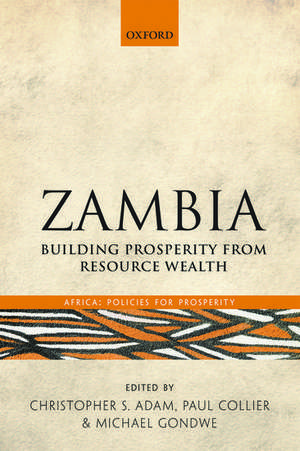
Zambia: Building Prosperity from Resource Wealth: Africa: Policies for Prosperity
Editat de Christopher Adam, Paul Collier, Michael Gondween Limba Engleză Hardback – 18 sep 2014

Preț: 937.21 lei
Preț vechi: 1358.40 lei
-31%
Puncte Express: 1406
Carte tipărită la comandă
Livrare economică 27 noiembrie-08 decembrie
Livrare prin curier în România Termenul estimat este afișat lângă disponibilitate.
Transport gratuit pentru acest produs Plată online sau ramburs, în funcție de opțiunile comenzii.
Retur gratuit în 14 zile Comandă securizată și suport în română.
Specificații
ISBN-13: 9780199660605
ISBN-10: 0199660603
Pagini: 480
Ilustrații: Figures and Tables
Dimensiuni: 168 x 240 x 33 mm
Greutate: 0.86 kg
Editura: OUP OXFORD
Colecția OUP Oxford
Seria Africa: Policies for Prosperity
Locul publicării:Oxford, United Kingdom
ISBN-10: 0199660603
Pagini: 480
Ilustrații: Figures and Tables
Dimensiuni: 168 x 240 x 33 mm
Greutate: 0.86 kg
Editura: OUP OXFORD
Colecția OUP Oxford
Seria Africa: Policies for Prosperity
Locul publicării:Oxford, United Kingdom
V-ar putea interesa
-
 The Looting MachineTom BurgisPreț: 79.75 lei
 -
 The Elements of PowerNicolas NiarchosPreț: 125.36 lei
 -
 False EconomyAlan Beattie-26%Preț: 63.24 lei84.96 lei
 -
 The Plundered PlanetPaul Collier-19%Preț: 62.93 lei77.79 lei
 -
 How The West Was LostDambisa Moyo-32%Preț: 63.15 lei92.44 lei
 -
 GrowthDaniel SusskindPreț: 93.52 lei
 -
 The Oxford Handbook of the Zambian EconomyHorman Chitonge-32%Preț: 1001.16 lei1470.05 lei
 -
 -32%Preț: 590.18 lei869.13 lei
 -
 The Oxford Handbook of the Malawi EconomyHopestone Chavula-32%Preț: 899.54 lei1328.73 lei
 -
 Born with a Copper Spoon: A Global History of Copper, 1830–1980Robrecht DeclercqPreț: 287.12 lei
 -
 Zambia Stole My HeartMerfyn Morley TemplePreț: 110.43 lei
 -
 -32%Preț: 551.25 lei816.36 lei
 -
 -26%Preț: 99.39 lei135.09 lei
 -
 Decolonizing EconomicsDevika DuttPreț: 142.79 lei
 -
 Rebooting a NationJoel BurkePreț: 219.41 lei
 -
 The Future of AgricultureSarah BearchellPreț: 70.02 lei
 -
 The Economic Impact of Christian Missionaries in ZambiaMichael Chanda ChiseniPreț: 280.95 lei
 -
 Economic Dependence of Mongolia on MineralsYoshitaka Hosoi-24%Preț: 1017.75 lei1339.15 lei
Recenzii
Christopher Adam, Paul Collier and their colleagues provide and expert guide for Zambia to follow if it is to make the best use of its 'second chance'.
Notă biografică
Christopher Adam is Professor of Development Economics at the University of Oxford. He studied economics at the University of St Andrews in Scotland and at Nuffield College, Oxford. His research is primarily on the macroeconomics of low-income economies, particularly those of Sub-Saharan Africa. He is a Research Associate at the Centre for the Study of African Economies, Fellow of the European Development Network, Visiting Professor at the University of Clemont-Ferrand, France and occasional Visiting Scholar at the IMF. He currently serves as Lead Academic for Tanzania for the International Growth Centre and is Vice Chair of the Board of the African Economic Research Consortium.Paul Collier, CBE, is a Professor of Economics and Director for the Centre for the Study of African Economies at the University of Oxford. From 1998 to 2003 he was the Director of the Development Research Group of the World Bank. He is the author of several books including 'The Bottom Billion: Why the Poorest Countries are Failing and What Can Be Done About It' which won the Lionel Gelber, the Arthur Ross and Corine prizes. His most recent book 'The Plundered Planet: Why We Must and How We Can Manage The World's Natural Resources to Ensure Global Prosperity' has recently been published. His research covers the causes and consequences of civil war; the effects of aid and the problems of democracy in low-income and natural-resources rich societies.Michael Gondwe, was appointed Governor of the Bank of Zambia on 12 December 2011. He had, prior to this appointment, served as the President and the Chief Executive Officer of the Eastern and Southern African Trade and Development Bank, commonly known as the PTA Bank. He assumed the position of President of the PTA Bank on 27 March 2001 and served in that position, following his re-appointment in 2006, until his appointment as Governor. Dr Gondwe served in senior positions in the PTA Bank for 15 years before his appointment as President. He worked for the Zambia Industrial and Mining Corporation (ZIMCO) and the Bank of Zambia before joining the PTA Bank. Dr Gondwe holds law degrees from the University of Zambia and the University of Virginia. He also holds an MBA from Moi University and a Diploma in Finance from the Kenya College of Accountancy. He is an alumnus of the Advanced Management Program of the University of Oxford.