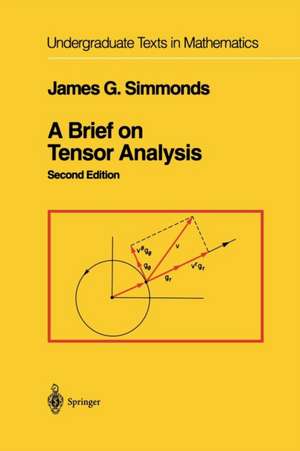
A Brief on Tensor Analysis
Autor James G. Simmondsen Limba Engleză Paperback – 17 oct 2012
Nivelul de studiu vizat de acest volum este cel de licență, fiind conceput special pentru studenții de la facultățile de inginerie și științe care întâlnesc pentru prima dată conceptul de tensor. A Brief on Tensor Analysis de James G. Simmonds reprezintă o introducere concisă, de doar 132 de pagini, care elimină barierele abstracte ale subiectului în favoarea unei clarități riguroase. Remarcăm faptul că această a doua ediție publicată de Springer aduce îmbunătățiri semnificative față de varianta originală, incluzând o secțiune nouă dedicată geometriei diferențiale — esențială pentru cei care studiază mecanica structurilor sau relativitatea generală.
Structura cursului urmărește o progresie logică: primul capitol reia fundamentele vectorilor în spațiul euclidian, definind produsele scalar și vectorial, pentru ca ulterior să introducă tensorii de ordinul doi. Al doilea capitol face tranziția către bazele generale și notația tensorială, explicând convenția de sumare și distincția dintre componentele covariante și contravariante. Subliniem că autorul a adăugat exerciții suplimentare, în special la finalul capitolului 4, pentru a consolida înțelegerea practică a materiei.
Cititorii familiarizați cu Tensor Analysis de Fridtjov Irgens vor aprecia abordarea lui Simmonds, care, deși pornește tot de la algebra vectorială elementară, se concentrează pe o prezentare mult mai compactă și aplicată. În timp ce volumul lui Irgens tinde spre un nivel avansat, A Brief on Tensor Analysis rămâne fidel scopului său de a fi un ghid de pornire rapid. De asemenea, spre deosebire de A Primer in Tensor Analysis and Relativity de Ilya L. Shapiro, care integrează extensiv fizica relativistă, lucrarea de față se concentrează pe aparatul matematic pur, oferind o bază solidă ce poate fi aplicată ulterior în diverse ramuri ale ingineriei.
Preț: 383.31 lei
Carte tipărită la comandă
Livrare economică 19 noiembrie-03 decembrie
Specificații
ISBN-10: 1461264243
Pagini: 132
Ilustrații: XIV, 114 p.
Dimensiuni: 155 x 235 x 8 mm
Greutate: 0.2 kg
Ediția:Second Edition 1994
Editura: Springer
Locul publicării:New York, NY, United States
V-ar putea interesa
-
 Introduction to Metric and Topological SpacesWilson A Sutherland-12%Preț: 365.72 lei415.14 lei
 -
 Limits, Limits Everywhere: The Tools of Mathematical AnalysisDavid Applebaum-14%Preț: 290.35 lei338.49 lei
 -
 An Introduction to Infinite-Dimensional Linear Systems TheoryRuth F. Curtain-15%Preț: 683.78 lei804.45 lei
 -
 An Introduction to Banach Space TheoryRobert E. Megginson-15%Preț: 635.93 lei748.15 lei
 -
 Lectures on the HyperrealsRobert Goldblatt-15%Preț: 661.87 lei778.67 lei
 -
 A First Course in Wavelets with Fourier AnalysisAlbert Boggess-27%Preț: 803.11 lei1100.15 lei
 -
 -8%Preț: 419.50 lei455.98 lei
 -
 DistributionsJ J Duistermaat-15%Preț: 578.42 lei680.50 lei
 -
 Foundations of Mathematical AnalysisSaminathan Ponnusamy-15%Preț: 608.28 lei715.62 lei
 -
 The Mathematica GuideBook for ProgrammingMichael TrottPreț: 555.02 lei
 -
 Vector CalculusPaul C. MatthewsPreț: 267.95 lei
 -
 Complex AnalysisEberhard Freitag-15%Preț: 486.93 lei572.86 lei
 -
 Real Analysis on IntervalsA. D. R. ChoudaryPreț: 412.98 lei
 -
 Wiener Chaos: Moments, Cumulants and DiagramsGiovanni PeccatiPreț: 390.72 lei
 -
 -15%Preț: 438.43 lei515.79 lei
Public țintă
Lower undergraduateDe ce să citești această carte
Recomandăm acest volum studenților la licență care au nevoie de o introducere rapidă și clară în calculul tensorial. Cartea transformă un subiect adesea intimidant într-un instrument de lucru accesibil, fiind ideală pentru pregătirea examenelor de mecanică teoretică sau fizică matematică. Cititorul câștigă o înțelegere precisă a notațiilor și transformărilor tensoriale, sprijinită de exerciții actualizate și corectate.