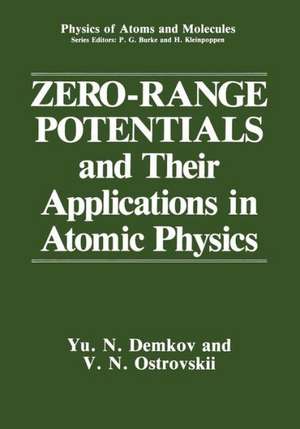
Zero-Range Potentials and Their Applications in Atomic Physics: Physics of Atoms and Molecules
Autor Yu. N. Demkov, V. N. Ostrovskiien Limba Engleză Paperback – 29 mar 2012
Din seria Physics of Atoms and Molecules
-
 Preț: 377.79 lei
 - 18%
 Preț: 911.34 lei
 - 18%
 Preț: 983.00 lei
 - 18%
 Preț: 1278.65 lei
 -
 Preț: 380.93 lei
 - 18%
 Preț: 980.74 lei
 - 18%
 Preț: 1265.00 lei
 - 18%
 Preț: 953.15 lei
 - 5%
 Preț: 351.12 lei
 - 18%
 Preț: 983.60 lei
 - 15%
 Preț: 652.21 lei
 - 15%
 Preț: 667.70 lei
 - 18%
 Preț: 1271.62 lei
 -
 Preț: 378.32 lei
 - 18%
 Preț: 1266.85 lei
 - 15%
 Preț: 632.00 lei
 - 18%
 Preț: 981.93 lei
 - 18%
 Preț: 989.61 lei
 - 15%
 Preț: 669.72 lei
 - 24%
 Preț: 1235.46 lei
 - 18%
 Preț: 981.83 lei
 -
 Preț: 375.08 lei
 - 15%
 Preț: 692.44 lei
 - 15%
 Preț: 666.13 lei
 -
 Preț: 403.65 lei
 - 15%
 Preț: 669.83 lei
 -
 Preț: 406.12 lei
 - 15%
 Preț: 655.26 lei
 - 15%
 Preț: 664.88 lei
 - 18%
 Preț: 984.91 lei
 - 15%
 Preț: 591.29 lei
 -
 Preț: 408.64 lei
 - 15%
 Preț: 629.98 lei
 - 18%
 Preț: 990.96 lei
 - 15%
 Preț: 662.17 lei
 - 20%
 Preț: 600.45 lei
 - 18%
 Preț: 1267.52 lei
Preț: 381.05 lei
Puncte Express: 572
Carte tipărită la comandă
Livrare economică 07-21 decembrie
Livrare prin curier în România Termenul estimat este afișat lângă disponibilitate.
Transport gratuit de la 400.00 lei Plată online sau ramburs, în funcție de opțiunile comenzii.
Retur gratuit în 14 zile Comandă securizată și suport în română.
Specificații
ISBN-13: 9781468454536
ISBN-10: 1468454536
Pagini: 300
Ilustrații: 296 p. 21 illus.
Dimensiuni: 178 x 254 x 17 mm
Greutate: 0.57 kg
Ediția:Softcover reprint of the original 1st ed. 1988
Editura: Springer
Colecția Physics of Atoms and Molecules
Seria Physics of Atoms and Molecules
Locul publicării:New York, NY, United States
ISBN-10: 1468454536
Pagini: 300
Ilustrații: 296 p. 21 illus.
Dimensiuni: 178 x 254 x 17 mm
Greutate: 0.57 kg
Ediția:Softcover reprint of the original 1st ed. 1988
Editura: Springer
Colecția Physics of Atoms and Molecules
Seria Physics of Atoms and Molecules
Locul publicării:New York, NY, United States
V-ar putea interesa
-
 Dreams Of A Final TheorySteven WeinbergPreț: 115.08 lei
 -
 Elementary Atomic StructureG. K. Woodgate-29%Preț: 410.61 lei574.51 lei
 -
 Molecular BeamsNorman Ramsey-31%Preț: 574.64 lei829.00 lei
 -
 -21%Preț: 364.97 lei461.42 lei
 -
 -22%Preț: 474.68 lei611.28 lei
 -
 -28%Preț: 516.21 lei717.85 lei
 -
 Nuclear Physics - Principles & ApplicationsJohn LilleyPreț: 400.16 lei
 -
 Atmospheric DynamicsMankin Mak-11%Preț: 609.02 lei684.29 lei
 -
 Introduction to High Energy PhysicsDonald H. Perkins-23%Preț: 739.48 lei960.36 lei
 -
 A Walk through the Southern SkyMilton HeifetzPreț: 286.48 lei
 -
 -15%Preț: 680.10 lei800.11 lei
 -
 Introducing Particle PhysicsTom WhyntiePreț: 63.96 lei
 -
 Quantum PhysicsAlistair I M RaePreț: 65.69 lei
 -
 INTR TO BLACK HOLES, INFORMATION & THE..Susskind LeonardPreț: 133.11 lei
Public țintă
ResearchCuprins
1 Basic Principles of the Zero-Range Potential Method.- 1.1 Introduction.- 1.2 Formulation of the Method.- 1.3 The One-Center Problem and Its Simple Applications.- 1.4 Separable Potentials and Scattering of Slow Electrons by Atoms.- 2 Trajectories of the Poles of the S-Matrix and Resonance Scattering.- 2.1 Preliminary Remarks.- 2.2 Trajectories of the Zeros of the Jost Function for ? = 0.- 2.3 The S-Matrix in a Two-Pole Approximation.- 2.4 The Case of ? ? 0 and Perturbation Theory for a Bound State Close to the Continuum.- 2.5 Trajectories of the Poles of the S-Matrix in the Case of ZRP and Separable Potentials.- 3 Zero-Range Potentials for Molecular Systems. Bound States.- 3.1 Many-Center Problems without External Fields.- 3.2 Potential Curves for a Two-Center System and Some Applications.- 3.3 Analytic Properties of the Potential Curves and Trajectories of the Poles of the S-Matrix.- 3.4 Perturbation Theory in the Presence of an External Electric Field.- 3.5 Perturbation Theory in the Presence of an External Magnetic Field.- 3.6 Solution of the Schrödinger Equation with the Help of ZRPs.- 4 Scattering by a System of Zero-Range Potentials and the Partial Wave Method for a Nonspherical Scatterer.- 4.1 The Partial Wave Method.- 4.2 Behavior of the Phases at Low Energy.- 4.3 The Variational Principle.- 4.4 Scattering by a System of ZRPs.- 4.5 ZRPs in the Theory of Multiple Scattering.- 5 Zero-Range Potentials in Multi-Channel Problems.- 5.1 Zero-Range Potentials for a Many-Component Wavefunction.- 5.2 Singlet-Triplet Splitting and Cross Sections for Elastic and Inelastic Scattering.- 5.3 Energy Terms of the e + H2 System and Trajectories of the Poles of the S-Matrix for a Two-Channel Problem.- 5.4 Electron Scattering by Molecules in the Separable PotentialApproximation.- 6 Motion of a Particle in a Periodic Field of Zero-Range Potentials.- 6.1 One-Dimensional Lattice in a Three-Dimensional Space. Bound States.- 6.2 Electron Scattering by Long Linear Molecules.- 6.3 Two-Dimensional Lattice in Three-Dimensional Space.- 6.4 Three-Dimensional Lattice and the Method of Ewald.- 7 Weakly Bound Systems in Electric and Magnetic Fields.- 7.1 Weakly Bound Systems in a Homogeneous Electric Field.- 7.2 Weakly Bound Systems in a Homogeneous Magnetic Field.- 7.3 Weakly Bound Systems in Crossed Electric and Magnetic Fields.- 7.4 A Combination of ZRPs and a Coulomb Field.- 8 Electron Detachment in Slow Collisions Between a Negative Ion and an Atom.- 8.1 ZRPs in Time-Dependent Quantum Mechanical Problems.- 8.2 Linear Approximation in Detachment Theory.- 8.3 Account of the Finite Size of the Colliding System.- 8.4 Production of Negative Ions in Three-Body Collisions.- 9 Time-Dependent Quantum Mechanical Problems Solvable by Contour Integration.- 9.1 General Time-Dependent Problems Solvable by Contour Integration.- 9.2 Adiabatic Approximation and Trajectories of the Poles of the S-Matrix.- 9.3 Ionization in Slow Atomic Collisions.- 10 Nonlinear Approximations in the Theory of Electron Detachment.- 10.1 Nonlinear Problems Solvable by Contour Integration. Sudden Approximation.- 10.2 Quadratic Approximation in the Theory of Electron Detachment.- 10.3 Quadratic Approximation (General Case).- 11 Time-Independent Quantum Mechanical Problems.- 11.1 Account of the Quantal Motion of the Nuclei in Detachment Theory.- 11.2 Time-Independent Quantum Mechanical Problems Solvable by Contour Integration.- References.