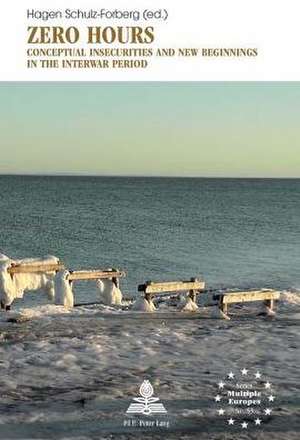
Zero Hours
Autor Hagen Schulz-Forbergfr Limba Franceză Paperback – 16 noi 2000
Preț: 327.66 lei
Preț vechi: 357.70 lei
-8%
Puncte Express: 491
Carte indisponibilă temporar
Livrare prin curier în România Termenul estimat este afișat lângă disponibilitate.
Transport gratuit de la 400.00 lei Plată online sau ramburs, în funcție de opțiunile comenzii.
Retur gratuit în 14 zile Comandă securizată și suport în română.
Specificații
ISBN-13: 9782875741035
ISBN-10: 2875741039
Pagini: 315
Ilustrații: ill. b/w
Dimensiuni: 174 x 241 x 21 mm
Greutate: 0.44 kg
Ediția:Nouă
Editura: Peter Lang Publishing
ISBN-10: 2875741039
Pagini: 315
Ilustrații: ill. b/w
Dimensiuni: 174 x 241 x 21 mm
Greutate: 0.44 kg
Ediția:Nouă
Editura: Peter Lang Publishing
V-ar putea interesa
-
 CongoDavid van ReybrouckPreț: 123.82 lei
-
 Operation MayhemSteve Heaney, MCPreț: 69.76 lei
-
 The Unknown TutankhamunMarianne Eaton-Krauss-16%Preț: 199.01 lei236.35 lei
-
 Nigeria: A New History of a Turbulent CenturyRichard Bourne-14%Preț: 150.55 lei174.27 lei
-
 The Woman Who Would be KingKara CooneyPreț: 94.05 lei
-
 South Sudan: The Untold Story from Independence to Civil WarHilde F. Johnson-38%Preț: 349.81 lei559.93 lei
-
 Lord Leverhulme's GhostsJules MarchalPreț: 119.88 lei
-
 Breaking SudanJok Madut JokPreț: 190.27 lei
-
 BurundiNigel Watt-16%Preț: 152.05 lei181.93 lei
-
 The Travels of Ibn BattutahTim Mackintosh-Smith-38%Preț: 53.77 lei86.52 lei
Notă biografică
Hagen Schulz-Forberg is Associate Professor of Global and European History at Aarhus University, where he co-ordinates the International Studies programme. His latest monograph, co-authored with Bo Stråth, The Political History of European Integration (2010, paperback 2012), was shortlisted for the European Book Prize 2011.
Cuprins
Contents: Hagen Schulz-Forberg: Introduction. Time and Again Toward the Future. Claims on Time as a New Approach for Global History - Andreas Steen: «The Power of Music»: Strengthening China in the 1920s - Maria Framke: Fascist Italy: Ideal Template for India's Economic Development? - Omar Guèye: Social Reforms in the Interwar period and the «Revolution» of the Popular Front in French Africa - Christoffer Kølvraa: Space and Spirit in the European Colonial Imagination after the First World War - Kenneth Weisbrode: Contours of the New Diplomacy - Volker Prott: War Aims, Wilsonian Ideas, and the 'New Diplomacy'. Reinventing the Franco-German Border of Alsace-Lorraine, 1914-1919 - Bertel Nygaard: French Revolution and Communist Future. Historical Time and Agency in European Labour Movements at the End of the First World War - James Kaye: To the Biennale, and the anti-Biennale. How the Lone Cleanser of the World Briefly Contributed to the Globalisation of Art Exhibition in Aestival Venice of 1920-22 - Niels Brimnes: 1918: International Health between Cordon Sanitaires and Rural Hygiene - Hagen Schulz-Forberg: Rejuvenating Liberalism: Economic Thought, Social Imagination, and the Invention of Neoliberalism in the 1930s.