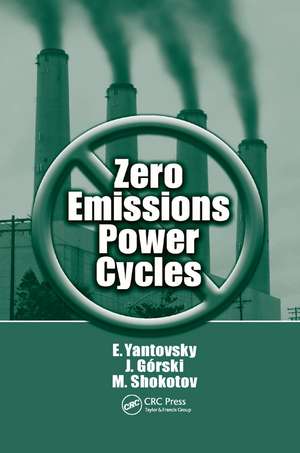
Zero Emissions Power Cycles
Autor Evgeny Yantovsky, J. Gorski, Mykola Shokotoven Limba Engleză Paperback – 19 sep 2019
The authors explore various aspects of zero emissions power plant (ZEPP) technology, including carbon dioxide sequestration, ion transport, and oxygen enrichment. They show that ZEPP technology can:
- Provide affordable, clean power to meet expanding energy demand
- Solve critical environmental problems, such as eliminating carbon dioxide and pollutant emissions
- Address energy security issues by supporting the use of diverse fossil fuels, including integrated coal gasification and pulverized coal combustion
- Ease the economic cost of sustainable energy supplies primarily through the use of cogenerated carbon dioxide for enhanced oil recovery
Addressing the significant human contribution to global warming, this book presents reasonable and effective approaches to minimize the harmful pollution that results from fossil fuel emissions. It shows how to create and operate ZEPPs, making our energy future clean, secure, and inexpensive.
Preț: 531.31 lei
Preț vechi: 625.07 lei
-15%
Puncte Express: 797
Carte tipărită la comandă
Livrare economică 23 noiembrie-07 decembrie
Livrare prin curier în România Termenul estimat este afișat lângă disponibilitate.
Transport gratuit pentru acest produs Plată online sau ramburs, în funcție de opțiunile comenzii.
Retur gratuit în 14 zile Comandă securizată și suport în română.
Specificații
ISBN-13: 9780367385705
ISBN-10: 0367385708
Pagini: 300
Dimensiuni: 156 x 234 x 15 mm
Greutate: 0.48 kg
Ediția:1
Editura: CRC Press
Colecția CRC Press
ISBN-10: 0367385708
Pagini: 300
Dimensiuni: 156 x 234 x 15 mm
Greutate: 0.48 kg
Ediția:1
Editura: CRC Press
Colecția CRC Press
V-ar putea interesa
-
 -18%Preț: 1488.00 lei1814.64 lei
 -
 Production Chemicals for the Oil and Gas IndustryMalcolm A. Kelland-18%Preț: 1484.61 lei1810.51 lei
 -
 -19%Preț: 537.92 lei664.09 lei
 -
 Modelling and Simulation of Power Electronic Converter Dominated Power Systems in PowerFactoryFrancisco M. Gonzalez-Longatt-15%Preț: 678.41 lei798.13 lei
 -
 -18%Preț: 735.11 lei896.47 lei
 -
 Virtual Inertia Synthesis and ControlThongchart Kerdphol-24%Preț: 747.68 lei983.79 lei
 -
 High Voltage Digital Power Line Carrier ChannelsAnton G. Merkulov-15%Preț: 561.58 lei660.68 lei
 -
 -15%Preț: 608.31 lei715.66 lei
 -
 Oil Mortality in Post-Fossil Fuel Era NigeriaAugustine Sadiq Okoh-24%Preț: 767.63 lei1010.04 lei
 -
 Thermosyphons and Heat Pipes: Theory and ApplicationsMarcia Barbosa Henriques Mantelli-18%Preț: 737.50 lei899.39 lei
 -
 Power System AnalysisMehdi Rahmani-AndebiliPreț: 439.87 lei
 -
 -15%Preț: 671.17 lei789.61 lei
 -
 Economics of Renewable EnergyYoram Krozer-18%Preț: 734.96 lei896.29 lei
 -
 Mitigating Climate ChangeDavid S. -K. Ting-18%Preț: 1073.10 lei1308.66 lei
 -
 Jevons' ParadoxesKent KlitgaardPreț: 381.27 lei
 -
 Smart Energy in the Smart CityRocco Papa-18%Preț: 733.00 lei893.91 lei
 -
 Advanced Decision Making for HVAC EngineersJavad Khazaii-15%Preț: 560.58 lei659.51 lei
 -
 Complex Systems and Social Practices in Energy TransitionsNicola Labanca-18%Preț: 1006.84 lei1227.85 lei
 -
 Sinusoidal Three-Phase Windings of Electric MachinesJonas Juozas BuksnaitisPreț: 363.41 lei
 -
 International Climate Negotiation FactorsWytze Van Der Gaast-15%Preț: 643.40 lei756.94 lei
 -
 Energy Return on InvestmentCharles A. S. Hall-15%Preț: 450.47 lei529.97 lei
 -
 Synchronized Phasor Measurements and Their ApplicationsArun G. Phadke-18%Preț: 702.65 lei856.89 lei
 -
 HochspannungsmesstechnikKlaus Schon-11%Preț: 559.42 lei628.56 lei
 -
 System Efficiency by Renewable ElectricityGünther Brauner-15%Preț: 584.29 lei687.40 lei
 -
 Nuclear Waste ManagementMan-Sung Yim-23%Preț: 888.23 lei1153.56 lei
 -
 -18%Preț: 1614.86 lei1969.34 lei
 -
 Photoelectrochemical Hydrogen GenerationPraveen Kumar-18%Preț: 708.38 lei863.88 lei
 -
 Infrastructure Planning and Management in IndiaPravin Jadhav-18%Preț: 977.32 lei1191.85 lei
Public țintă
Academic and Professional Practice & DevelopmentCuprins
Controversial Future. Cycles Review. Zero Emission Quasicombined Cycle with External Oxygen Supply. Oxygen Ion Transport Membranes. The ZEITMOP Cycle and Its Variants. Detailed Simulation of the ZEITMOP Cycle. Zero Emissions Piston Engines with Oxygen Enrichment. Solar Energy Conversion through Photosynthesis and Zero Emission Oxy-Fuel Combustion. Associated Tool for Calculations.
Descriere
Focusing on fossil-fueled, nonpolluting power generation systems, this timely volume presents alternative solutions to the severe emissions issues of power plants. Along with a description of new thermodynamic cycles and the results of computational analyses, it provides modern analytical tools and equations to evaluate exergy and introduce currentology. The authors explore various aspects of zero emissions power plant technology, including carbon dioxide sequestration, ion transport, and oxygen enrichment. They also explain the Pareto optimization of power cycles as well as solar energy conversion, such as seaweed photosynthesis with zero emissions power generation.