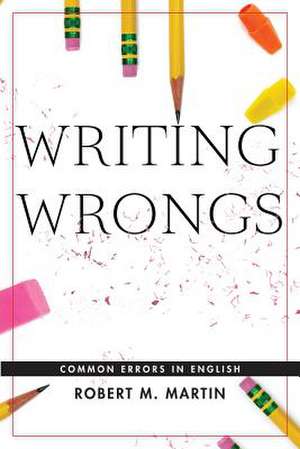
Writing Wrongs: Common Errors in English
Autor Robert M. Martinen Limba Engleză Paperback – 18 dec 2017
Preț: 174.71 lei
Preț vechi: 211.95 lei
-18%
Puncte Express: 262
Preț estimativ în valută:
30.89€ • 36.16$ • 26.97£
30.89€ • 36.16$ • 26.97£
Carte disponibilă
Livrare economică 13-27 februarie
Livrare express 30 ianuarie-05 februarie pentru 69.09 lei
Specificații
ISBN-13: 9781554813919
ISBN-10: 1554813913
Pagini: 352
Dimensiuni: 152 x 229 x 17 mm
Greutate: 0.46 kg
Editura: BROADVIEW PR
Colecția Broadview Press
Locul publicării:Peterborough, Canada
ISBN-10: 1554813913
Pagini: 352
Dimensiuni: 152 x 229 x 17 mm
Greutate: 0.46 kg
Editura: BROADVIEW PR
Colecția Broadview Press
Locul publicării:Peterborough, Canada
V-ar putea interesa
-
 The Meaning Of LanguageHeidi SavagePreț: 315.00 lei
 -
 How To Write A Better Thesis (3rd Edition)David EvansPreț: 159.91 lei
 -
 The Write State of MindEmily GoworPreț: 152.18 lei
 -
 Manual y Taller de Puntuacion y EscrituraRivano Fischer, EmilioPreț: 50.68 lei
 -
 Cursive Handwriting Workbook for GirlsJulie HarperPreț: 70.97 lei
 -
 Hablar Bien No Cuesta NADA y Escribir TampocoLeonor TejadaPreț: 81.86 lei
 -
 The Word-Loss DietRayne HallPreț: 45.17 lei
 -
 Arabic Handwriting for BeginnersSelim HakimPreț: 71.12 lei
 -
 Scientific ThinkingRobert M. Martin-6%Preț: 339.58 lei362.76 lei
 -
 The Philosopher's Dictionary - Third EditionRobert M. Martin-12%Preț: 146.61 lei166.00 lei
 -
 Introducing Symbolic LogicRobert M. Martin-23%Preț: 345.72 lei446.41 lei
 -
 Philosophical ConversationsRobert M. Martin-13%Preț: 338.15 lei387.33 lei
 -
 Writing Science in the Twenty-First CenturyChristopher Thaiss-13%Preț: 360.58 lei412.70 lei
 -
 For the Sake of Argument: How to Do PhilosophyRobert M. Martin-13%Preț: 134.39 lei154.08 lei
 -
 Art for ReversalsBridgette SharpPreț: 62.56 lei
Recenzii
Writing Wrongs is a concise and thoughtful guide to common errors in English. It covers frequently confused and misused words along with problems of grammar, punctuation, and style, and offers a brief and up-to-date guide to major citation styles. Though it provides guidelines and recommendations for usage, Writing Wrongs acknowledges the evolution of language over time and the fact that different contexts have different rules—it is not narrowly prescriptive. A friendly, flexible, and easy-to-read reference, Writing Wrongs will be useful to students and general readers alike.
“Finally, a book designed the way I teach. It doesn’t need to be taught page by page or chapter by chapter. You use what you need when you need it. Robert M. Martin uses clear examples to make points with a light conversational style and, at times, a hint of satire. Readers are not just given rules; they are given full explanations about how those rules have changed and are changing. That level of detail is unique. After all, sometimes you just need to know the rule; but sometimes you also need to know why.” — Kirk Layton, Mount Royal University
“Informative, refreshingly honest, and often genuinely humorous, Martin’s Writing Wrongs is a comprehensive guide to writing that will serve teachers and students of composition well. While Martin’s book covers many standard topics featured in most textbooks on this subject (grammar, the writing process, documentation), its strength derives from its focus on the less-discussed and trickier issue of the style of good prose, and from its open acknowledgement that ‘the rules’ of good writing are contingent on context and the subject of constant, ongoing negotiation. Eschewing dogma and embracing a conversational tone, Writing Wrongs manages to entertain while teaching its readers the ins and outs of a skill set with which many students—especially early-career undergraduates—routinely struggle.” — Morgan Rooney, Carleton University
“Finally, a book designed the way I teach. It doesn’t need to be taught page by page or chapter by chapter. You use what you need when you need it. Robert M. Martin uses clear examples to make points with a light conversational style and, at times, a hint of satire. Readers are not just given rules; they are given full explanations about how those rules have changed and are changing. That level of detail is unique. After all, sometimes you just need to know the rule; but sometimes you also need to know why.” — Kirk Layton, Mount Royal University
“Informative, refreshingly honest, and often genuinely humorous, Martin’s Writing Wrongs is a comprehensive guide to writing that will serve teachers and students of composition well. While Martin’s book covers many standard topics featured in most textbooks on this subject (grammar, the writing process, documentation), its strength derives from its focus on the less-discussed and trickier issue of the style of good prose, and from its open acknowledgement that ‘the rules’ of good writing are contingent on context and the subject of constant, ongoing negotiation. Eschewing dogma and embracing a conversational tone, Writing Wrongs manages to entertain while teaching its readers the ins and outs of a skill set with which many students—especially early-career undergraduates—routinely struggle.” — Morgan Rooney, Carleton University
Cuprins
FOREWORD
PART I: WAIT! STOP! MAKE SURE YOU READ THIS!
PART I: WAIT! STOP! MAKE SURE YOU READ THIS!
- How to Use This Book
- What’s Going On?
Why?
What Makes for Acceptability?
Sticklers
A Surprising Note on Rules
One Last Word
- Meanings, Uses, and Idioms: A Dictionary
Singular and Plural
- Plurals not Made with -S
Singular or Plural?
Words Borrowed from Other Languages
Compound Words
Abbreviations and Acronyms
Mass Nouns and Count Nouns
Homophones or Nearly
Mondegreens and Eggcorns
- Verb Forms
- The Continuous Tenses
The Perfect Tenses
The Subjunctive
Sequence of Tenses in Indirect Speech
Active and Passive Voice
- Collective Nouns 168
Other Agreement Problems
Split Infinitives
Like vs. As
The Order of Adjectives
Danglers and Misplacements
- The Supposedly Dangling Infinitive
Ending Sentences with Prepositions
The Cases of Pronouns
Sentences and Fragments
- Beginning Sentences with Conjunctions
Run-on Sentences
- The Comma ,
The Question Mark ?
The Exclamation Mark !
The Semicolon ;
The Colon :
The Hyphen -
The Dashes – —
Parentheses ( )
Square Brackets [ ]
The Apostrophe ’
Quotation Marks “
The Ellipsis …
- Publications
Non-English Words
Emphasis
Numerals
- Redundancy
Filler
Overblown Language
- The Thesaurus
- Worries and Motives
Replacement
Other Problems
The Workaround
Jargon, Good and Evil
- Good Jargon
Evil Jargon
Metaphors and Similes
- Mixed Metaphors
Translation
- Short and Long Sentences
Greening
Planning Overall Structure
Signposting
Paragraphing
Citing Sources
- Citing and Quoting Authorities
When to Cite Sources
Plagiarism
- How to Insert Source Material
- Summarizing and Paraphrasing
Quoting Directly
Formatting Quotations
Signal Phrases
- About In-Text Citations
About Works Cited
- About Chicago Style
- About In-Text Citations
About References