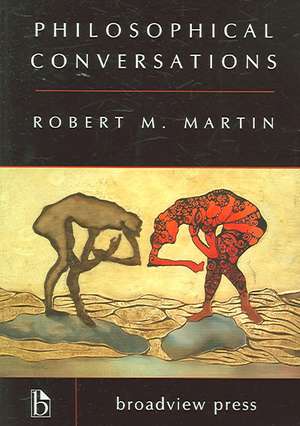
Philosophical Conversations
Autor Robert M. Martinen Limba Engleză Paperback – 8 noi 2005
These substantive yet entertaining conversations emphasize that philosophical questions are contested and open-ended. The characters in each dialogue advocate different answers to questions on religion, ethics, personal identity, and other topics equitably and without naming any clear winners. Philosophic positions are presented with maximum clarity and persuasiveness, so that readers can appreciate all sides of an issue and make their own choices. An excellent tool for newcomers to philosophy, Philosophical Conversations provides the necessary background for further study while vividly portraying the back-and-forth argument that is essential to the philosophical method.
Preț: 337.85 lei
Preț vechi: 411.98 lei
-18%
Puncte Express: 507
Carte disponibilă
Livrare economică 17 noiembrie-01 decembrie
Livrare prin curier în România Termenul estimat este afișat lângă disponibilitate.
Transport gratuit de la 400.00 lei Plată online sau ramburs, în funcție de opțiunile comenzii.
Retur gratuit în 14 zile Comandă securizată și suport în română.
Specificații
ISBN-13: 9781551116495
ISBN-10: 1551116499
Pagini: 351
Dimensiuni: 152 x 229 x 19 mm
Greutate: 0.53 kg
Editura: BROADVIEW PR
Colecția Broadview Press
Locul publicării:Peterborough, Canada
ISBN-10: 1551116499
Pagini: 351
Dimensiuni: 152 x 229 x 19 mm
Greutate: 0.53 kg
Editura: BROADVIEW PR
Colecția Broadview Press
Locul publicării:Peterborough, Canada
V-ar putea interesa
-
 Embodied Minds in ActionRobert Hanna-30%Preț: 885.75 lei1263.78 lei
 -
 An Essay concerning Human UnderstandingJohn Locke-16%Preț: 91.59 lei109.62 lei
 -
 -18%Preț: 130.89 lei159.83 lei
 -
 -20%Preț: 392.21 lei490.46 lei
 -
 Knowing Without ThinkingZ. RadmanPreț: 407.07 lei
 -
 Metaphysics: Contemporary Readings: 2nd EditionMichael Loux-8%Preț: 448.83 lei487.86 lei
 -
 Batman and Philosophy - The Dark Knight of the SoulMark D. WhitePreț: 151.17 lei
 -
 Preț: 219.98 lei
 -
 Letter to DAndré GorzPreț: 381.30 lei
 -
 The Age of Reason - Thomas PaineThomas PainePreț: 130.05 lei
 -
 The Essential Philosophical WorksDavid HumePreț: 48.77 lei
 -
 EpistemologyRobert M. MartinPreț: 65.79 lei
 -
 Preț: 154.56 lei
 -
 Fuller, R: EducationR. Buckminster FullerPreț: 180.71 lei
Recenzii
Philosophical Conversations is a light, informal, and contemporary introduction to the study of philosophy. Using a dialogue format, Robert M. Martin delves into the traditional questions of philosophy in a manner that readers will find engaging.
These substantive yet entertaining conversations emphasize that philosophical questions are contested and open-ended. The characters in each dialogue advocate different answers to questions on religion, ethics, personal identity, and other topics equitably and without naming any clear winners. Philosophic positions are presented with maximum clarity and persuasiveness, so that readers can appreciate all sides of an issue and make their own choices. An excellent tool for newcomers to philosophy, Philosophical Conversations provides the necessary background for further study while vividly portraying the back-and-forth argument that is essential to the philosophical method.
“Robert M. Martin’s book will be invaluable for undergraduate teaching. The dialogues present a wide range of philosophical debates clearly and interestingly, quickly clearing up common but uninteresting mistakes, while exploring the issues and leaving them open for further discussion.” — Peter J. King, Pembroke College, Oxford University
“An excellent introduction to philosophy. Packed with key ideas and theories; clear and engaging; well-organised. Its conversations succeed as conceptual interplay, showing how philosophical debates arise and develop.” — Stephen Hetherington, University of New South Wales
“The best new introductory philosophy text in decades! It covers the central issues in both analytic and continental philosophy, presenting arguments and counter-arguments so that readers can see why philosophic debate can be so thrilling.” — Sheldon Wein, St. Mary’s University
“Martin skillfully employs the dialogue format to produce an engaging and accessible—but rigorous—introductory text.” — Jeff Lawrence, North Island College, in Philosophy in Review
These substantive yet entertaining conversations emphasize that philosophical questions are contested and open-ended. The characters in each dialogue advocate different answers to questions on religion, ethics, personal identity, and other topics equitably and without naming any clear winners. Philosophic positions are presented with maximum clarity and persuasiveness, so that readers can appreciate all sides of an issue and make their own choices. An excellent tool for newcomers to philosophy, Philosophical Conversations provides the necessary background for further study while vividly portraying the back-and-forth argument that is essential to the philosophical method.
“Robert M. Martin’s book will be invaluable for undergraduate teaching. The dialogues present a wide range of philosophical debates clearly and interestingly, quickly clearing up common but uninteresting mistakes, while exploring the issues and leaving them open for further discussion.” — Peter J. King, Pembroke College, Oxford University
“An excellent introduction to philosophy. Packed with key ideas and theories; clear and engaging; well-organised. Its conversations succeed as conceptual interplay, showing how philosophical debates arise and develop.” — Stephen Hetherington, University of New South Wales
“The best new introductory philosophy text in decades! It covers the central issues in both analytic and continental philosophy, presenting arguments and counter-arguments so that readers can see why philosophic debate can be so thrilling.” — Sheldon Wein, St. Mary’s University
“Martin skillfully employs the dialogue format to produce an engaging and accessible—but rigorous—introductory text.” — Jeff Lawrence, North Island College, in Philosophy in Review
Cuprins
Acknowledgements
Introduction
Participants: RATIONALIST · ATHEIST · COSMOLOGIST · BIOLOGIST · PRAGMATIST · PSYCHOLOGIST · FIDEIST · SYMBOLIST · MYSTIC
Participants: SCEPTIC · LEGALIST · CONTRACTARIAN · MORALIST · BIOLOGIST · COMMUNITARIAN · INDIVIDUALIST · COMMUNIST · LIBERTARIAN · INTERVENTIONIST · FEMINIST · EGALITARIAN
Participants: SCEPTIC · UTILITARIAN · DEONTOLOGIST · RIGHTS-THEORIST · KANTIAN · SUBJECTIVIST · RELATIVIST
Participants: SCEPTIC · DUALIST · IDENTITY THEORIST · ELIMINATIVIST · BEHAVIOURIST
Participants: IDENTITY THEORIST · SCEPTIC · DETERMINIST · FATALIST · MATHEMATICIAN · PHYSICIST · INDETERMINIST · HARD DETERMINIST · SOFT DETERMINIST · UTILITARIAN · RETRIBUTIVIST · PSYCHOLOGIST
Participants: SCEPTIC · DEFINER · CARTESIAN · FALLIBILIST · EMPIRICIST · RATIONALIST
Participants: SCEPTIC · CARTESIAN · EMPIRICIST · RATIONALIST · ANTIREALIST · INTERNALIST · REFERENTIALIST · SPEECH-ACT THEORIST
Glossary Workbook
Introduction
- Philosophy
- How to Study Philosophy
- Arguments
- Notes on “Suggested Readings” Sections
Participants: RATIONALIST · ATHEIST · COSMOLOGIST · BIOLOGIST · PRAGMATIST · PSYCHOLOGIST · FIDEIST · SYMBOLIST · MYSTIC
- The First-Cause Argument
- The Argument from Design
- The Ontological Argument
- The Argument from Morality
- The Pragmatic Argument
- Pascal’s Wager
- The Burden of Proof
- The Argument from History
- The Argument from Psychology
- The Argument from the Existence of Evil
- Life After Death
- Fideism
- Symbolism
- Mysticism
Suggested Readings
Participants: SCEPTIC · LEGALIST · CONTRACTARIAN · MORALIST · BIOLOGIST · COMMUNITARIAN · INDIVIDUALIST · COMMUNIST · LIBERTARIAN · INTERVENTIONIST · FEMINIST · EGALITARIAN
- The Question
- The Tragedy of the Commons and the Prisoner’s Dilemma
- The Social Contract
- Enforcement of the Contract
- A Moral Answer
- A Biological Answer
- Communitarianism
- Communism
- Socialism, Fascism, Nazism
- Libertarianism
- Interventionism
- Equality
- Justice
Suggested Readings
Participants: SCEPTIC · UTILITARIAN · DEONTOLOGIST · RIGHTS-THEORIST · KANTIAN · SUBJECTIVIST · RELATIVIST
- A Question
- Hedonism
- Utilitarianism
- Objections to Utilitarianism
- Doing and Not Doing
- Admiral Byng
- Rights
- Using People
- The Categorical Imperative
- The Motivation Question
- Ethical Knowledge
- Ethical Subjectivism
- The Weirdness of Ethical Characteristics
- Relativism
Suggested Readings
Participants: SCEPTIC · DUALIST · IDENTITY THEORIST · ELIMINATIVIST · BEHAVIOURIST
- Materialism
- The Science Argument
- Is Dualism Obvious?
- The Differences Between the Mental and the Physical
- Introspection and Infallibility
- Recognizing the Mental vs. Recognizing the Physical
- Interaction
- Eliminative Materialism
- The Problem of Other Minds
- Behaviourism
- Could a Machine Think?
- Instinct and Learning; Unpredictability
- Creativity
- The Turing Test
- Deep Blue and the Sphex Wasp
- The Chinese Room
Suggested Readings
Participants: IDENTITY THEORIST · SCEPTIC · DETERMINIST · FATALIST · MATHEMATICIAN · PHYSICIST · INDETERMINIST · HARD DETERMINIST · SOFT DETERMINIST · UTILITARIAN · RETRIBUTIVIST · PSYCHOLOGIST
- Determinism
- Cause
- Fatalism
- Predictability
- Is there Evidence for Determinism?
- Quantum Indeterminacy
- Free Will
- The Incompatibility of Responsibility and Determinism
- Soft Determinism
- The Function of Praise and Blame
- Randomness and Freedom
- Utilitarian Justifications of Punishment
- Retributivism
Suggested Readings
Participants: SCEPTIC · DEFINER · CARTESIAN · FALLIBILIST · EMPIRICIST · RATIONALIST
- The Definition of ‘Knowledge’
- Certainty and Fallibility
- Certainty and Probability
- Probable Beliefs and the Lottery Paradox
- Gettier Problems
- Empiricism and Rationalism: Concepts
- Innateness and Language
- Empiricism and Rationalism: Judgements
- Analytic and Synthetic Judgements
- Synthetic A Priori Judgements
- Scepticism: Perception
- The Brain in the Vat
- Scepticism: The Five-Minute Hypothesis
- Scepticism: The Problem of Induction
Suggested Readings
Participants: SCEPTIC · CARTESIAN · EMPIRICIST · RATIONALIST · ANTIREALIST · INTERNALIST · REFERENTIALIST · SPEECH-ACT THEORIST
- Life After Death Again
- Continuing Mental Substance
- Criticisms of the Substance Theories
- The Mysterious Boat
- Relationism
- Some Strange Cases
- The Real Route 22
- Meaning Empiricism
- Meaning Internalism
- Meaning as Reference
- Meaning as Use
- Meanings and Intentions
- Meanings and Conventions
Suggested Readings
Glossary Workbook