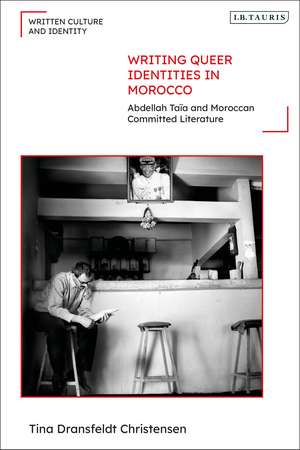
Writing Queer Identities in Morocco: Abdellah Taïa and Moroccan Committed Literature: Written Culture and Identity
Autor Tina Dransfeldt Christensenen Limba Engleză Paperback – 28 iul 2022
Placing key novels such as Salvation Army and Infidels in dialogue with Moroccan writers including Driss Chraïbi and Abdelkebir Khatibi, she shows how Taïa draws upon a long tradition of politically committed art in Morocco to subvert traditional notions of heteronormativity. By giving space to silenced or otherwise marginalised voices, she shows how his writings offer a powerful critique of discourses of class, authenticity, culture and nationality in Morocco and North Africa.
Preț: 217.15 lei
Preț vechi: 311.98 lei
-30%
Puncte Express: 326
Carte tipărită la comandă
Livrare economică 23 noiembrie-07 decembrie
Livrare prin curier în România Termenul estimat este afișat lângă disponibilitate.
Transport gratuit de la 400.00 lei Plată online sau ramburs, în funcție de opțiunile comenzii.
Retur gratuit în 14 zile Comandă securizată și suport în română.
Specificații
ISBN-13: 9780755637706
ISBN-10: 0755637704
Pagini: 216
Dimensiuni: 152 x 232 x 14 mm
Greutate: 0.34 kg
Editura: Bloomsbury Publishing
Colecția I.B.Tauris
Seria Written Culture and Identity
Locul publicării:London, United Kingdom
ISBN-10: 0755637704
Pagini: 216
Dimensiuni: 152 x 232 x 14 mm
Greutate: 0.34 kg
Editura: Bloomsbury Publishing
Colecția I.B.Tauris
Seria Written Culture and Identity
Locul publicării:London, United Kingdom
Cuprins
Acknowledgements
Notes on Transcriptions and Translations
Introduction
1. Writing the self as a site of (queer) commitment
From "national allegory" to multidirectionality as a strategy of subversion
The dual function of self-narration
Queering the nation
2. Abdellah Taïa as author and activist
Breaking the silence
La génération du "je"
Homosexuality "à la marocaine"
3. Subverting "ethnographic" reading strategies
"Generation 54": Beyond ethnography and acculturation
Nobody sees anybody: Driss Chraïbi's Le Passé simple
Simply living a life of "deviance": Abdellah Taïa's L'Armée du salut
4. Writing transidentity in the language of the "other"
"Third Worldism" and French as language of resistance: The Souffles-Anfa¯s movement
Toward an ethics of bilingualism: Abdelkébir Khatibi's Amour bilingue
"Poor" French as a strategy of resistance: Abdellah Taïa's Un Pays pour mourir
5. Shame, silence and nation building
Gendered memories of political violence during the Years of Lead
Dialogue of suffering: Fatna El Bouih's ?adith al-'atmah
Taking revenge through love: Abdellah Taïa's Infidèles
Conclusion
Notes
Bibliography
Notes on Transcriptions and Translations
Introduction
1. Writing the self as a site of (queer) commitment
From "national allegory" to multidirectionality as a strategy of subversion
The dual function of self-narration
Queering the nation
2. Abdellah Taïa as author and activist
Breaking the silence
La génération du "je"
Homosexuality "à la marocaine"
3. Subverting "ethnographic" reading strategies
"Generation 54": Beyond ethnography and acculturation
Nobody sees anybody: Driss Chraïbi's Le Passé simple
Simply living a life of "deviance": Abdellah Taïa's L'Armée du salut
4. Writing transidentity in the language of the "other"
"Third Worldism" and French as language of resistance: The Souffles-Anfa¯s movement
Toward an ethics of bilingualism: Abdelkébir Khatibi's Amour bilingue
"Poor" French as a strategy of resistance: Abdellah Taïa's Un Pays pour mourir
5. Shame, silence and nation building
Gendered memories of political violence during the Years of Lead
Dialogue of suffering: Fatna El Bouih's ?adith al-'atmah
Taking revenge through love: Abdellah Taïa's Infidèles
Conclusion
Notes
Bibliography
Recenzii
Writing Queer Identities in Morocco tackles very significant aspects of Moroccan literature and society. Taïa's writing is suggestively related to crucial moments and authors since colonial times, such as Chraïbi and Khatibi, or to prison testimonies of the Years of Lead. In writing the self as an act of (queer) commitment and questioning any readily established identity categories, Taïa becomes one of the key voices, literally and politically, of the future of Morocco, that necessarily has to be queer.
"Writing Queer Identities in Morocco makes a very timely and important contribution to the field of queer Maghribi studies and North African studies more generally. Whereas Abdellah Taïa is often presented as an exceptionally "out" and "self-absorbed" Moroccan writer, the strength of Tina Dransfeldt Christensen's approach consists in situating his treatment of sexuality in relation to other Morocco writers and LGBTQ organising in Morocco. By recontextualising his individual story within the collective as a key site for the writing of queer identity, this book's rich, informative chapters invite us to consider committed literature and autobiographical writing in innovative ways."
"Writing Queer Identities in Morocco makes a very timely and important contribution to the field of queer Maghribi studies and North African studies more generally. Whereas Abdellah Taïa is often presented as an exceptionally "out" and "self-absorbed" Moroccan writer, the strength of Tina Dransfeldt Christensen's approach consists in situating his treatment of sexuality in relation to other Morocco writers and LGBTQ organising in Morocco. By recontextualising his individual story within the collective as a key site for the writing of queer identity, this book's rich, informative chapters invite us to consider committed literature and autobiographical writing in innovative ways."