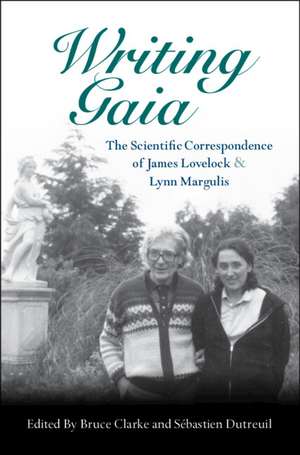
Writing Gaia
Editat de Bruce Clarke, Sébastien Dutreuilen Limba Engleză Hardback – 18 aug 2022
Subliniem natura profund interdisciplinară a volumului Writing Gaia: The Scientific Correspondence of James Lovelock and Lynn Margulis, o lucrare ce transcende granițele dintre microbiologie, chimie atmosferică și istoria ideilor. Această ediție publicată de Cambridge University Press oferă o perspectivă rară, „din interior”, asupra modului în care s-a cristalizat ipoteza Gaia — ideea că viața de pe Pământ joacă un rol activ în producerea și reglarea propriului mediu. Notăm cu interes cum cele aproape 300 de scrisori schimbate între James Lovelock și Lynn Margulis, pe parcursul a aproape patru decenii, dezvăluie nu doar rigoarea științifică, ci și procesul creativ și adesea controversat al unei colaborări ce a transformat concepțiile contemporane despre natură. Comparabil cu Gaian Systems în rigoarea analizei sistemice, acest volum se distinge prin faptul că este actualizat cu surse primare inedite, oferind cititorului acces direct la dialogul intelectual brut, nefiltrat de interpretări ulterioare. Apreciem efortul editorilor Bruce Clarke și Sébastien Dutreuil de a adnota acest corpus masiv, facilitând înțelegerea unor concepte complexe pentru publicul academic. În contextul operei lui Bruce Clarke, lucrarea continuă explorarea intersecțiilor dintre literatură și știință, temă centrală și în The Routledge Companion to Literature and Science, dar se ancorează mult mai ferm în datele istorice ale cercetării de mediu. Tonul corespondenței variază de la speculație teoretică la detalii tehnice despre evoluția microbiană și compoziția gazelor, oferind o structură narativă organică a unei revoluții științifice în curs de desfășurare.
Preț: 368.94 lei
Carte tipărită la comandă
Livrare economică 18 noiembrie-02 decembrie
Specificații
ISBN-10: 1108833098
Pagini: 512
Dimensiuni: 157 x 235 x 32 mm
Greutate: 0.89 kg
Editura: Cambridge University Press
Locul publicării:Cambridge, United Kingdom
V-ar putea interesa

De ce să citești această carte
Recomandăm această carte cercetătorilor și studenților interesați de istoria științei și ecologie. Este o resursă fundamentală pentru a înțelege cum o ipoteză marginală a devenit un pilon al dezbaterilor climatice actuale. Cititorul câștigă o înțelegere profundă a procesului de colaborare științifică, dincolo de articolele publicate, descoperind mecanismele intelectuale care au unit biologia cu geologia.
Despre autor
Bruce Clarke este profesor de engleză și director al Centrului pentru Interacțiunea dintre Arte și Științe la Texas Tech University. Expertiza sa vastă în teoria sistemelor și postumanism este reflectată în lucrări precum The Cambridge Companion to Literature and Science. În acest volum, Clarke colaborează cu Sébastien Dutreuil pentru a contextualiza corespondența dintre Lovelock și Margulis, folosindu-și experiența în analiza metaforelor științifice și a evoluției ideilor despre biosferă pentru a oferi o structură coerentă dialogului lor epistolar.
Descriere scurtă
Cuprins
Recenzii
'Indeed, Lovelock and Margulis found that they 'had something to say' together, a question they ask in 1971 in a letter! What they had to say changed my life and the lives of many people. Gaia is a polymorphous concept, hypothesis, planet, boundary object in conflict, and collaboration among scientists of different disciplines and persuasions, Earth systems' conceptual foundation, popular passion, and much more. Gaia matters, and Lovelock and Margulis gave us this generative formulation of the living Earth as a complex dynamic, self-organizing system. This collection – with its sober, extensive, enticing scholarly apparatus – makes the hairs of my arms stand up with pleasure and excitement. Here the reader will find unadorned letters between two very different kinds of professional scientist over many years of a complex personal and intellectual relationship. I am deeply grateful to the scholarship and passion of Bruce Clarke and Sébastien Dutreuil for this book.' Donna Haraway, University of California at Santa Cruz, author of Staying with the Trouble: Making Kin in the Chthulucene
'Writing Gaia offers a fascinating window on the meeting of two great minds. This insightful set of correspondence and commentaries provides an unprecedented resource on the history of the Gaia concept.' Michael R. Dietrich, University of Pittsburgh, USA
'Writing Gaia is a revealing and surprisingly entertaining record of the long intellectual and personal relationship between two idiosyncratic scientific geniuses and rebels from whose cerebral symbiosis and complex friendship was born the Gaia hypothesis, which profoundly changed how we think about Earth and life. The collected letters of Lovelock and Margulis, along with accompanying essays by some of their key collaborators, have been skillfully assembled with insightful commentary by Clarke and Dutreuil. The result is a riveting intellectual journey, spiced with gossip, intellectual feuds, and occasional moments of touching intimacy. This book will be required reading for students of Earth's biosphere and of modern history of science.' David Grinspoon, Astrobiologist and author of Earth in Human Hands
'It is not hyperbole to say that microbiologist and cell biologist Lynn Margulis and atmospheric chemist James Lovelock were two giants of twentieth-century science. Margulis's serial endosymbiosis theory resolved the riddle of the origin of the eukaryotic cell, forever changing biology. Lovelock developed the Gaia hypothesis, a radically synthetic vision of life on Earth, in which Margulis became his chief collaborator. Published here for the first time, their correspondence provides a fascinating window into the lively interaction of two extraordinary minds and personalities, while also showing the evolution of the Gaia idea and its cultural and scientific reception. This is captivating reading, and I could not put it down!' James Strick, Professor and Chair of Program in Science, Technology and Society, Franklin and Marshall College, Lancaster, USA
'… a fascinating read that reproduces and contextualizes a four-decade-long conversation …' Paul Falkowski, Science
'Writing Gaia charts the inside story of a long-running collaboration that gave birth to one of the most influential environmental ideas in the modern world … fascinating reading.' Adam Vaughan, New Scientist