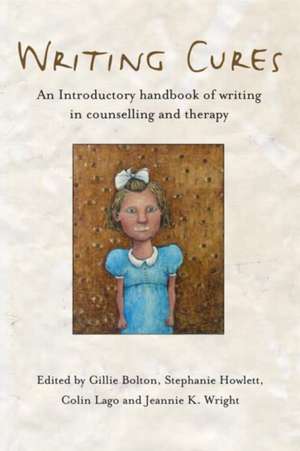
Writing Cures: An Introductory Handbook of Writing in Counselling and Therapy
Editat de Gillie Bolton, Stephanie Howlett, Colin Lago, Jeannie K. Wrighten Limba Engleză Paperback – apr 2004
Writing Cures demonstrates power of expressive and reflective writing in the context of therapy, whether online or text-based, enabling the practitioner to undertake writing methods with clients. It introduces the reader to therapeutic writing in a range of settings and contexts, and from a range of approaches. Chapters from an impressive list of
contributors include:
• 'Ethical and Practical Dimensions of Online Writing Cures' by Stephen Goss and Kate Anthony
• 'Writing by Patients and Therapists in Cognitive and Analytic Therapy' by Anthony Ryle
• 'Reflective and Therapeutic Writing in Counsellor Training' by Colin Feltham and Jacquie Daniels.
Illustrated throughout from clinical experience Writing Cures will be of benefit to all counsellors and
psychotherapists.
Preț: 401.52 lei
Puncte Express: 602
Carte tipărită la comandă
Livrare economică 03-17 decembrie
Livrare prin curier în România Termenul estimat este afișat lângă disponibilitate.
Transport gratuit pentru acest produs Plată online sau ramburs, în funcție de opțiunile comenzii.
Retur gratuit în 14 zile Comandă securizată și suport în română.
Specificații
ISBN-13: 9781583919125
ISBN-10: 1583919120
Pagini: 256
Ilustrații: black & white illustrations
Dimensiuni: 156 x 234 x 20 mm
Greutate: 0.7 kg
Ediția:1
Editura: Taylor & Francis
Colecția Routledge
Locul publicării:Oxford, United Kingdom
ISBN-10: 1583919120
Pagini: 256
Ilustrații: black & white illustrations
Dimensiuni: 156 x 234 x 20 mm
Greutate: 0.7 kg
Ediția:1
Editura: Taylor & Francis
Colecția Routledge
Locul publicării:Oxford, United Kingdom
V-ar putea interesa
-
 Race, Culture and CounsellingColin Lago-28%Preț: 214.32 lei298.04 lei
 -
 -27%Preț: 212.78 lei290.90 lei
 -
 -26%Preț: 200.21 lei269.26 lei
 -
 Annual Progress in Child Psychiatry and Child Development 1992Margaret E. Hertzig-5%Preț: 1958.53 lei2061.61 lei
 -
 The Psychology of Neurogenic Communication DisordersDennis C. Tanner-5%Preț: 142.73 lei150.25 lei
 -
 A Simple Guide to DepressionW. Edison Houpt Jr. MD-5%Preț: 115.74 lei121.83 lei
 -
 Delivered from ADHDT. S. Gill MD-5%Preț: 60.05 lei63.21 lei
 -
 Achieving Personal IntegrityCharles C. DeLong MD-5%Preț: 61.72 lei64.97 lei
 -
 Mental Status Examination for Personality DisordersWes Burgess MD-5%Preț: 124.74 lei131.30 lei
 -
 Calm SeasRoger Sparhawk M. D.-5%Preț: 99.89 lei105.15 lei
 -
 The St Vincent's Hospital Handbook of Clinical PsychogeriatricsSt Vincent's Psychogeriatric Team-5%Preț: 289.90 lei305.16 lei
 -
 Communication and LivingRussell, William J.-5%Preț: 131.47 lei138.38 lei
 -
 Dissociative Identity Disorder a GiftU. R. Ideal-5%Preț: 46.19 lei48.62 lei
 -
 Do You Know a Good Expert?Danny Allen-5%Preț: 81.82 lei86.12 lei
 -
 Is Ect Right for You?Sana Johnson-Quijada-5%Preț: 41.03 lei43.19 lei
 -
 ADHD Is Not a SentenceDr Robert Garsia-5%Preț: 128.75 lei135.52 lei
 -
 The Non-Stop LoverDr Magnus Jc Sjogren-5%Preț: 42.82 lei45.08 lei
 -
 The Monster Inside of MeBrooke Price-5%Preț: 35.88 lei37.76 lei
 -
 Psychiatry in the Service of MankindVijayasenan, Dr M. E.-5%Preț: 52.11 lei54.86 lei
 -
 Trauma, the Body and Transformation: A Narrative InquiryKim Etherington-29%Preț: 189.89 lei269.32 lei
 -
 -29%Preț: 195.76 lei274.49 lei
 -
 -29%Preț: 204.54 lei288.76 lei
 -
 -29%Preț: 207.43 lei292.84 lei
 -
 Carl Rogers Counsels a Black ClientAnissa Talahite-5%Preț: 183.26 lei192.91 lei
 -
 Les conquêtes récentes de la psychiatrieCesare LombrosoPreț: 72.77 lei
Public țintă
Postgraduate and ProfessionalCuprins
McMillan, Foreword. Part I: Theory and Research. J. Wright, The Passion of Science, the Precision of Poetry: Therapeutic Writing, a Review of the Literature. G. Lowe, Cognitive Psychology and the Biomedical Foundations of Writing Therapy. J. Speedy, The Contribution of Narrative Ideas and Practices in Therapy. C. Hunt, Reading Ourselves: Imagining the Reader in the Writing Process. D. Steinberg, From Archetype to Impressions: The Magic of Words. Part II: Writing in Therapy. A. Ryle, Writing by Patients and Therapists in Cognitive Analytic Therapy. K. Thompson, Journal Writing as a Therapeutic Tool. S. Howlett, Writing the Link between Body and Mind: The Use of Writing in Clients with Chronic Stress-related Medical Disorders. C. Lago, 'When I Write I Can Think': Personal Uses of Writing by International Students. G. Bolton, J. Latham, 'Every Poem Breaks a Silence That Had to be Overcome': The Therapeutic Role of Poetry Writing. C. Williamson, Writing as a Therapy for People in Recovery from Addiction. Part III: Writing Online. K. Anthony, Therapy Online: The Therapeutic Relationship in Typed Text. J. Wright, 'She Put Down in Writing What Was in Her Mind': Developing Online, Text-based Counselling in the Workplace. L. Griffiths, Electronic Text Based Communication: Assumptions and Illusions Created by the Transference Phenomena. S. Howlett, R. Langdon, Message to Jo: The Samaritans Experience of E-mail Befriending. S. Goss, K. Anthony, Ethical and Practical Dimensions of Online Writing Cures. Part IV: Reflective Practice. C. Feltham, J. Daniels, Reflective and Therapeutic Writing in Counsellor Training. A. Ryle, The Uses of Writing in the Supervision of Cognitive Analytic Therapy. G. Bolton, H. Allan, H. Drucquer, Black and Blue: Writing for Reflective Practice. J. Hilsdon, After the Session: 'Freewriting' in Response. L. Heller, Writing in a Reflective Practice Group for Staff Working with People with Dementia.
Recenzii
'The section on the evidence base will astonish... The 'Writing in Therapy' section is a rich source of techniques with many examples drawn from experience. The section on 'writing online' includes a remarkable account of The Samaritans' use of email befriending... the 'reflective practice' section reminds us that writing is not only therapeutic for clients but can be an invaluable tool... I heartily recommend this book as an accessible, wide-ranging and thought-provoking introduction for counsellors, writers, therapists and nurses.' - Tony Gillam, Mental Health Practice 2005
‘This is a timely, ambitious and stimulating book… I congratulate the editors on their achievement and am sure Writing Cures will ‘entice readers back’ to the value of writing in therapy and its role in the search for the self.’ – Eva Burns-Lundgren, European Journal of Psychotherapy & Counselling
The section on the evidence base will astonish... The 'Writing in Therapy' section is a rich source of techniques with many examples drawn from experience. The section on 'writing online' includes a remarkable account of The Samaritans' use of email befriending... the 'reflective practice' section reminds us that writing is not only therapeutic for clients but can be an invaluable tool... I heartily recommend this book as an accessible, wide-ranging and thought-provoking introduction for counsellors, writers, therapists and nurses. - Tony Gillam, Mental Health Practice 2005
...most interesting section of the book is dedicated to online therapy and writing. These newly emerging options for therapy are often met with client enthusiasm and clinician resistance. The ethics are well debated, and I found some of my scepticism being eroded by some impressive examples in practice. - Clare Moran, The Psychologist, 2005
‘This is a timely, ambitious and stimulating book… I congratulate the editors on their achievement and am sure Writing Cures will ‘entice readers back’ to the value of writing in therapy and its role in the search for the self.’ – Eva Burns-Lundgren, European Journal of Psychotherapy & Counselling
The section on the evidence base will astonish... The 'Writing in Therapy' section is a rich source of techniques with many examples drawn from experience. The section on 'writing online' includes a remarkable account of The Samaritans' use of email befriending... the 'reflective practice' section reminds us that writing is not only therapeutic for clients but can be an invaluable tool... I heartily recommend this book as an accessible, wide-ranging and thought-provoking introduction for counsellors, writers, therapists and nurses. - Tony Gillam, Mental Health Practice 2005
...most interesting section of the book is dedicated to online therapy and writing. These newly emerging options for therapy are often met with client enthusiasm and clinician resistance. The ethics are well debated, and I found some of my scepticism being eroded by some impressive examples in practice. - Clare Moran, The Psychologist, 2005
Notă biografică
Stephanie Howlett, Gillie Bolton, Colin Lago, Jeannie K. Wright
Descriere
Writing Cures demonstrates the power of expressive and reflective writing in the context of therapy, whether online or text-based, enabling counsellors and psychotherapists to undertake writing methods with clients.