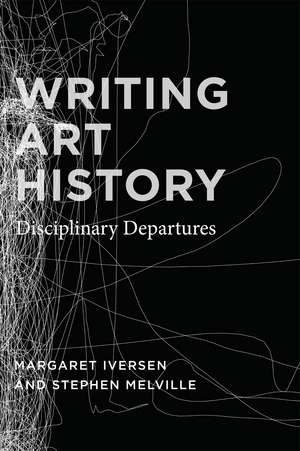
Writing Art History: Disciplinary Departures
Autor Margaret Iversen, Stephen Melvilleen Limba Engleză Paperback – dec 2010
In Writing Art History, Margaret Iversen and Stephen Melville address these questions by exploring some assumptions at the discipline’s foundation. Their project is to excavate the lost continuities between philosophical aesthetics, contemporary theory, and art history through close readings of figures as various as Michael Baxandall, Martin Heidegger, Jacques Lacan, and Alois Riegl. Ultimately, the authors propose that we might reframe the questions concerning art history by asking what kind of writing might help the discipline to better imagine its actual practices—and its potential futures.
Preț: 303.41 lei
Puncte Express: 455
Carte tipărită la comandă
Livrare economică 20 noiembrie-04 decembrie
Livrare prin curier în România Termenul estimat este afișat lângă disponibilitate.
Transport gratuit de la 400.00 lei Plată online sau ramburs, în funcție de opțiunile comenzii.
Retur gratuit în 14 zile Comandă securizată și suport în română.
Specificații
ISBN-13: 9780226388267
ISBN-10: 0226388263
Pagini: 256
Ilustrații: 30 halftones, 15 line drawings
Dimensiuni: 152 x 229 x 23 mm
Greutate: 0.37 kg
Editura: University of Chicago Press
Colecția University of Chicago Press
ISBN-10: 0226388263
Pagini: 256
Ilustrații: 30 halftones, 15 line drawings
Dimensiuni: 152 x 229 x 23 mm
Greutate: 0.37 kg
Editura: University of Chicago Press
Colecția University of Chicago Press
V-ar putea interesa
-
 The Great Image Has No Form, or On the Nonobject through PaintingFrançois Jullien-23%Preț: 561.63 lei729.39 lei
 -
 Preț: 228.95 lei
 -
 Preț: 368.19 lei
 -
 Picturing War in France, 1792–1856Katie Hornstein-8%Preț: 521.54 lei566.90 lei
 -
 German ExpressionismRose-Carol Washton LongPreț: 282.08 lei
 -
 The Mustard Seed Garden Manual of PaintingMai-Mai SzePreț: 375.16 lei
 -
 Mahler and His WorldKaren PainterPreț: 351.56 lei
 -
 Museums After ModernismPollockPreț: 371.61 lei
Notă biografică
Margaret Iversen is professor of the history of art at the University of Essex and author of Beyond Pleasure: Freud, Lacan, Barthes, among other titles. Stephen Melville is professor emeritus of the history of art at Ohio State University and author of Seams: Art as Philosophical Context and other works.
Cuprins
Preface
Chapter 1 What’s the Matter with Methodology?
Chapter 2 Historical Distance (Bridging and Spanning)
Chapter 3 On the Limits of Interpretation: Dürer’s Melencolia I
Chapter 4 What the Formalist Knows
Chapter 5 The Spectator: Riegl, Steinberg, and Morris
Chapter 6 The Gaze in Perspective: Merleau-Ponty, Lacan, Damisch
Chapter 7 Seeing and Reading: Lyotard, Barthes, Schapiro
Chapter 8 Plasticity: The Hegelian Writing of Art
Chapter 9 Curriculum
Chapter 2 Historical Distance (Bridging and Spanning)
Chapter 3 On the Limits of Interpretation: Dürer’s Melencolia I
Chapter 4 What the Formalist Knows
Chapter 5 The Spectator: Riegl, Steinberg, and Morris
Chapter 6 The Gaze in Perspective: Merleau-Ponty, Lacan, Damisch
Chapter 7 Seeing and Reading: Lyotard, Barthes, Schapiro
Chapter 8 Plasticity: The Hegelian Writing of Art
Chapter 9 Curriculum
Notes
Works Cited
Index
Recenzii
“Iversen and Melville offer a sophisticated and well-written introduction to the central twentieth-century themes, theories, and methods of art history, and to how this history has been written. Filled with rich and probing accounts of many of art history’s most noted writers, this book shows how, through the writing of art history, deep changes have been encouraged and effected in our modes of contemplation and judgment.”
“Writing about the writing about writing the history and theory of visual art—this book, coauthored by two speculative and critical art historians, constructs an intriguing hall of mirrors that lures its reader into being inescapably reflective about our too often workaday discipline. Because of the richness, variety, and history of thinkers whom it addresses—from Hegel to Heidegger, to Riegl to Wölfflin, to Warburg to Panofsky, to Merleau-Ponty to Barthes, to Steinberg to Baxandall, to many contemporary theorists as well as practicing artists (and that’s to name only some)—this is a deep and thick study, often phenomenological in inclination, for all who are interested in the intellectual history of the history of art. ‘Theory,’ its authors convincingly assert, should never be a substitute for ‘methodology,’ and in that conviction they conclude with its curricular potential. Directed especially to those who are philosophically-inclined (and why would one not be?), this is a most thoughtful book that many will read and relish.”
"Margaret Iversen and Stephen Melville have written a challenging book, one that will attract the attention of all art historians. Offering an insightful account of the discipline's historiography that runs from Warburg to Didi-Huberman and insisting on the relevance of extra-disciplinary writing of philosophers from Heidegger to Nancy, they argue against art historical 'method' and in favor of the type of reflection prompted by a response to works of art themselves. Their phenomenological position emphasizes the active role of art in shaping its own reception and rejects the predetermined structure of knowledge often imposed on it in the name of history. The book asks for no less than a radical rethinking of the art historical enterprise."—Keith Moxey, Barnard College