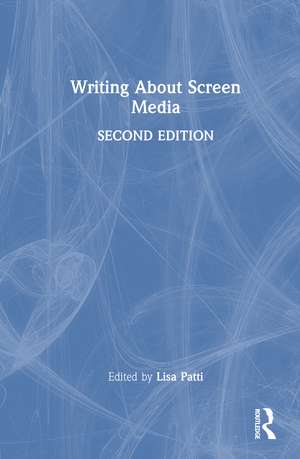
Writing About Screen Media
Editat de Lisa Pattien Limba Engleză Hardback – 9 iul 2026
The book’s case studies showcase media studies’ geographical and industrial breadth, with essays covering topics as varied as: Brazilian telenovelas, K-pop music videos, global streaming services, film festivals, and archives. New chapters on writing about AI-enhanced media, digital media fandoms, and immersive media experiences expand the book’s scope. With the expertise of over forty esteemed media scholars, the collection combines their personal reflections about writing with practical advice.
Through its unprecedented scope, this volume will engage not only those who may be writing about film and other screen media for the first time but also accomplished writers who are interested in exploring new screen media objects, new approaches to writing about media, and new formats for critical expression.
Accompanying instructor resources, including sample syllabi, are available at www.writingaboutscreenmedia.net
Preț: 1354.64 lei
Preț vechi: 1652.00 lei
-18%
Puncte Express: 2032
Carte tipărită la comandă
Livrare economică 05-19 decembrie
Livrare prin curier în România Termenul estimat este afișat lângă disponibilitate.
Transport gratuit pentru acest produs Plată online sau ramburs, în funcție de opțiunile comenzii.
Retur gratuit în 14 zile Comandă securizată și suport în română.
Specificații
ISBN-13: 9781032933771
ISBN-10: 1032933771
Pagini: 338
Ilustrații: 116
Dimensiuni: 156 x 234 mm
Greutate: 0.79 kg
Ediția:2
Editura: Taylor & Francis
Colecția Routledge
Locul publicării:Oxford, United Kingdom
ISBN-10: 1032933771
Pagini: 338
Ilustrații: 116
Dimensiuni: 156 x 234 mm
Greutate: 0.79 kg
Ediția:2
Editura: Taylor & Francis
Colecția Routledge
Locul publicării:Oxford, United Kingdom
V-ar putea interesa
-
 -10%Preț: 266.89 lei296.66 lei
 -
 -23%Preț: 707.29 lei918.56 lei
 -
 Preț: 420.39 lei
 -
 Preț: 245.37 lei
 -
 Preț: 348.75 lei
 -
 Dark Shadows Episode Guide Volume 6Hanley Jennings PetersonPreț: 160.52 lei
 -
 Producing and Directing the Short Film and VideoPeter W. Rea-14%Preț: 1338.18 lei1556.02 lei
 -
 Grammar of the EditChristopher BowenPreț: 352.20 lei
 -
 Grammar of the ShotChristopher BowenPreț: 319.88 lei
 -
 Scenic Automation HandbookGareth Conner-8%Preț: 539.39 lei586.30 lei
 -
 Hollywood HeydayDavid FantlePreț: 313.33 lei
 -
 Henry BrandonBill CassaraPreț: 236.35 lei
 -
 Getting Even With StevenMichael SelsmanPreț: 94.47 lei
 -
 Dark Shadows Episode Guide Volume 5Hanley Jennings PetersonPreț: 156.04 lei
 -
 101 moderne MonologeEva SpambalgPreț: 151.98 lei
 -
 55 Monologe für FrauenAnke RoederPreț: 138.39 lei
 -
 55 Monologe für MännerAnke RoederPreț: 138.49 lei
 -
 ABC des SprechensHeidi PufferPreț: 125.67 lei
Public țintă
Postgraduate and Undergraduate AdvancedCuprins
List of figures
List of contributors
Acknowledgements
Part I
Strategies for writing about screen media
Lisa Patti
1. Introduction
(Still) learning to write about screen media
How to read this book
In practice: Write your (writing) autobiography – Keep a journal – Accept invitations to experiment with your writing
2. Writing practices: How to begin writing about screen media
Framing
Curating
Collaborating
Step-by-step spotlight: Peer review
In practice: Think like a programmer – Think like a designer – Think like an editor
3. Entering the conversation: How to develop a critical argument
Thinking with others: Arguing
Thinking on the page: Free writing
Structuring your argument: Outlines
Step-by-step spotlight: Outlining your argument
Telling a story: Evidence
Setting the scene: Introductions
Step-by-step spotlight: Analyzing introductions
Making a last(ing) impression: Conclusions
In practice: Write a blurb – Write a new ending – Write a script
4. From notebook to network: How to use practical and digital writing tools
Reading
Watching
Writing
Citing
Generating
In practice: Search without a search engine – Create a commonplace book – Show your work (of art)
5. Elements of screen style: How to write about screen media form
Notes
Step-by-step spotlight: Drafting screening questions
Texts
Step-by-step spotlight: Reading a screen media text
Contexts
Resources
In practice: Make GIFs – Make an audio commentary – Make an audio playlist – Make a video essay playlist
Part II
Writers on writing about screen media
Objects and events
6. Writing about transnational cinema: Crazy Rich Asians
Olivia Khoo
7. Capturing moments: Writing about film festivals as events
Kirsten Stevens
8. Writing about experimental cinema: Andy Warhol’s Empire (1964)
Glyn Davis
9. From meaning to effect: Writing about archival footage
Jaimie Baron
10. Making the absent present: Writing about nonextant media
Allyson Nadia Field
11. Expressing race in Brazilian telenovelas
Jasmine Mitchell
12. Writing about music video: Tracing the ephemeral
Carol Vernallis
13. Writing across divides: Locating power in K-pop music videos
S. Heijin Lee
14. Playing to write: Analyzing video games
TreaAndrea M. Russworm and Jennifer Malkowski
15. When it all clicks: Writing about participatory media
Lauren S. Berliner
16. Feeling out social media
Julie Wilson and Emily Chivers Yochim
17. “A Very Black Project”: A method for digital visual culture
Lauren McLeod Cramer
18. Writing about transnational media: From representation to materiality
Fan Yang
19. Writing about digital and interactive media
Dale Hudson and Patricia R. Zimmermann
20. (Un)limited mobilities
Rahul Mukherjee
21. Context is key: How (and why) you should write about outdoor advertising
Beth Corzo-Duchardt
Methods and locations
22. How sound helps tell a story: Sound, music, and narrative in Vishal Bhardwaj’s Omkara
Nilanjana Bhattacharjya
23. Writing outside the text: A cultural approach to exhibition and moviegoing
Jasmine Nadua Trice
24. Writing about streaming: The drama of distribution
Ramon Lobato
25. Analyzing and writing about credit sequences
Monika Mehta
26. “We are not thinking frogs”: The archive, the artifact, and the task of the film historian
Katherine Groo
27. Show me the data!: Uncovering the evidence in screen media industry research
Bronwyn Coate and Deb Verhoeven
28. Researching and writing across media industries
Derek Johnson
29. The value of surprise: Ethnography of media industries
Tejaswini Ganti
30. Listen up!: Interviewing as method
Alicia Kozma
31. The need for translation: Difference, footnotes, hyperlinks
Tijana Mamula
Forms and formats
32. Words and more: Strategies for writing about and with media
Virginia Kuhn
33. Best practices for screen media podcasting
Christine Becker and Kyle Wrather
34. Confessions of an academic blogger
Henry Jenkins
35. The research and the remix: Video essays as creative criticism
Jeffrey Romero Middents
36. Foregrounding the invisible: Notes on the video essay review
Chiara Grizzaffi
37. Review, edit, repeat: Writing and editing book reviews
Alice Leppert
38. Extracurricular scholarship: “Writing” my audio commentary of Losing Ground
Terri Francis
39. The sharp, short, sweet art of blurb writing
Leah Shafer
40. Bridging the gaps between scholarly essays and mass-market film writing
Nick Davis
41. Writing across the page without a line
Holly Willis
Vantage points
42. The algorithm strikes back: Writing about generative AI
Bridget Kies
43. Hidden faces and digital affect: Writing about online fandoms
Osarugue Otebele
44. Documenting immersive media experiences with ArcGIS Storymaps
Melanie Kohnen
List of contributors
Acknowledgements
Part I
Strategies for writing about screen media
Lisa Patti
1. Introduction
(Still) learning to write about screen media
How to read this book
In practice: Write your (writing) autobiography – Keep a journal – Accept invitations to experiment with your writing
2. Writing practices: How to begin writing about screen media
Framing
Curating
Collaborating
Step-by-step spotlight: Peer review
In practice: Think like a programmer – Think like a designer – Think like an editor
3. Entering the conversation: How to develop a critical argument
Thinking with others: Arguing
Thinking on the page: Free writing
Structuring your argument: Outlines
Step-by-step spotlight: Outlining your argument
Telling a story: Evidence
Setting the scene: Introductions
Step-by-step spotlight: Analyzing introductions
Making a last(ing) impression: Conclusions
In practice: Write a blurb – Write a new ending – Write a script
4. From notebook to network: How to use practical and digital writing tools
Reading
Watching
Writing
Citing
Generating
In practice: Search without a search engine – Create a commonplace book – Show your work (of art)
5. Elements of screen style: How to write about screen media form
Notes
Step-by-step spotlight: Drafting screening questions
Texts
Step-by-step spotlight: Reading a screen media text
Contexts
Resources
In practice: Make GIFs – Make an audio commentary – Make an audio playlist – Make a video essay playlist
Part II
Writers on writing about screen media
Objects and events
6. Writing about transnational cinema: Crazy Rich Asians
Olivia Khoo
7. Capturing moments: Writing about film festivals as events
Kirsten Stevens
8. Writing about experimental cinema: Andy Warhol’s Empire (1964)
Glyn Davis
9. From meaning to effect: Writing about archival footage
Jaimie Baron
10. Making the absent present: Writing about nonextant media
Allyson Nadia Field
11. Expressing race in Brazilian telenovelas
Jasmine Mitchell
12. Writing about music video: Tracing the ephemeral
Carol Vernallis
13. Writing across divides: Locating power in K-pop music videos
S. Heijin Lee
14. Playing to write: Analyzing video games
TreaAndrea M. Russworm and Jennifer Malkowski
15. When it all clicks: Writing about participatory media
Lauren S. Berliner
16. Feeling out social media
Julie Wilson and Emily Chivers Yochim
17. “A Very Black Project”: A method for digital visual culture
Lauren McLeod Cramer
18. Writing about transnational media: From representation to materiality
Fan Yang
19. Writing about digital and interactive media
Dale Hudson and Patricia R. Zimmermann
20. (Un)limited mobilities
Rahul Mukherjee
21. Context is key: How (and why) you should write about outdoor advertising
Beth Corzo-Duchardt
Methods and locations
22. How sound helps tell a story: Sound, music, and narrative in Vishal Bhardwaj’s Omkara
Nilanjana Bhattacharjya
23. Writing outside the text: A cultural approach to exhibition and moviegoing
Jasmine Nadua Trice
24. Writing about streaming: The drama of distribution
Ramon Lobato
25. Analyzing and writing about credit sequences
Monika Mehta
26. “We are not thinking frogs”: The archive, the artifact, and the task of the film historian
Katherine Groo
27. Show me the data!: Uncovering the evidence in screen media industry research
Bronwyn Coate and Deb Verhoeven
28. Researching and writing across media industries
Derek Johnson
29. The value of surprise: Ethnography of media industries
Tejaswini Ganti
30. Listen up!: Interviewing as method
Alicia Kozma
31. The need for translation: Difference, footnotes, hyperlinks
Tijana Mamula
Forms and formats
32. Words and more: Strategies for writing about and with media
Virginia Kuhn
33. Best practices for screen media podcasting
Christine Becker and Kyle Wrather
34. Confessions of an academic blogger
Henry Jenkins
35. The research and the remix: Video essays as creative criticism
Jeffrey Romero Middents
36. Foregrounding the invisible: Notes on the video essay review
Chiara Grizzaffi
37. Review, edit, repeat: Writing and editing book reviews
Alice Leppert
38. Extracurricular scholarship: “Writing” my audio commentary of Losing Ground
Terri Francis
39. The sharp, short, sweet art of blurb writing
Leah Shafer
40. Bridging the gaps between scholarly essays and mass-market film writing
Nick Davis
41. Writing across the page without a line
Holly Willis
Vantage points
42. The algorithm strikes back: Writing about generative AI
Bridget Kies
43. Hidden faces and digital affect: Writing about online fandoms
Osarugue Otebele
44. Documenting immersive media experiences with ArcGIS Storymaps
Melanie Kohnen
Notă biografică
Lisa Patti is Associate Professor of Media and Society at Hobart and William Smith Colleges. She is the editor of Writing About Screen Media; co-editor (with Tijana Mamula) of The Multilingual Screen: New Reflections on Cinema and Linguistic Difference; and co-author (with Glyn Davis, Kay Dickinson, and Amy Villarejo) of Film Studies: A Global Introduction.
Descriere
An essential guide to writing about a broad range of media objects – including film, television, social media, advertising, video games, mobile media, music videos, and digital media – in an equally broad range of formats – from essays and video essays to podcasts and playlists.