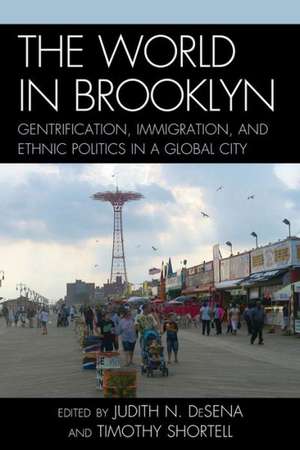
World in Brooklyn
Editat de Judith Desenaen Limba Engleză Paperback – 10 dec 2013
As a whole, this book considers both theoretical and practical urban issues. In most cases the scholarly perspective is on everyday life. With this in mind there are also social justice concerns. Issues of social segregation and attendant homogenization are brought to light. Moreover, social class and race advantages or disadvantages, as part of urban processes, are underscored through critiques of local policy decisions throughout the chapters. A common thread is the assertion by contributors that planning the future of Brooklyn needs to include multi-ethnic, racial, and economic groups, those very residents who make-up Brooklyn.
| Toate formatele și edițiile | Preț | Express |
|---|---|---|
| Paperback (1) | 340.36 lei 6-8 săpt. | |
| Bloomsbury Publishing – 10 dec 2013 | 340.36 lei 6-8 săpt. | |
| Hardback (1) | 871.44 lei 6-8 săpt. | |
| Bloomsbury Publishing – 22 mar 2012 | 871.44 lei 6-8 săpt. |
Preț: 340.36 lei
Preț vechi: 495.44 lei
-31%
Puncte Express: 511
Preț estimativ în valută:
60.25€ • 70.39$ • 52.29£
60.25€ • 70.39$ • 52.29£
Carte tipărită la comandă
Livrare economică 25 februarie-11 martie
Preluare comenzi: 021 569.72.76
Specificații
ISBN-13: 9780739190630
ISBN-10: 0739190636
Pagini: 430
Ilustrații: black & white halftones, maps, figures
Dimensiuni: 152 x 226 x 18 mm
Greutate: 0.34 kg
Editura: Bloomsbury Publishing
Locul publicării:New York, United States
ISBN-10: 0739190636
Pagini: 430
Ilustrații: black & white halftones, maps, figures
Dimensiuni: 152 x 226 x 18 mm
Greutate: 0.34 kg
Editura: Bloomsbury Publishing
Locul publicării:New York, United States
Cuprins
Chapter 1: Introduction: The World in Brooklyn
Judith N. DeSena and Timothy Shortell
Chapter 2: Mapping a Changing Brooklyn, Mapping a Changing World: Gentrification and Immigration, 2000-2008
Lorna Mason, Ed Morlock and Christina Pisano
Chapter 3: Forgetting Poverty in Brooklyn and the U.S.
William DiFazio
Chapter 4: Gentrification in Everyday Life in Brooklyn
Judith N. DeSena
Chapter 5: "Williamsburg Walks": Public Space and Community Events in a Gentrified Neighborhood
Sara Martucci
Chapter 6: The Environmental Injustice of Green Gentrification: The Case of Brooklyn's Prospect Park
Kenneth A. Gould and Tammy L. Lewis
Chapter 7: Rezoning Coney Island: A History of Decline and Revival, of Heroes and Villains at the "People's Playground
Alessandro Busà
Chapter 8: The Gowanus Canal: Local Politics of "Superfunding" Status
Shanna Farrell
Chapter 9: Striving for Sustainability on the Urban Waterfront: The Case of Newtown Creek
Steve Lang
Chapter 10: Riding the Bus in Brooklyn: Seeing the Spectacle of Everyday Multicultural Life
Jerome Krase
Chapter 11: Brooklyn and Belleville: On the Visual Semiotics of Ethnic Identity in Two Immigrant Neighborhoods
Timothy Shortell
Chapter 12: Constructing an Oppositional Community: Sunset Park and the Politics of Organizing Across Difference
Mark Treskon
Chapter 13: An Ethnography of Local Politics in a Brooklyn Caribbean Community
Evrick Brown
Chapter 14: The Dual Roles of Brighton Beach: A Local and Global Community
Phyllis Conn
Chapter 15: Hood Politics: Charter Schools, Race and Gentrification in Fort Greene
Noel S. Anderson
Chapter 16: Revising Canarsie: Racial Transition and Neighborhood Stability in Brooklyn
Jennifer Candipan, Roberta Cordeau, Mark Peterson, Nicole Riordan, Bengisu Peker, Danielle Shallow and Gregory Smithsimon
Judith N. DeSena and Timothy Shortell
Chapter 2: Mapping a Changing Brooklyn, Mapping a Changing World: Gentrification and Immigration, 2000-2008
Lorna Mason, Ed Morlock and Christina Pisano
Chapter 3: Forgetting Poverty in Brooklyn and the U.S.
William DiFazio
Chapter 4: Gentrification in Everyday Life in Brooklyn
Judith N. DeSena
Chapter 5: "Williamsburg Walks": Public Space and Community Events in a Gentrified Neighborhood
Sara Martucci
Chapter 6: The Environmental Injustice of Green Gentrification: The Case of Brooklyn's Prospect Park
Kenneth A. Gould and Tammy L. Lewis
Chapter 7: Rezoning Coney Island: A History of Decline and Revival, of Heroes and Villains at the "People's Playground
Alessandro Busà
Chapter 8: The Gowanus Canal: Local Politics of "Superfunding" Status
Shanna Farrell
Chapter 9: Striving for Sustainability on the Urban Waterfront: The Case of Newtown Creek
Steve Lang
Chapter 10: Riding the Bus in Brooklyn: Seeing the Spectacle of Everyday Multicultural Life
Jerome Krase
Chapter 11: Brooklyn and Belleville: On the Visual Semiotics of Ethnic Identity in Two Immigrant Neighborhoods
Timothy Shortell
Chapter 12: Constructing an Oppositional Community: Sunset Park and the Politics of Organizing Across Difference
Mark Treskon
Chapter 13: An Ethnography of Local Politics in a Brooklyn Caribbean Community
Evrick Brown
Chapter 14: The Dual Roles of Brighton Beach: A Local and Global Community
Phyllis Conn
Chapter 15: Hood Politics: Charter Schools, Race and Gentrification in Fort Greene
Noel S. Anderson
Chapter 16: Revising Canarsie: Racial Transition and Neighborhood Stability in Brooklyn
Jennifer Candipan, Roberta Cordeau, Mark Peterson, Nicole Riordan, Bengisu Peker, Danielle Shallow and Gregory Smithsimon
Recenzii
Mobility defines Brooklyn, a place of arrival and aspiration. Waves of immigrants have shaped and reshaped the borough's neighborhoods; gentrifiers have discovered and revived its brownstone-lined streets, recreating value destroyed by periods of municipal divestment. In this sense, Brooklyn is more like other cities than not. This edited volume balances these universal, generalizable aspects with particular historical-geographical perspectives on Brooklyn's diversities. The second chapter analyzes demographic trends, using maps to show where various ethnic groups have settled over the past decade. The following chapters effectively use case studies to examine gentrification, productions of space, and politics. Oft-examined neighborhoods such as Coney Island and Williamsburg are included, as well as less familiar places such as Canarsie and Sunset Park. Unique perspectives on places, such as education politics in Fort Greene and the visual semiotics of immigrant retail landscapes, add interest. Chapters are uniformly well written, with clear literature reviews that establish theoretical frameworks supported by ethnographic fieldwork, interviews, statistics, and other forms of qualitative and quantitative data. This attention to method makes this collection particularly well suited for use in a variety of courses. Many illustrations, graphs, and tables enhance an already lively text. Summing Up: Highly recommended.
Judith N. DeSena and Timothy Shortell have produced an invaluable compendium of original essays about Brooklyn's changing social worlds. Their book is a must read for anyone concerned with urban change and social justice. They also prove that Thomas Wolfe was wrong: not only the dead know Brooklyn. These essays by highly dedicated, living scholars capture the joys and struggles of life in the nation's greatest borough.
DeSena and Shortell bring together a stellar cast of scholars who use demographic, ethnographic, and comparative data to offer a fresh perspective on race, ethnicity and class in Brooklyn's changing neighborhoods. It is a must-read for anybody interested in understanding gentrification and growing inequality after the Great Recession.
Judith N. DeSena and Timothy Shortell have produced an invaluable compendium of original essays about Brooklyn's changing social worlds. Their book is a must read for anyone concerned with urban change and social justice. They also prove that Thomas Wolfe was wrong: not only the dead know Brooklyn. These essays by highly dedicated, living scholars capture the joys and struggles of life in the nation's greatest borough.
DeSena and Shortell bring together a stellar cast of scholars who use demographic, ethnographic, and comparative data to offer a fresh perspective on race, ethnicity and class in Brooklyn's changing neighborhoods. It is a must-read for anybody interested in understanding gentrification and growing inequality after the Great Recession.