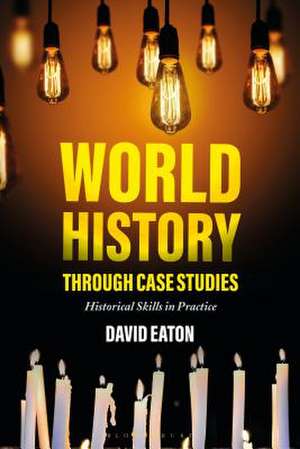
World History through Case Studies: Historical Skills in Practice
Autor David Eatonen Limba Engleză Paperback – 19 sep 2019
By taking the approach of 'unwrapping the textbook,' David Eaton reveals how historians think, making it clear that the past is not nearly as tidy as most textbooks suggest. Provocative questions like whether ancient Greece was shaped by contact with Egypt provide an entry point into how history professors may sharply disagree on even basic narratives, and how historical interpretations can be influenced by contemporary concerns. By illuminating these historiographical debates, and linking them to key skills required by historians, World History through Case Studies shows how the study of history is relevant to a new generation of students and teachers.
Preț: 181.65 lei
Preț vechi: 240.53 lei
-24%
Puncte Express: 272
Carte disponibilă
Livrare economică 17 noiembrie-01 decembrie
Livrare prin curier în România Termenul estimat este afișat lângă disponibilitate.
Transport gratuit de la 400.00 lei Plată online sau ramburs, în funcție de opțiunile comenzii.
Retur gratuit în 14 zile Comandă securizată și suport în română.
Specificații
ISBN-13: 9781350042612
ISBN-10: 1350042617
Pagini: 304
Ilustrații: 30 bw illus
Dimensiuni: 156 x 234 x 18 mm
Greutate: 0.45 kg
Editura: Bloomsbury Publishing
Colecția Bloomsbury Academic
Locul publicării:London, United Kingdom
ISBN-10: 1350042617
Pagini: 304
Ilustrații: 30 bw illus
Dimensiuni: 156 x 234 x 18 mm
Greutate: 0.45 kg
Editura: Bloomsbury Publishing
Colecția Bloomsbury Academic
Locul publicării:London, United Kingdom
Cuprins
Introduction
Part 1 - Prehistory to 600 BCE
1. Urge Overkill: Kennewick Man and the Settling of the Americas
2. Horsing Around: The Domestication of Mammals
3. #AncientEgyptMatters: The Black Athena Debate
Part 2 - The Age of Empires, 600 BCE - 600 CE
4. Stretching the Past: A History of Yoga
5. Whose Key to China? Confucius in History
6. Making Waves: The Bantu Migrations across Central Africa
7. Bread and Circuses: Sport and Society in Imperial Rome
Part 3 - Cross-Cultural Interactions, 600 - 1450 CE
8. Veiled Meanings: Islam and Gender
9. Going Berserk: The Vikings and Violence
10. Cosmopolitan Culture: Life along the Swahili Coast
11. This Island Earth: Environmental Change on Easter Island
Part 4 - The Origins of Global Interdependence, 1450 - 1750 CE
12. Supreme Sacrifice: Assessing Aztec Religion
13. Orunmila Saves: Polytheism and World Religions
14. Heavy Metals: Silver and the World Economy
15. "We'll Always Have Paris": The Origins of Modernity
Part 5 - Accelerating Global Integration, 1750 - 1900
16. Germ Warfare: Disease and the Age of Revolutions
17. Tokyo Drift: Japan and the Industrial Revolution
18. Light and Shade: Studying Colonialism in the Dutch East Indies
Part 6 - The Modern World, 1900 - Present
19. Open Wounds: The Horrors of the Second World War
20. Global Goals: Soccer and Globalization
Conclusion
Index
Part 1 - Prehistory to 600 BCE
1. Urge Overkill: Kennewick Man and the Settling of the Americas
2. Horsing Around: The Domestication of Mammals
3. #AncientEgyptMatters: The Black Athena Debate
Part 2 - The Age of Empires, 600 BCE - 600 CE
4. Stretching the Past: A History of Yoga
5. Whose Key to China? Confucius in History
6. Making Waves: The Bantu Migrations across Central Africa
7. Bread and Circuses: Sport and Society in Imperial Rome
Part 3 - Cross-Cultural Interactions, 600 - 1450 CE
8. Veiled Meanings: Islam and Gender
9. Going Berserk: The Vikings and Violence
10. Cosmopolitan Culture: Life along the Swahili Coast
11. This Island Earth: Environmental Change on Easter Island
Part 4 - The Origins of Global Interdependence, 1450 - 1750 CE
12. Supreme Sacrifice: Assessing Aztec Religion
13. Orunmila Saves: Polytheism and World Religions
14. Heavy Metals: Silver and the World Economy
15. "We'll Always Have Paris": The Origins of Modernity
Part 5 - Accelerating Global Integration, 1750 - 1900
16. Germ Warfare: Disease and the Age of Revolutions
17. Tokyo Drift: Japan and the Industrial Revolution
18. Light and Shade: Studying Colonialism in the Dutch East Indies
Part 6 - The Modern World, 1900 - Present
19. Open Wounds: The Horrors of the Second World War
20. Global Goals: Soccer and Globalization
Conclusion
Index
Recenzii
David Eaton's inventive approach offers students a way to see and take part in the detective work that goes into analyzing and understanding the past. His case studies of key historical issues about which there is contemporary debate range widely across time and space. They provide a fresh perspective on commonly-taught topics in ways that will intrigue students, such as exploring globalization through South Africa's hosting soccer's World Cup, and also allow them to explore issues that rarely make it into textbooks but should, such as the impact of the horse.
In this new approach to world history, David Eaton helps his readers acquire the skills of the historian, and demonstrates how these skills can be applied to the construction of reliable knowledge both in the discipline of history, and in life more generally.
David Eaton's book is a game changer for teaching world history because it centers historiographical debates that are the beating, messy heart of our discipline. Breath-taking in thematic, temporal and geographical range, it also digs deep into well-chosen case studies with panache. The great French scholar Emmanuel Le Roy Ladurie once divided historians into 'parachutists', searching out grand patterns for below them, and 'truffle hunters', their noses buried in the fine-grained details. With this book, budding historians and their teachers should trust Prof. Eaton to both pack their chutes and find them the tastiest morsels. A must read.
In this new approach to world history, David Eaton helps his readers acquire the skills of the historian, and demonstrates how these skills can be applied to the construction of reliable knowledge both in the discipline of history, and in life more generally.
David Eaton's book is a game changer for teaching world history because it centers historiographical debates that are the beating, messy heart of our discipline. Breath-taking in thematic, temporal and geographical range, it also digs deep into well-chosen case studies with panache. The great French scholar Emmanuel Le Roy Ladurie once divided historians into 'parachutists', searching out grand patterns for below them, and 'truffle hunters', their noses buried in the fine-grained details. With this book, budding historians and their teachers should trust Prof. Eaton to both pack their chutes and find them the tastiest morsels. A must read.