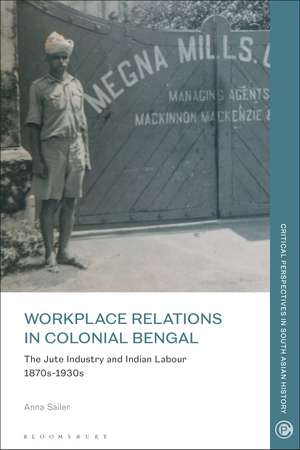
Workplace Relations in Colonial Bengal: The Jute Industry and Indian Labour 1870s-1930s: Critical Perspectives in South Asian History
Autor Anna Saileren Limba Engleză Paperback – 24 aug 2023
Moving away from polarities such as class/culture or modernity/tradition and reconsidering the context around industrial conflicts in this period, Workplace relations in Colonial Bengal offers a new framework to analyse the changing organisation of work in colonial India, and identifies the implications for worker relations both inside and outside the factory. Focusing on a major colonial era industry, this book opens up new perspectives n the history of workers and colonial capitalism in modern India.







Preț: 199.79 lei
Preț vechi: 280.70 lei
-29%
Puncte Express: 300
Carte tipărită la comandă
Livrare economică 08-22 iunie
Specificații
ISBN-13: 9781350233560
ISBN-10: 1350233560
Pagini: 312
Ilustrații: 13 bw illus
Dimensiuni: 152 x 232 x 20 mm
Greutate: 0.48 kg
Editura: Bloomsbury Publishing
Colecția Bloomsbury Academic
Seria Critical Perspectives in South Asian History
Locul publicării:London, United Kingdom
ISBN-10: 1350233560
Pagini: 312
Ilustrații: 13 bw illus
Dimensiuni: 152 x 232 x 20 mm
Greutate: 0.48 kg
Editura: Bloomsbury Publishing
Colecția Bloomsbury Academic
Seria Critical Perspectives in South Asian History
Locul publicării:London, United Kingdom
Cuprins
Introduction
1. Sets, Squads, and Shifts: The Emergence and Development of the 'Multiple Shift' System
2. Uninterrupted hours of work and frequent breaks: The modalities of shared work and excess employment at the shopfloor
3. Defending the spaces and rhythms of the workplace: Labour conflicts over the change in shift systems
4. 'Various Paths Are Today Opened': Working class politics and the General strike of 1929
5. 'Fight to finish': Labour Conflicts in the Bengal Jute Belt in the 1930s
1. Sets, Squads, and Shifts: The Emergence and Development of the 'Multiple Shift' System
2. Uninterrupted hours of work and frequent breaks: The modalities of shared work and excess employment at the shopfloor
3. Defending the spaces and rhythms of the workplace: Labour conflicts over the change in shift systems
4. 'Various Paths Are Today Opened': Working class politics and the General strike of 1929
5. 'Fight to finish': Labour Conflicts in the Bengal Jute Belt in the 1930s
Recenzii
This book reminds us that we must know what happens on the shop-floor to understand the factory. In South Asian labour historiography, we have theorized capitalist strategy without paying sufficient attention to the actual work process. It is also blindingly obvious, as the author of this book points out, that workers' everyday experience of work is critical to their politics.
[This book] highlights the importance of work relations and the organisation of work - conventionally known as labour process theory - in our understanding of the Jute Industry, its working population and its political economy between the 1870s and the 1940s in Calcutta.The discussion presented in the monograph is illuminating and analytically valuable.
[This book] highlights the importance of work relations and the organisation of work - conventionally known as labour process theory - in our understanding of the Jute Industry, its working population and its political economy between the 1870s and the 1940s in Calcutta.The discussion presented in the monograph is illuminating and analytically valuable.