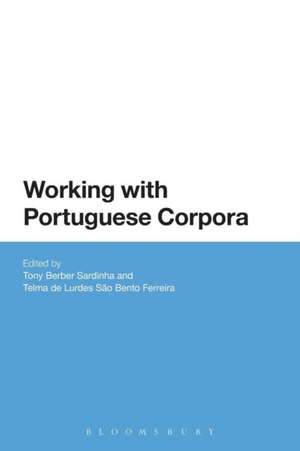
Working with Portuguese Corpora
Editat de Tony Berber Sardinha, Telma de Lurdes São Bento Ferreiraen Limba Engleză Paperback – 22 oct 2015
The book is divided into six sections, each covering a key issue in Corpus Linguistics: lexis and grammar, lexicography, language teaching and terminology, translation, corpus building and sharing, and parsing and annotation. Together these sections present the reader with a broad picture of the field.
Preț: 286.34 lei
Preț vechi: 336.85 lei
-15%
Puncte Express: 430
Carte tipărită la comandă
Livrare economică 05-19 decembrie
Livrare prin curier în România Termenul estimat este afișat lângă disponibilitate.
Transport gratuit de la 400.00 lei Plată online sau ramburs, în funcție de opțiunile comenzii.
Retur gratuit în 14 zile Comandă securizată și suport în română.
Specificații
ISBN-13: 9781474262842
ISBN-10: 1474262848
Pagini: 344
Dimensiuni: 156 x 234 x 18 mm
Greutate: 0.53 kg
Editura: Bloomsbury Publishing
Colecția Bloomsbury Academic
Locul publicării:London, United Kingdom
ISBN-10: 1474262848
Pagini: 344
Dimensiuni: 156 x 234 x 18 mm
Greutate: 0.53 kg
Editura: Bloomsbury Publishing
Colecția Bloomsbury Academic
Locul publicării:London, United Kingdom
V-ar putea interesa
-
 -20%Preț: 417.22 lei518.90 lei
 -
 Interfaces in Linguistics: New Research PerspectivesRaffaella Folli-22%Preț: 450.76 lei578.68 lei
 -
 Preț: 431.15 lei
 -
 Meaning and HumourAndrew GoatlyPreț: 247.82 lei
 -
 Meaning and RelevanceDeirdre WilsonPreț: 436.11 lei
 -
 Talk in ActionHeritagePreț: 354.57 lei
 -
 The Bloomsbury Companion to Discourse AnalysisProfessor Ken HylandPreț: 291.74 lei
 -
 -23%Preț: 264.21 lei341.66 lei
 -
 Worlds of Written Discourse: A Genre-Based ViewVijay Bhatia-16%Preț: 185.11 lei219.71 lei
 -
 Opposition In Discourse: The Construction of Oppositional MeaningDr Lesley Jeffries-17%Preț: 179.03 lei216.14 lei
 -
 The Bloomsbury Companion To LexicographyProfessor Howard Jackson-16%Preț: 264.60 lei314.82 lei
 -
 Encuentros 02. GrammatikheftJochen SchleyerPreț: 97.44 lei
 -
 Ginger 2. My Second Writing Book. Schreibheft. Mit LösungsheftBirgit HollbrüggePreț: 85.53 lei
Cuprins
List of contributors
Foreword, Mike Scott
Acknowledgments
Introduction, Tony Berber Sardinha and Telma de Lurdes São Bento Ferreira
Section 1: Lexis and grammar
1. Looking at collocations in Brazilian Portuguese through the Brazilian Corpus, Tony Berber Sardinha
2. Lexical bundles in Brazilian Portuguese, Tony Berber Sardinha, Rosana de Barros Silva e Teixeira and Telma de Lurdes São Bento Ferreira
3. Changing 'faces': A case study of complex prepositions in Brazilian Portuguese, Tania Maria Granja Shepherd
Section 2: Lexicography
4. The Corpus do Português and the Frequency Dictionary of Portuguese, Mark Davies
5. PtTenTen: A corpus for Portuguese lexicography, Adam Kilgarriff, Milos Jakubícek, Jan Pomikalek, Tony Berber Sardinha and Pete Whitelock
Section 3: Language teaching and terminology
6. Idiomaticity in a course book for Brazilian Portuguese as a foreign language, Telma de Lurdes São Bento Ferreira
7. Retrieving (onco)mastology terms in Portuguese corpora, Rosana de Barros Silva e Teixeira
Section 4: Translation
8. Understanding Portuguese translations with the help of corpora, Ana Frankenberg-Garcia
9. The Per-Fide Corpus: A new resource for corpus-based terminology, contrastive linguistics and translation studies, José João Almeida, Sílvia Araújo, Nuno Carvalho, Idalete Dias, Ana Oliveira, André Santos and Alberto Simões
10. The CoMET Project: Corpora for teaching and translation, Stella E. O. Tagnin
Section 5: Corpus building and sharing
11. Corpora at Linguateca: Vision and roads taken, Diana Santos
12. The Reference Corpus of Contemporary Portuguese and related resources, Maria Fernanda Bacelar do Nascimento, Amália Mendes, Sandra Antunes and Luísa Pereira
13. C-ORAL-BRASIL: Description, methodology and theoretical framework, Tommaso Raso and Heliana Mello
Section 6: Parsing and annotation
14. PALAVRAS: A Constraint Grammar-based parsing system for Portuguese, Eckhard Bick
15. New corpora for 'new' challenges in Portuguese processing, Sandra Maria Aluísio, Thiago Alexandre Salgueiro Pardo and Magali Sanches Duran
Index
Foreword, Mike Scott
Acknowledgments
Introduction, Tony Berber Sardinha and Telma de Lurdes São Bento Ferreira
Section 1: Lexis and grammar
1. Looking at collocations in Brazilian Portuguese through the Brazilian Corpus, Tony Berber Sardinha
2. Lexical bundles in Brazilian Portuguese, Tony Berber Sardinha, Rosana de Barros Silva e Teixeira and Telma de Lurdes São Bento Ferreira
3. Changing 'faces': A case study of complex prepositions in Brazilian Portuguese, Tania Maria Granja Shepherd
Section 2: Lexicography
4. The Corpus do Português and the Frequency Dictionary of Portuguese, Mark Davies
5. PtTenTen: A corpus for Portuguese lexicography, Adam Kilgarriff, Milos Jakubícek, Jan Pomikalek, Tony Berber Sardinha and Pete Whitelock
Section 3: Language teaching and terminology
6. Idiomaticity in a course book for Brazilian Portuguese as a foreign language, Telma de Lurdes São Bento Ferreira
7. Retrieving (onco)mastology terms in Portuguese corpora, Rosana de Barros Silva e Teixeira
Section 4: Translation
8. Understanding Portuguese translations with the help of corpora, Ana Frankenberg-Garcia
9. The Per-Fide Corpus: A new resource for corpus-based terminology, contrastive linguistics and translation studies, José João Almeida, Sílvia Araújo, Nuno Carvalho, Idalete Dias, Ana Oliveira, André Santos and Alberto Simões
10. The CoMET Project: Corpora for teaching and translation, Stella E. O. Tagnin
Section 5: Corpus building and sharing
11. Corpora at Linguateca: Vision and roads taken, Diana Santos
12. The Reference Corpus of Contemporary Portuguese and related resources, Maria Fernanda Bacelar do Nascimento, Amália Mendes, Sandra Antunes and Luísa Pereira
13. C-ORAL-BRASIL: Description, methodology and theoretical framework, Tommaso Raso and Heliana Mello
Section 6: Parsing and annotation
14. PALAVRAS: A Constraint Grammar-based parsing system for Portuguese, Eckhard Bick
15. New corpora for 'new' challenges in Portuguese processing, Sandra Maria Aluísio, Thiago Alexandre Salgueiro Pardo and Magali Sanches Duran
Index
Recenzii
This book is chock-full of excellent papers, many of them by world-class corpus linguists. It should be on the reading list of anyone who has the slightest interest in corpus-linguistic perspectives on language.
Working with Portuguese Corpora contains chapters that are very accessible to anyone interested in using corpora, as well as texts that are better understood by computational and/or corpus linguists. This blend makes the book accessible to a wide audience and valuable to linguists who utilize Portuguese language corpora for any purpose, from annotating corpora to developing language teaching materials.
Working with Portuguese Corpora is a rich collection of research looking at Portuguese. That in itself is exciting - to have a major volume on a non-English language. But the editors did not stop there. Tony Berber Sardinha and Telma de Lurdes São Bento Ferreira have assembled an exciting group of scholars who apply various corpus approaches to language analysis from a lexical and grammatical level, to using information to explore pedagogical implications and applications for translation, as well as addressing issues related to annotating and parsing Portuguese corpora. This well rounded volume is a welcome addition to research on Portuguese.
This impressive collection brings together the leading scholars in Portuguese corpus linguistics and makes some cutting-edge research that has previously been only discussed in Portuguese language publications accessible to a wider audience. I would recommend the volume to corpus researchers, Romance linguists, NLP researchers, and graduate students of corpus and applied linguistics. Readers will appreciate the detailed accounts of available Portuguese corpus resources and their practical applications in lexicography, phraseology, translation studies, terminology extraction, and language teaching.
Working with Portuguese Corpora contains chapters that are very accessible to anyone interested in using corpora, as well as texts that are better understood by computational and/or corpus linguists. This blend makes the book accessible to a wide audience and valuable to linguists who utilize Portuguese language corpora for any purpose, from annotating corpora to developing language teaching materials.
Working with Portuguese Corpora is a rich collection of research looking at Portuguese. That in itself is exciting - to have a major volume on a non-English language. But the editors did not stop there. Tony Berber Sardinha and Telma de Lurdes São Bento Ferreira have assembled an exciting group of scholars who apply various corpus approaches to language analysis from a lexical and grammatical level, to using information to explore pedagogical implications and applications for translation, as well as addressing issues related to annotating and parsing Portuguese corpora. This well rounded volume is a welcome addition to research on Portuguese.
This impressive collection brings together the leading scholars in Portuguese corpus linguistics and makes some cutting-edge research that has previously been only discussed in Portuguese language publications accessible to a wider audience. I would recommend the volume to corpus researchers, Romance linguists, NLP researchers, and graduate students of corpus and applied linguistics. Readers will appreciate the detailed accounts of available Portuguese corpus resources and their practical applications in lexicography, phraseology, translation studies, terminology extraction, and language teaching.