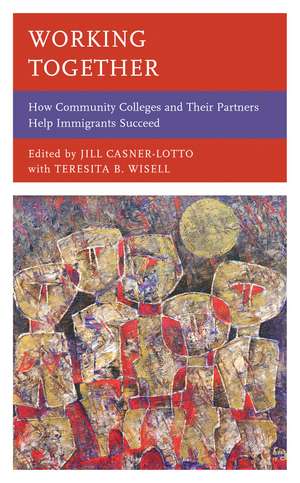
Working Together: How Community Colleges and Their Partners Help Immigrants Succeed
Editat de Jill Casner-Lotto Cu Teresita B. Wisellen Limba Engleză Paperback – oct 2019
This book focuses on two key components of successful immigrant and refugee integration: multisector partnerships that have been essential for increasing immigrant and refugee students' college and career readiness and assuring their transition to further education, training, or jobs; and strategies related to replicating and scaling best-practice models and the policy implications involved.
Preț: 283.29 lei
Preț vechi: 369.85 lei
-23%
Puncte Express: 425
Carte tipărită la comandă
Livrare economică 05-19 decembrie
Livrare prin curier în România Termenul estimat este afișat lângă disponibilitate.
Transport gratuit de la 400.00 lei Plată online sau ramburs, în funcție de opțiunile comenzii.
Retur gratuit în 14 zile Comandă securizată și suport în română.
Specificații
ISBN-13: 9781475852547
ISBN-10: 1475852541
Pagini: 160
Ilustrații: 2 b/w photos; 2 tables
Dimensiuni: 151 x 226 x 14 mm
Greutate: 0.27 kg
Editura: Bloomsbury Publishing
Colecția Rowman & Littlefield
Locul publicării:New York, United States
ISBN-10: 1475852541
Pagini: 160
Ilustrații: 2 b/w photos; 2 tables
Dimensiuni: 151 x 226 x 14 mm
Greutate: 0.27 kg
Editura: Bloomsbury Publishing
Colecția Rowman & Littlefield
Locul publicării:New York, United States
V-ar putea interesa
-
 Conversations with AcademicsCatheryn Khoo-LattimorePreț: 102.25 lei
 -
 Preț: 393.91 lei
 -
 RelaxDaniel J. SullivanPreț: 83.90 lei
 -
 Business and Fundamentals of Music ProductionTony M DofatPreț: 198.96 lei
 -
 College Prep 101 Second EditionMR Lance a. MillisPreț: 92.11 lei
 -
 The Pre-Med BibleAdam E. M. EltoraiPreț: 106.24 lei
 -
 LSAT 60 DissectedDan F. OakesPreț: 159.16 lei
 -
 Preț: 114.06 lei
 -
 Earn a Debt-Free College Degree!Cyrus VanoverPreț: 95.48 lei
 -
 Preț: 92.65 lei
 -
 Little Red Riding HoodDr Karlene a. RichardsonPreț: 91.33 lei
 -
 Conquering CollegeAustin Francis FadelyPreț: 84.94 lei
 -
 -26%Preț: 280.74 lei381.75 lei
 -
 -27%Preț: 279.71 lei383.35 lei
 -
 -24%Preț: 289.33 lei382.67 lei
 -
 -26%Preț: 216.24 lei292.02 lei
 -
 -23%Preț: 283.37 lei369.90 lei
 -
 -25%Preț: 216.37 lei290.36 lei
 -
 -23%Preț: 279.24 lei362.71 lei
 -
 Academic Writing: Process and ProductAndrew P. Johnson-24%Preț: 253.93 lei333.22 lei
 -
 -23%Preț: 280.25 lei363.34 lei
 -
 -26%Preț: 222.33 lei299.66 lei
 -
 -23%Preț: 283.56 lei370.03 lei
Cuprins
Foreword
Walter Bumphus, President and CEO, American Association of Community Colleges
Preface
Teresita B. Wisell, Vice President, Workforce Development and Community Education, and Executive Director, Community College Consortium for Immigrant Education, Westchester Community College
Acknowledgements
Introduction
Jill Casner-Lotto, Director, Community College Consortium for Immigrant Education, Westchester Community College
Part I: Meaningful, Multi-Sector Partnerships: Building a Community of Support On and Off Campus
Chapter 1: Foreign-Trained Talent for Local Jobs: The Skilled Immigrant Project at Howard Community College
Jeff Gross, Policy Consultant, World Education Services
Chapter 2: The Roots of Our Story: The Latino Leadership and College Experience Camp
Erin Howard, Director of Latino Outreach and Global Learning, and James Fenton, Associate Professor in Humanities, Bluegrass Community and Technical College
Chapter 3: Building Retail Career Pathways for the New American Workforce
Jennie Murray, Director, Integration Programs, and Ana Negoescu, Manager, Integration Programs, National Immigration Forum
Chapter 4: Empowering Student Scholars, Activists, and Advocates for Social Change
Jeannett Manzanero, Director, Dr. Kathryn W. Davis Global Education Center, Palm Beach State College
A Reflective Narrative: How Community Colleges Can Reframe the Immigration Narrative
Denzil Mohammed, Director, Public Education Institute, The Immigrant Learning Center
Part II: Scaling Our Initiatives: Strategies and Policy Implications for Program Replication and Building a Field
Chapter 5: Washington's I-DEA: Increasing Equity for English-Language Learners
Jodi Ruback, Program Administrator, William S. Durden, Policy Associate, and Jon Kerr, Director, Basic Education for Adults, Washington State Board for Community and Technical Colleges
Chapter 6: ALLIES-Partnerships That Promote English Learner Success in College, Career, and the Community
Jenny Castello, ESL Professor Emeritus, Cañada College, and ALLIES Board Member, and Ilse Pollett, Executive Director, ALLIES
Chapter 7: How Community Colleges Can Serve Immigrant Professionals
Jeff Gross, Policy Consultant, World Education Services
Chapter 8: Creating Career Pathways for All Oregonians
Kate Kinder, Career Pathways Director, and Marc Goldberg, Associate Vice President for Workforce Development and Community Education, Portland Community College
A Reflective Narrative: English Plus Integration: Shifting the Instructional Paradigm for Immigrant Adult Learners to Succeed
Margie McHugh, Director, and Catrina Doxsee, Research Assistant, National Center on Immigrant Integration Policy, Migration Policy Institute
Conclusion
Jill Casner-Lotto, Director, Community College Consortium for Immigrant Education, Westchester Community College
Afterword
Suzette Brooks Masters, Consultant on Immigration and Immigrant Integration Issues
About the Editors
About the Contributors
Index
Walter Bumphus, President and CEO, American Association of Community Colleges
Preface
Teresita B. Wisell, Vice President, Workforce Development and Community Education, and Executive Director, Community College Consortium for Immigrant Education, Westchester Community College
Acknowledgements
Introduction
Jill Casner-Lotto, Director, Community College Consortium for Immigrant Education, Westchester Community College
Part I: Meaningful, Multi-Sector Partnerships: Building a Community of Support On and Off Campus
Chapter 1: Foreign-Trained Talent for Local Jobs: The Skilled Immigrant Project at Howard Community College
Jeff Gross, Policy Consultant, World Education Services
Chapter 2: The Roots of Our Story: The Latino Leadership and College Experience Camp
Erin Howard, Director of Latino Outreach and Global Learning, and James Fenton, Associate Professor in Humanities, Bluegrass Community and Technical College
Chapter 3: Building Retail Career Pathways for the New American Workforce
Jennie Murray, Director, Integration Programs, and Ana Negoescu, Manager, Integration Programs, National Immigration Forum
Chapter 4: Empowering Student Scholars, Activists, and Advocates for Social Change
Jeannett Manzanero, Director, Dr. Kathryn W. Davis Global Education Center, Palm Beach State College
A Reflective Narrative: How Community Colleges Can Reframe the Immigration Narrative
Denzil Mohammed, Director, Public Education Institute, The Immigrant Learning Center
Part II: Scaling Our Initiatives: Strategies and Policy Implications for Program Replication and Building a Field
Chapter 5: Washington's I-DEA: Increasing Equity for English-Language Learners
Jodi Ruback, Program Administrator, William S. Durden, Policy Associate, and Jon Kerr, Director, Basic Education for Adults, Washington State Board for Community and Technical Colleges
Chapter 6: ALLIES-Partnerships That Promote English Learner Success in College, Career, and the Community
Jenny Castello, ESL Professor Emeritus, Cañada College, and ALLIES Board Member, and Ilse Pollett, Executive Director, ALLIES
Chapter 7: How Community Colleges Can Serve Immigrant Professionals
Jeff Gross, Policy Consultant, World Education Services
Chapter 8: Creating Career Pathways for All Oregonians
Kate Kinder, Career Pathways Director, and Marc Goldberg, Associate Vice President for Workforce Development and Community Education, Portland Community College
A Reflective Narrative: English Plus Integration: Shifting the Instructional Paradigm for Immigrant Adult Learners to Succeed
Margie McHugh, Director, and Catrina Doxsee, Research Assistant, National Center on Immigrant Integration Policy, Migration Policy Institute
Conclusion
Jill Casner-Lotto, Director, Community College Consortium for Immigrant Education, Westchester Community College
Afterword
Suzette Brooks Masters, Consultant on Immigration and Immigrant Integration Issues
About the Editors
About the Contributors
Index
Recenzii
Working Together is the second volume in this companion series, chronicling the importance of strategic partnerships to foster career success and community stewardship among immigrant populations at community colleges. Each chapter recounts the opportunities and challenges community colleges face as they "address emerging economic and workforce challenges" (p. 3) while supporting the diverse needs of immigrants who are navigating the communities where they live and work. This study details how community colleges are the fabric of their communities and can be used as a resource for immigrants as they adjust to new lives in the US. Contributors further emphasize that community colleges are well positioned to maintain innovative and multi-sector partnerships that include programmatic funding and training to help immigrants develop workforce skills. Importantly, the stories recounted here highlight the spectrum of immigrant students, from those learning foundational workforce skills to those who are highly educated and looking to transition into the American workforce. Case studies and practical advice encourage practitioners to sustain initiatives that will support academic and career success for immigrant populations, as the collection describes how to successfully replicate and scale immigrant initiatives. Summing Up: Recommended. All levels.
The Community College Consortium for Immigrant Education has provided a significant set of resources with the publication of the companion books, Working Towardan Equitable and Prosperous Future For All: How Community Colleges and Immigrants Are Changing America and Working Together: How Community Colleges and Their Partners Help Immigrants Succeed. Community colleges are the natural choice for immigrants to learn the skills needed to adapt to a new environment and to become successful contributors to American society and our economy. These companion books, written by experienced community college leaders, provide valuable information to assist our colleges to develop and strengthen programs for this important group of students.
These books offer deep insight into the most promising, innovative models for addressing barriers to economic opportunity for immigrants and English language learners and understanding how partnerships can help strengthen, sustain, and replicate this work. You could spend the next few years traveling across the country to meet these thought leaders and see their programs in action. Or you can acquire the knowledge from the frontlines in this two-volume compendium.
This publication highlights effective community college partnerships, policies and programs that support immigrant and refugee students. Community colleges across the country act as the bridge to the middle class and careers with economic mobility. Community college leaders committed to equitable student success can benefit greatly from the promising practices in this CCCIE publication, including the chapter on the Oregon Career Pathways framework.
As America's workforce continues to diversify, community colleges are a critical provider of skills and opportunities for immigrants and refugees seeking to realize their fullest potential. The expertise and vision found in the pages of Working Together: How Community Colleges and Their Partners Help Immigrants Succeed will improve training opportunities and, in the end, help our newest citizens reach their American dream.
Working Together: How Community Colleges and Their Partners Help Immigrants Succeed demonstrates how partnerships are crucial to strengthening communities and local and regional economies. The case studies demonstrate practical solutions to challenges--what makes programs and partnerships work, but also what hasn't worked and how to address challenges. We learn how campuses and communities recognize immigrants and refugees as valued assets, enhancing the diversity of college campuses and contributing to the cultural vibrancy of our communities.
In the 21st century global knowledge economy, the only ticket to a middle class and a prosperous life is a post-secondary degree. At community and state colleges across the country, innovative and trend-setting initiatives and partnerships are full force ahead to ensure all individuals succeed, especially those who are new to our country. This book highlights the unique role these partnerships play in the growth and development of our communities, so that everyone has access to an equitable and prosperous future.
The Community College Consortium for Immigrant Education has provided a significant set of resources with the publication of the companion books, Working Towardan Equitable and Prosperous Future For All: How Community Colleges and Immigrants Are Changing America and Working Together: How Community Colleges and Their Partners Help Immigrants Succeed. Community colleges are the natural choice for immigrants to learn the skills needed to adapt to a new environment and to become successful contributors to American society and our economy. These companion books, written by experienced community college leaders, provide valuable information to assist our colleges to develop and strengthen programs for this important group of students.
These books offer deep insight into the most promising, innovative models for addressing barriers to economic opportunity for immigrants and English language learners and understanding how partnerships can help strengthen, sustain, and replicate this work. You could spend the next few years traveling across the country to meet these thought leaders and see their programs in action. Or you can acquire the knowledge from the frontlines in this two-volume compendium.
This publication highlights effective community college partnerships, policies and programs that support immigrant and refugee students. Community colleges across the country act as the bridge to the middle class and careers with economic mobility. Community college leaders committed to equitable student success can benefit greatly from the promising practices in this CCCIE publication, including the chapter on the Oregon Career Pathways framework.
As America's workforce continues to diversify, community colleges are a critical provider of skills and opportunities for immigrants and refugees seeking to realize their fullest potential. The expertise and vision found in the pages of Working Together: How Community Colleges and Their Partners Help Immigrants Succeed will improve training opportunities and, in the end, help our newest citizens reach their American dream.
Working Together: How Community Colleges and Their Partners Help Immigrants Succeed demonstrates how partnerships are crucial to strengthening communities and local and regional economies. The case studies demonstrate practical solutions to challenges--what makes programs and partnerships work, but also what hasn't worked and how to address challenges. We learn how campuses and communities recognize immigrants and refugees as valued assets, enhancing the diversity of college campuses and contributing to the cultural vibrancy of our communities.
In the 21st century global knowledge economy, the only ticket to a middle class and a prosperous life is a post-secondary degree. At community and state colleges across the country, innovative and trend-setting initiatives and partnerships are full force ahead to ensure all individuals succeed, especially those who are new to our country. This book highlights the unique role these partnerships play in the growth and development of our communities, so that everyone has access to an equitable and prosperous future.