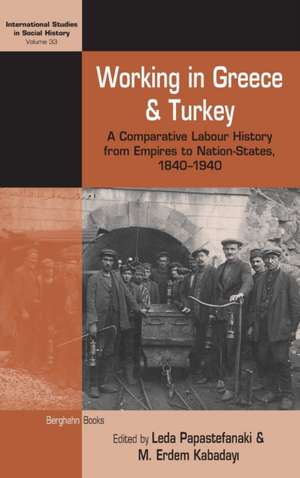
Working in Greece and Turkey: International Studies in Social History, cartea 33
Editat de Leda Papastefanaki, M. Erdem Kabaday¿en Limba Engleză Hardback – iul 2020
Din seria International Studies in Social History
-
 Preț: 251.97 lei
 -
 Preț: 261.63 lei
 - 23%
 Preț: 761.52 lei
 - 23%
 Preț: 775.69 lei
 - 23%
 Preț: 1017.80 lei
 - 23%
 Preț: 757.24 lei
 - 23%
 Preț: 759.82 lei
 - 23%
 Preț: 761.93 lei
 - 23%
 Preț: 761.56 lei
 - 23%
 Preț: 758.97 lei
 - 23%
 Preț: 755.53 lei
 - 23%
 Preț: 762.13 lei
 - 23%
 Preț: 759.81 lei
 -
 Preț: 165.16 lei
 -
 Preț: 268.94 lei
 - 23%
 Preț: 758.37 lei
 - 23%
 Preț: 844.58 lei
 - 23%
 Preț: 851.48 lei
 -
 Preț: 270.27 lei
 - 23%
 Preț: 772.96 lei
 -
 Preț: 263.72 lei
 - 23%
 Preț: 867.00 lei
 -
 Preț: 231.26 lei
 -
 Preț: 265.79 lei
 -
 Preț: 251.28 lei
 - 23%
 Preț: 758.37 lei
 -
 Preț: 266.66 lei
 - 23%
 Preț: 850.56 lei
 - 23%
 Preț: 760.17 lei
 - 23%
 Preț: 760.44 lei
 - 15%
 Preț: 479.61 lei
Preț: 1038.82 lei
Preț vechi: 1349.11 lei
-23%
Puncte Express: 1558
Carte tipărită la comandă
Livrare economică 04-18 decembrie
Livrare prin curier în România Termenul estimat este afișat lângă disponibilitate.
Transport gratuit pentru acest produs Plată online sau ramburs, în funcție de opțiunile comenzii.
Retur gratuit în 14 zile Comandă securizată și suport în română.
Specificații
ISBN-13: 9781789206968
ISBN-10: 1789206960
Pagini: 480
Dimensiuni: 157 x 235 x 30 mm
Greutate: 0.79 kg
Editura: BERGHAHN BOOKS
Colecția International Studies in Social History
Seria International Studies in Social History
ISBN-10: 1789206960
Pagini: 480
Dimensiuni: 157 x 235 x 30 mm
Greutate: 0.79 kg
Editura: BERGHAHN BOOKS
Colecția International Studies in Social History
Seria International Studies in Social History
Cuprins
List of Illustrations
Acknowledgements
Introduction and Historiographical Essay: Greek and Turkish Economic and Social History, and Labour History
Leda Papastefanaki and M. Erdem Kabadayi
Part I: Agrarian Property and Labour Relations, Rural and Urban Organization of Work
Chapter 1. Were Peasants Bound to the Soil in the Nineteenth-Century Balkans? A Reappraisal of the Question of the New/Second Serfdom in Ottoman Historiography
Alp Yücel Kaya
Chapter 2. The 'Invisible' Army of Greek Labourers
Christos Hadziiossif
Chapter 3. 'No Work for Anyone in this Country of Misery': Famine and Labour Relations in Mid-Nineteenth-Century Anatolia
Semih Çelik
Chapter 4. Rural Manufacturing in the Mid-Nineteenth-Century Ottoman Countryside: Textile Workers in Three Plovdiv Villages
Fatma Öncel
Chapter 5. Ethno-religious Division of Labour in Urban Economies of the Ottoman Empire in the Nineteenth Century
M. Erdem Kabadayi and Murat Güvenç
Download the Appendix here
Part II: Political Change, Migration, and Nationalisms
Chapter 6. Class Formation on the Modern Waterfront: Port Workers and Their Struggles in Late Ottoman Istanbul
Akin Sefer
Chapter 7. Labourers, Refugees, Revolutionaries: Ottoman Perceptions of Armenian Emigration
Sinan Dinçer
Chapter 8. The Greek Labour Movement and National Preference Demands, 1890-1922
Nikos Potamianos
Chapter 9. Refugees, Foreigners, Non-Muslims: Nationalism and Workers in the Silahtaraga Power Plant, 1914-24
Erol Ülker
Part III: Labour Market and Emotions in the Twentieth Century
Chapter 10. "Fatherly Interest...": Industrial Paternalism, Labour Management, and Gender in the Textile Mills of a Greek Island (Hermoupolis, Syros, 1900-1940)
Leda Papastefanaki
Chapter 11. The Changing Organization of Production and Modes of Control, and the Workers' Response: The Turkish Textile Industry in the 1940s and 50s
Baris Alp Özden
Chapter 12. 'It is Fair to Ask for the Improvement of Their Fate': The Demands, Mobilization, and the Political Orientation of the Press Workers and Printers of Patras, 1900-1940
Asimakis Palaiologos
Chapter 13. Children's Domestic Labour: Intimate Relations, Family Politics, and the Construction of Identity of Domestic Workers in Interwar Greece
Pothiti Hantzaroula
Epilogue
Leda Papastefanaki and M. Erdem Kabadayi
Index
Acknowledgements
Introduction and Historiographical Essay: Greek and Turkish Economic and Social History, and Labour History
Leda Papastefanaki and M. Erdem Kabadayi
Part I: Agrarian Property and Labour Relations, Rural and Urban Organization of Work
Chapter 1. Were Peasants Bound to the Soil in the Nineteenth-Century Balkans? A Reappraisal of the Question of the New/Second Serfdom in Ottoman Historiography
Alp Yücel Kaya
Chapter 2. The 'Invisible' Army of Greek Labourers
Christos Hadziiossif
Chapter 3. 'No Work for Anyone in this Country of Misery': Famine and Labour Relations in Mid-Nineteenth-Century Anatolia
Semih Çelik
Chapter 4. Rural Manufacturing in the Mid-Nineteenth-Century Ottoman Countryside: Textile Workers in Three Plovdiv Villages
Fatma Öncel
Chapter 5. Ethno-religious Division of Labour in Urban Economies of the Ottoman Empire in the Nineteenth Century
M. Erdem Kabadayi and Murat Güvenç
Download the Appendix here
Part II: Political Change, Migration, and Nationalisms
Chapter 6. Class Formation on the Modern Waterfront: Port Workers and Their Struggles in Late Ottoman Istanbul
Akin Sefer
Chapter 7. Labourers, Refugees, Revolutionaries: Ottoman Perceptions of Armenian Emigration
Sinan Dinçer
Chapter 8. The Greek Labour Movement and National Preference Demands, 1890-1922
Nikos Potamianos
Chapter 9. Refugees, Foreigners, Non-Muslims: Nationalism and Workers in the Silahtaraga Power Plant, 1914-24
Erol Ülker
Part III: Labour Market and Emotions in the Twentieth Century
Chapter 10. "Fatherly Interest...": Industrial Paternalism, Labour Management, and Gender in the Textile Mills of a Greek Island (Hermoupolis, Syros, 1900-1940)
Leda Papastefanaki
Chapter 11. The Changing Organization of Production and Modes of Control, and the Workers' Response: The Turkish Textile Industry in the 1940s and 50s
Baris Alp Özden
Chapter 12. 'It is Fair to Ask for the Improvement of Their Fate': The Demands, Mobilization, and the Political Orientation of the Press Workers and Printers of Patras, 1900-1940
Asimakis Palaiologos
Chapter 13. Children's Domestic Labour: Intimate Relations, Family Politics, and the Construction of Identity of Domestic Workers in Interwar Greece
Pothiti Hantzaroula
Epilogue
Leda Papastefanaki and M. Erdem Kabadayi
Index
Notă biografică
M. Erdem Kabadayi is an Associate Professor of Economic History and the History of Economic Thought at Koç University, Istanbul, Turkey.
Descriere
Provides an overdue exploration of labour history on both sides of the Aegean, before as well as after the fall of the Ottoman Empire. Deploying the approaches of global labour history as a framework, this volume presents transnational, transcontinental, and diachronic comparisons that illuminate the shared history of Greece and Turkey.