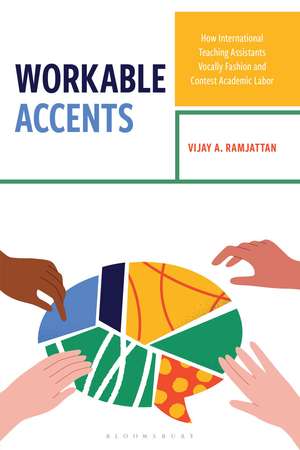
Workable Accents: How International Teaching Assistants Vocally Fashion and Contest Academic Labor
Autor Vijay A. Ramjattanen Limba Engleză Hardback – 18 sep 2025
In this book, "workable" refers not only to manipulating an accent, but also to ensuring that an accent achieves certain objectives such as being perceived as an intelligible speaker, an expert educator, and an acceptable worker. Drawing on commentaries from ITAs working in Canadian universities, Vijay A. Ramjattan highlights how crafting a workable accent is not an apolitical endeavor, but rather a practice that works within and against the various communicative affordances of neoliberal academia. Just as it can involve fashioning one's voice to satisfy oppressive communication norms, a workable accent can also contest these norms to varying degrees. Ramjattan ultimately demonstrates that (academic) institutions must do a better job at addressing how vocally marginalized workers are heard at work.
Preț: 524.43 lei
Preț vechi: 738.52 lei
-29%
Puncte Express: 787
Carte tipărită la comandă
Livrare economică 07-21 decembrie
Livrare prin curier în România Termenul estimat este afișat lângă disponibilitate.
Transport gratuit pentru acest produs Plată online sau ramburs, în funcție de opțiunile comenzii.
Retur gratuit în 14 zile Comandă securizată și suport în română.
Specificații
ISBN-13: 9781666958331
ISBN-10: 1666958336
Pagini: 184
Dimensiuni: 158 x 232 x 20 mm
Greutate: 0.84 kg
Editura: Bloomsbury Publishing
Colecția Bloomsbury Academic
Locul publicării:New York, United States
ISBN-10: 1666958336
Pagini: 184
Dimensiuni: 158 x 232 x 20 mm
Greutate: 0.84 kg
Editura: Bloomsbury Publishing
Colecția Bloomsbury Academic
Locul publicării:New York, United States
V-ar putea interesa
-
 AccentHelen AshtonPreț: 123.67 lei
 -
 -18%Preț: 93.51 lei114.52 lei
 -
 Preț: 114.43 lei
 -
 Race, Empire, and English Language TeachingSuhanthie MothaPreț: 344.88 lei
 -
 Get Rid of Your AccentLinda JamesPreț: 172.07 lei
 -
 -5%Preț: 347.69 lei365.99 lei
 -
 Preț: 182.50 lei
 -
 Preț: 386.30 leiRecomandat
 -
 The Accent Handbook: A Practical Guide to Learning AccentsJessica Hammett-10%Preț: 148.38 lei164.96 lei
 -
 -26%Preț: 207.35 lei279.92 lei
 -
 -9%Preț: 113.10 lei124.79 lei
 -
 Speaking with SkillDudley Knight-26%Preț: 222.37 lei299.13 lei
 -
 Lessons in DragKareem KhubchandaniPreț: 159.98 lei
 -
 -23%Preț: 161.03 lei210.44 lei
 -
 OracyNeil MercerPreț: 135.90 lei
 -
 The Crip Linguistics ReaderOctavian Robinson-11%Preț: 468.16 lei526.03 lei
 -
 Always an Academic Immigrant: A Collective MemoirDafna LemishPreț: 190.70 lei
 -
 Preț: 259.68 lei
 -
 International Academic StaffKendall Richards-18%Preț: 806.20 lei983.17 lei
Cuprins
Acknowledgments
Introduction
Chapter 1: Theorizing Workable Accents
Chapter 2: Achieving and Expanding Intelligibility
Chapter 3: Displaying and Creating Expertise
Chapter 4: Being Acceptable to Others and Oneself
Chapter 5: Workable Accents and (International Teaching Assistant) Work
Conclusion
References
Index
About the Author
Introduction
Chapter 1: Theorizing Workable Accents
Chapter 2: Achieving and Expanding Intelligibility
Chapter 3: Displaying and Creating Expertise
Chapter 4: Being Acceptable to Others and Oneself
Chapter 5: Workable Accents and (International Teaching Assistant) Work
Conclusion
References
Index
About the Author
Recenzii
With this book, Ramjattan establishes himself as the leading thinker on accentism in educational linguistics and beyond. Not only does this book bring together utterly pressing matters of political economy, higher education, racialization, and labour consciousness, it provides strategies for casting off oppressive models around what makes a good teacher. By listening closely to teachers of various multilingual competencies, Ramjattan undoes allegedly common-sense notions around how and when accent is assessed and assessible, identifies precisely how it is used as supremacist wedge to keep people down and out of power, and discerns what schools and universities need to do to provide a truly just workplace for all. In a moment inclined toward cynical impulses and reactionary dread, this is instead a book driven by justice, commitment, attentiveness, respect for people, and clarity of educational purpose.