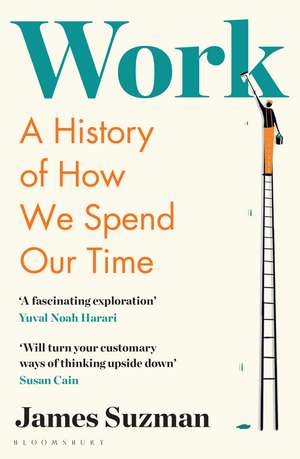
Work: A History of How We Spend Our Time
Autor James Suzmanen Limba Engleză Paperback – 2 sep 2021
Știați că pentru 95% din istoria umanității, munca nu a reprezentat axa centrală a existenței noastre? În Work, antropologul James Suzman ne provoacă să regândim fundamental modul în care ne ocupăm timpul. Analizând parcursul speciei de la originile vieții până la era automatizării, autorul demonstrează că obsesia noastră actuală pentru productivitate este o anomalie istorică. Găsim în această carte o explicație riguroasă a modului în care munca a ajuns să ne modeleze valorile, statutul social și chiar biologia, deși trăim într-o eră a abundenței materiale fără precedent. Reținem perspectiva unică a lui Suzman, care își extrage autoritatea din studiul direct al populațiilor de vânători-culegători, oferind o critică pertinentă a economiei moderne. Ca și Jan Lucassen în The Story of Work, autorul distilează experiență reală în principii acționabile, însă Suzman pune un accent mai puternic pe lentila antropologică pentru a demonta mitul deficitului de resurse. Această lucrare continuă și aprofundează temele explorate în Affluence Without Abundance, unde James Suzman analiza lecțiile pe care societățile marginalizate le pot preda lumii industrializate. Recomandăm acest volum celor care doresc să înțeleagă de ce, în ciuda progresului tehnologic, muncim mai mult ca niciodată și cum ne putem recupera autonomia asupra timpului nostru.
Preț: 71.66 lei
Preț vechi: 95.03 lei
-25%
Carte disponibilă
Livrare economică 13-27 noiembrie
Livrare express 29 octombrie-04 noiembrie pentru 50.95 lei
Specificații
ISBN-10: 1526605023
Pagini: 464
Dimensiuni: 130 x 196 x 34 mm
Greutate: 0.38 kg
Editura: Bloomsbury Publishing
Colecția Bloomsbury Publishing
Locul publicării:London, United Kingdom
V-ar putea interesa
-
 Preț: 192.29 lei
 -
 Preț: 191.97 lei
 -
 In Europe's ShadowRobert D. Kaplan-20%Preț: 65.48 lei81.85 lei
 -
 Killing the LegendsBill O' ReillyPreț: 164.82 lei
 -
 Saving My AssassinVirginia ProdanPreț: 102.99 lei
 -
 Vlad the ImpalerHourly HistoryPreț: 62.74 lei
 -
 A Novel to Read on the TrainDumitru TsepeneagPreț: 93.05 lei
 -
 Into the CarpathiansAlan E. SparksPreț: 117.59 lei
 -
 Preț: 110.30 lei
 -
 Preț: 204.67 lei
 -
 Lost AirmenCharles E. Stanley-22%Preț: 123.03 lei157.26 lei
 -
 Preț: 106.20 lei
 -
 Preț: 491.95 lei
 -
 Environment and Society in Byzantium, 650-1150Alexander Olson-18%Preț: 699.22 lei852.71 lei
 -
 The Making of MămăligăAlex Drace-FrancisPreț: 180.32 lei
De ce să citești această carte
Dacă simțiți că echilibrul dintre viață și profesie este rupt, Work vă va oferi contextul istoric necesar pentru a înțelege de ce. Cititorul câștigă o perspectivă eliberatoare: munca, așa cum o cunoaștem, nu este un destin biologic, ci o construcție socială. Este lectura ideală pentru cei care vor să anticipeze impactul automatizării asupra identității umane și să descopere modele alternative de organizare a vieții, inspirate din istoria profundă a umanității.
Despre autor
James Suzman este un antropolog de renume, specialist în populațiile Khoisan din sudul Africii, a cărui carieră s-a concentrat pe intersecția dintre economie, istorie și antropologie. A deținut prestigioasa bursă Smuts Commonwealth la Universitatea Cambridge și în prezent conduce Anthropos Ltd, un grup de reflecție ce aplică metode antropologice pentru rezolvarea problemelor socio-economice contemporane. Experiența sa vastă, care include consultanță pentru Banca Mondială și Comisia Europeană, îi permite să abordeze tema muncii nu doar ca teoretician, ci ca un fin observator al dinamicii umane globale.
Descriere
'A fascinating exploration that challenges our basic assumptions of what work means' - Yuval Noah Harari
'There is eminently underlinable stuff on most pages ... Fascinating' - The Times
'One of those few books that will turn your customary ways of thinking upside down' - Susan Cain
'Illuminating' - New Statesman
_______________
A revolutionary new history of humankind through the prism of work, from the origins of life on Earth to our ever more automated present
The work we do brings us meaning, moulds our values, determines our social status and dictates how we spend most of our time. But this wasn't always the case: for 95% of our species' history, work held a radically different importance.
How, then, did work become the central organisational principle of our societies? How did it transform our bodies, our environments, our views on equality and our sense of time? And why, in a time of material abundance, are we working more than ever before?
Recenzii
There is eminently underlinable stuff on most pages . . . Fascinating
In this illuminating "deep history", the anthropologist James Suzman interrogates mainstream economic assumptions about human nature and argues that to make sense of our modern culture of rising inequality we must first understand our past
For too long, our notions of work have been dominated by economists obsessed with scarcity and productivity. As an anthropologist, James Suzman is here to change that. He reveals that for much of human history, hunter-gathers worked far less than we do today and led lives of abundance and leisure. I've been studying work for two decades, and I can't remember the last time I learned so much about it in one sitting. This book is a tour de force
A groundbreaking history of work, which exposes the productivity-at-all-costs mindset to strike a blow at the myth of the economic problem. I learned something new on every page
Brilliant . I thought I had read enough by now to know what work is and why we so often feel compelled to work - but I was wrong
Deeply researched, broad in scope and filled with insight, this is a modern classic. Every page brings something worth thinking hard about
Automation of all kinds looms on the horizon. Luckily, James Suzman is here with a revelatory new history that makes a persuasive case: that human industry can light a path forward, even in a future where we're put out of work by our own inventions
Chronicles how much humankind can still learn from the disappearing way of life of the most marginalised communities on earth
Elegant and absorbing . Rich with ethnographic detail, stylish, perceptive, compassionate and, ultimately, tragic
Here is one of those few books that will turn your customary ways of thinking upside down. An incisive and original new history that invites us to rethink our relationship with work - and to reimagine what it means to be human in an ever-more automated future