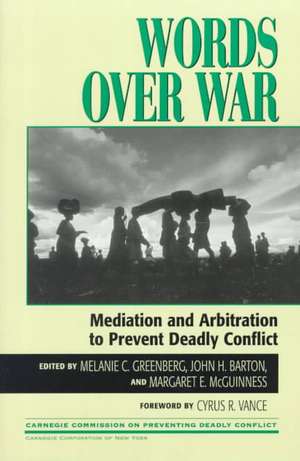
Words Over War: Mediation and Arbitration to Prevent Deadly Conflict: Carnegie Commission on Preventing Deadly Conflict
Editat de Melanie Greenberg, John H. Barton, Margaret E. McGuinness Contribuţii de William J. Bien, Peter Bouckaert, Alan Hanson, Arthur Khachikian, Kevin King, Mark Laudy, Tali Levy, Barbara Messing, Joel Stettenheim, Rock Tang, Erika Weinthalen Limba Engleză Paperback – 12 ian 2000
Preț: 368.69 lei
Preț vechi: 465.59 lei
-21%
Puncte Express: 553
Carte tipărită la comandă
Livrare economică 08-22 decembrie
Livrare prin curier în România Termenul estimat este afișat lângă disponibilitate.
Transport gratuit de la 400.00 lei Plată online sau ramburs, în funcție de opțiunile comenzii.
Retur gratuit în 14 zile Comandă securizată și suport în română.
Specificații
ISBN-13: 9780847698936
ISBN-10: 0847698939
Pagini: 499
Dimensiuni: 146 x 226 x 32 mm
Greutate: 0.62 kg
Ediția:0560
Editura: Bloomsbury Publishing
Colecția Rowman & Littlefield
Seria Carnegie Commission on Preventing Deadly Conflict
Locul publicării:New York, United States
ISBN-10: 0847698939
Pagini: 499
Dimensiuni: 146 x 226 x 32 mm
Greutate: 0.62 kg
Ediția:0560
Editura: Bloomsbury Publishing
Colecția Rowman & Littlefield
Seria Carnegie Commission on Preventing Deadly Conflict
Locul publicării:New York, United States
V-ar putea interesa
-
 -26%Preț: 399.39 lei537.06 lei
 -
 -31%Preț: 1002.10 lei1450.67 lei
 -
 The Making of International LawAlan Boyle-22%Preț: 512.62 lei654.18 lei
 -
 -21%Preț: 524.09 lei659.92 lei
 -
 -28%Preț: 521.87 lei726.59 lei
 -
 The Responsibility of States for International CrimesNina H. B. Jørgensen-27%Preț: 367.34 lei501.99 lei
 -
 Transatlantic Economic Disputes: The EU, the US, and the WTOErnst-Ulrich Petersmann-28%Preț: 506.13 lei701.78 lei
 -
 -19%Preț: 404.77 lei502.37 lei
 -
 Governance EcosystemsJ. SagebienPreț: 413.28 lei
 -
 The Policy Process in International Environmental GovernanceS. Aggarwal-KhanPreț: 402.67 lei
 -
 Preț: 285.57 lei
 -
 Neoliberalism in CrisisHenk OverbeekPreț: 404.26 lei
 -
 Justifying Interventions in AfricaN. WilénPreț: 405.27 lei
 -
 Nationalism and Human RightsG. ChengPreț: 387.15 lei
 -
 Preț: 464.26 lei
 -
 International Development PolicyGraduate Institute of International and Development Studies-15%Preț: 508.89 lei598.69 lei
 -
 GovernanceR. Theiselmann-15%Preț: 674.85 lei793.94 lei
 -
 Preț: 399.99 lei
Cuprins
Chapter 1 Introduction: Background and Analytical Perspectives
Part 2 Part One: Separation of Nations
Chapter 3 Multilateral Mediation in Intrastate Conflicts: Russia, the United Nations, and the War in Abkhazia
Chapter 4 From Lisbon to Dayton: International Mediation and the Bosnia Crisis
Chapter 5 Croatian Independence from Yugoslavia, 1991-1992
Chapter 6 The Oslo Channel: Benefits of a Neutral Facilitator to Secret Negotiations
Part 7 Part Two: Integration of Nations
Chapter 8 The 1991 Cambodia Settlement Agreements
Chapter 9 El Salvador
Chapter 10 The Role of Mediation in the Northern Ireland Peace Process
Chapter 11 The Arusha Accords and the Failure of International Intervention in Rwanda
Chapter 12 South Africa: The Negotiated Transition from Apartheid to Nonracial Democracy
Part 13 Part Three: Intermediation in Noncivil Conflicts
Chapter 14 Making Waves: Third Parties and International Mediation in the Aral Sea Basin
Chapter 15 The Vatican Mediation of the Beagle Channel Dispute: Crisis Intervention and Forum-Building
Chapter 16 The North Korean Nuclear Proliferation Crisis
Part 17 Part Four: Conclusion
Chapter 18 Lessons of the Case Studies for International Mediation and Arbitration to Prevent Deadly Conflict
Part 2 Part One: Separation of Nations
Chapter 3 Multilateral Mediation in Intrastate Conflicts: Russia, the United Nations, and the War in Abkhazia
Chapter 4 From Lisbon to Dayton: International Mediation and the Bosnia Crisis
Chapter 5 Croatian Independence from Yugoslavia, 1991-1992
Chapter 6 The Oslo Channel: Benefits of a Neutral Facilitator to Secret Negotiations
Part 7 Part Two: Integration of Nations
Chapter 8 The 1991 Cambodia Settlement Agreements
Chapter 9 El Salvador
Chapter 10 The Role of Mediation in the Northern Ireland Peace Process
Chapter 11 The Arusha Accords and the Failure of International Intervention in Rwanda
Chapter 12 South Africa: The Negotiated Transition from Apartheid to Nonracial Democracy
Part 13 Part Three: Intermediation in Noncivil Conflicts
Chapter 14 Making Waves: Third Parties and International Mediation in the Aral Sea Basin
Chapter 15 The Vatican Mediation of the Beagle Channel Dispute: Crisis Intervention and Forum-Building
Chapter 16 The North Korean Nuclear Proliferation Crisis
Part 17 Part Four: Conclusion
Chapter 18 Lessons of the Case Studies for International Mediation and Arbitration to Prevent Deadly Conflict
Recenzii
Words over War is part of the important series of books and reports sponsored by the Carnegie Commission on Preventing Deadly Conflict. The book is a welcome addition to the study of conflict prevention and dispute resolution.
The case studies in this volume discuss at length the changing international arena and the role of the international community in mediating deadly conflict. The studies represent a fascinating cross section of conflict in the post-Cold War era. . . . Only by studying different forms of mediation, and at the same time by comparing controlled variables, can we begin to understand how to make mediation more effective and how to use it in our arsenal of tools for preventing deadly conflict. . . . I sincerely hope that this volume will inspire future mediators in their search for peace and reconciliation.
The case studies in this volume discuss at length the changing international arena and the role of the international community in mediating deadly conflict. The studies represent a fascinating cross section of conflict in the post-Cold War era. . . . Only by studying different forms of mediation, and at the same time by comparing controlled variables, can we begin to understand how to make mediation more effective and how to use it in our arsenal of tools for preventing deadly conflict. . . . I sincerely hope that this volume will inspire future mediators in their search for peace and reconciliation.