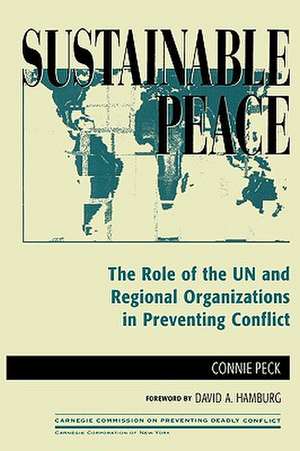
Sustainable Peace: The Role of the UN and Regional Organizations in Preventing Conflict: Carnegie Commission on Preventing Deadly Conflict
Autor Connie Peck Cuvânt înainte de David A. Hamburg, M.D.en Limba Engleză Paperback – 26 mar 1998
Preț: 383.43 lei
Preț vechi: 537.48 lei
-29%
Puncte Express: 575
Carte tipărită la comandă
Livrare economică 08-22 iunie
Specificații
ISBN-13: 9780847685615
ISBN-10: 0847685616
Pagini: 320
Dimensiuni: 154 x 228 x 23 mm
Greutate: 0.59 kg
Ediția:New.
Editura: Bloomsbury Publishing
Colecția Rowman & Littlefield
Seria Carnegie Commission on Preventing Deadly Conflict
Locul publicării:New York, United States
ISBN-10: 0847685616
Pagini: 320
Dimensiuni: 154 x 228 x 23 mm
Greutate: 0.59 kg
Ediția:New.
Editura: Bloomsbury Publishing
Colecția Rowman & Littlefield
Seria Carnegie Commission on Preventing Deadly Conflict
Locul publicării:New York, United States
V-ar putea interesa
-
 Emergency Sex (And Other Desperate Measures)Andrew Thomson-21%Preț: 80.28 lei101.72 lei
 -
 Imperfect Unions: Security Institutions Over Time and SpaceHelga Haftendorn-31%Preț: 470.92 lei682.12 lei
 -
 -23%Preț: 459.56 lei600.37 lei
 -
 Challenges for the New PeacekeepersTrevor Findlay-15%Preț: 285.43 lei334.71 lei
 -
 Peace, Security, and Conflict Prevention: SIPRI-UNESCO HandbookStockholm International Peace Research Institute-26%Preț: 325.36 lei440.44 lei
 -
 -14%Preț: 506.57 lei589.03 lei
 -
 -9%Preț: 319.75 lei351.00 lei
 -
 The Kosovo Report: Conflict, International Response, Lessons LearnedIndependent International Commission on Kosovo-37%Preț: 644.10 lei1027.69 lei
 -
 The UNHCR and World Politics: A Perilous PathGil Loescher-34%Preț: 521.59 lei787.25 lei
 -
 -18%Preț: 443.53 lei540.96 lei
 -
 -14%Preț: 317.65 lei369.05 lei
 -
 The Oxford Handbook on the United NationsThomas G. Weiss-12%Preț: 271.38 lei307.67 lei
 -
 -50%Preț: 389.32 lei783.29 lei
 -
 -31%Preț: 358.31 lei516.03 lei
 -
 -14%Preț: 453.81 lei526.34 lei
 -
 The European Union and Multilateral GovernanceHans Bruyninckx-15%Preț: 623.27 lei733.25 lei
 -
 Secretary or General?: The UN Secretary-General in World PoliticsSimon ChestermanPreț: 280.55 lei
 -
 The Thin Blue LineConor FoleyPreț: 166.82 lei
Cuprins
Chapter 1 Foreword by David A. Hamburg
Part 2 Part I. Contemporary Conflict and Sustainable Peace
Chapter 3 The Second Half of the Twentieth Century
Chapter 4 The Goal of Sustainable Peace
Chapter 5 Diagnosing Contemporary Conflict
Chapter 6 Finding Structural Solutions to Conflict
Part 7 Part II. The Role of the UN, Regional Organizations, and NGOs in Promoting Sustainable Peace
Chapter 8 The United Nations
Chapter 9 The Council of Europe
Chapter 10 The Organization for Security and Cooperation in Europe
Chapter 11 The Organization of American States
Chapter 12 The Organization of African Unity
Chapter 13 The Association of Southeast Asian Nations
Chapter 14 The Developing Role of Nongovernmental Organizations
Part 15 Part III. Organizing for Sustainable Peace
Chapter 16 Sharing Responsibility in Conflict Prevention
Chapter 17 Regional Centers for Sustainable Peace
Chapter 18 The First Half of the Twenty-first Century: Promoting Good Governance Regionally and Internationally
Part 2 Part I. Contemporary Conflict and Sustainable Peace
Chapter 3 The Second Half of the Twentieth Century
Chapter 4 The Goal of Sustainable Peace
Chapter 5 Diagnosing Contemporary Conflict
Chapter 6 Finding Structural Solutions to Conflict
Part 7 Part II. The Role of the UN, Regional Organizations, and NGOs in Promoting Sustainable Peace
Chapter 8 The United Nations
Chapter 9 The Council of Europe
Chapter 10 The Organization for Security and Cooperation in Europe
Chapter 11 The Organization of American States
Chapter 12 The Organization of African Unity
Chapter 13 The Association of Southeast Asian Nations
Chapter 14 The Developing Role of Nongovernmental Organizations
Part 15 Part III. Organizing for Sustainable Peace
Chapter 16 Sharing Responsibility in Conflict Prevention
Chapter 17 Regional Centers for Sustainable Peace
Chapter 18 The First Half of the Twenty-first Century: Promoting Good Governance Regionally and Internationally
Recenzii
This is a vitally important contribution to the debate about preventive diplomacy, early responses to incipient violent conflict, and medium- to long-term peace-building and peacemaking processes.
A thoroughly informative, indeed, a dazzling tour d'horizon of new regional actors in preventive diplomacy.
...containing as it does a wealth of valuable and interesting information for the student of conflict and conflict prevention.
Provides, first, a well-informed and down-to-earth macro-level analysis of the non-coercive conflict prevention mechanisms that are already operating in different parts of the world, and, secondly, a useful synthesis of those uncoordinated mechanisms in the form of a concrete institutional proposal. Peck should be congratulated for this valuable contribution to the conflict prevention literature.
This book is an instance of peace research, and a very good one, too.
This is a very comprehensive survey of the existing organizations working to build sustainable peace. A network of interlocking institutions would indeed be an excellent way of building capacity and institutionalizing knowledge and practice of conflict prevention.
A thoroughly informative, indeed, a dazzling tour d'horizon of new regional actors in preventive diplomacy.
...containing as it does a wealth of valuable and interesting information for the student of conflict and conflict prevention.
Provides, first, a well-informed and down-to-earth macro-level analysis of the non-coercive conflict prevention mechanisms that are already operating in different parts of the world, and, secondly, a useful synthesis of those uncoordinated mechanisms in the form of a concrete institutional proposal. Peck should be congratulated for this valuable contribution to the conflict prevention literature.
This book is an instance of peace research, and a very good one, too.
This is a very comprehensive survey of the existing organizations working to build sustainable peace. A network of interlocking institutions would indeed be an excellent way of building capacity and institutionalizing knowledge and practice of conflict prevention.