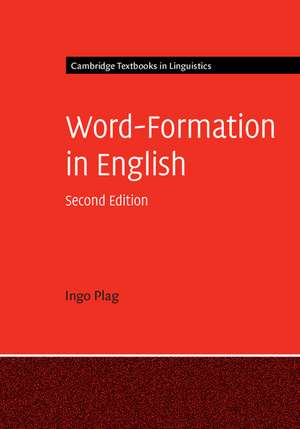
Word-Formation in English: Cambridge Textbooks in Linguistics
Autor Ingo Plagen Limba Engleză Paperback – 31 aug 2018
În procesul de studiu al lingvisticii moderne, accesul la resurse digitale și metodologii bazate pe date este esențial. Word-Formation in English se remarcă prin introducerea utilizării noilor corpora de texte și a bazelor de date actualizate, oferind cititorului algoritmi computaționali de ultimă generație pentru modelarea morfologiei. Această abordare practică transformă studiul teoretic într-o experiență de analiză aplicată. Recomandăm acest volum din seria Cambridge Textbooks in Linguistics pentru modul riguros în care este structurat. Ingo Plag ghidează cititorul de la concepte fundamentale, precum distincția dintre inflexiune și derivare, până la mecanisme complexe de productivitate și afixare. Organizarea capitolulul de „Productivitate și lexiconul mental” este deosebit de utilă, explorând modul în care restricțiile pragmatice și structurale modelează limba engleză contemporană. În contextul operei sale, această ediție revizuită rafinează temele explorate în Morphological Productivity, făcând trecerea de la cercetarea pur empirică la un instrument didactic accesibil. Credem că acest manual completează excelent titlul English Word-Formation de Laurie Bauer. În timp ce lucrarea lui Bauer oferă o perspectivă istorică și teoretică asupra dezbaterilor din domeniu, volumul lui Ingo Plag aduce un plus de rigoare metodologică prin exercițiile practice și accentul pus pe instrumentele de analiză digitală. Este o resursă care nu doar descrie formarea cuvintelor, ci învață studentul cum să identifice singur regulile morfologice într-un set de date necunoscut.



Preț: 391.70 lei
Carte tipărită la comandă
Livrare economică 07-21 decembrie
Livrare express 31 octombrie-06 noiembrie pentru 63.76 lei
Specificații
ISBN-10: 1316623297
Pagini: 258
Ilustrații: 39 b/w illus. 36 tables
Dimensiuni: 189 x 246 x 15 mm
Greutate: 0.51 kg
Ediția:Revizuită
Editura: Cambridge University Pr.
Seria Cambridge Textbooks in Linguistics
Locul publicării:Cambridge, United Kingdom
V-ar putea interesa
-
 The Oxford Reference Guide to English MorphologyLaurie Bauer-28%Preț: 421.51 lei588.10 lei
 -
 Bedders, Bulldogs and BedellsFrank StubbingsPreț: 229.48 lei
 -
 African American SlangMaciej Widawski-14%Preț: 730.17 lei849.04 lei
 -
 Learning to Read across Languages and Writing SystemsLudo Verhoeven-14%Preț: 924.10 lei1074.54 lei
 -
 English Politeness and ClassSara Mills-14%Preț: 781.16 lei908.32 lei
 -
 The Study of Word Stress and AccentRob Goedemans-31%Preț: 729.14 lei1050.94 lei
 -
 Standardising EnglishLinda Pillière-33%Preț: 623.92 lei929.37 lei
 -
 Language in Immigrant AmericaDominika BaranPreț: 251.42 lei
 -
 An Areal Typology of Agreement SystemsRanko Matasović-48%Preț: 484.99 lei930.50 lei
 -
 Fixing EnglishAnne CurzanPreț: 311.89 lei
 -
 -9%Preț: 708.19 lei778.23 lei
 -
 La Parole de L'AutreVignali, Cristina-19%Preț: 437.51 lei540.13 lei
 -
 Politics of Cross-Cultural ReadingMarion Dalvai-23%Preț: 538.18 lei698.94 lei
 -
 Les Modeles Latins Des Cent Nouvelles NouvellesRaphael Zehnder-23%Preț: 560.34 lei727.72 lei
 -
 -27%Preț: 785.60 lei1076.17 lei
 -
 -9%Preț: 849.66 lei933.70 lei
 -
 Morphological ProductivityIngo Plag-23%Preț: 1038.59 lei1348.83 lei
 -
 Creolization and Language ChangeIngo Plag-23%Preț: 879.76 lei1142.55 lei
 -
 -23%Preț: 1284.61 lei1668.33 lei
 -
 The Structure of Creole WordsIngo Plag-23%Preț: 1120.57 lei1455.28 lei
De ce să citești această carte
Această carte este ideală pentru studenții la filologie sau lingvistică care doresc să stăpânească mecanismele prin care limba engleză generează termeni noi. Veți câștiga nu doar cunoștințe teoretice, ci și abilități practice de utilizare a corpora-urilor de date și a algoritmilor de analiză. Este un ghid pas cu pas care transformă morfologia dintr-o disciplină abstractă într-un instrument de lucru concret.
Despre autor
Ingo Plag este profesor de lingvistică engleză în cadrul Departamentului de Lingvistică, Literatură și Studii Media de la Universitatea din Siegen. Expertiza sa vastă în domeniul morfologiei este reflectată în lucrări de referință precum Introduction to English Linguistics și Word Knowledge and Word Usage. Cercetările sale se concentrează pe integrarea metodelor empirice și experimentale în studiul limbii, autorul fiind recunoscut pentru capacitatea de a sintetiza teorii lingvistice complexe în formate didactice accesibile studenților de la nivel universitar.