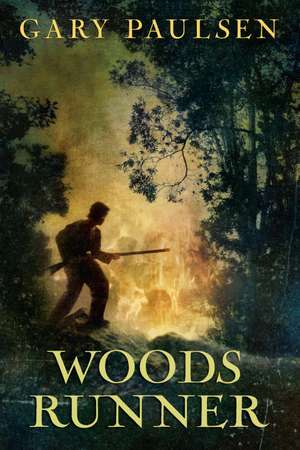
Woods Runner
Autor Gary Paulsenen Limba Engleză Paperback – 11 ian 2011 – vârsta de la 12 ani
Apreciem modul în care Woods Runner reușește să transforme o lecție de istorie într-o experiență viscerală de supraviețuire. Atmosfera amintește de Patriots, Redcoats and Spies, dar în timp ce acea lucrare se concentrează pe misiuni de spionaj și aventură, mizele lui Samuel sunt mult mai personale și brutale, fiind centrate pe salvarea părinților săi dintr-un peisaj devastat de conflict. Observăm o maturitate remarcabilă în abordarea lui Gary Paulsen, care nu menajează tânărul cititor, prezentând războiul nu ca pe o aventură glorioasă, ci ca pe o tragedie umană plină de confuzie și pierderi. Perspectiva este unică: un băiat de 13 ani care cunoaște pădurea mai bine decât lumea oamenilor civilizați este forțat să navigheze prin haosul creat de soldații britanici și triburile Iroquois. Tonul este alert, ritmul fiind dictat de urgența căutării, dar și de momente de tăcere tensionată în inima naturii. Suntem de părere că această lucrare se integrează perfect în bibliografia autorului, făcând puntea între memoriile sale despre creșterea în sălbăticie din Gone to the Woods: A True Story of Growing Up in the Wild și ficțiunea istorică dură din Soldier's Heart. Dacă în seria Hatchet supraviețuirea era o luptă împotriva elementelor naturii, aici Gary Paulsen adaugă elementul imprevizibil al cruzimii umane, oferind o perspectivă istorică documentată, completată de secțiuni informative care explică contextul real al evenimentelor de la 1776.
Preț: 61.33 lei
Carte disponibilă
Livrare economică 09-23 noiembrie
Specificații
ISBN-10: 037585908X
Pagini: 176
Dimensiuni: 139 x 209 x 15 mm
Greutate: 0.15 kg
Editura: RANDOM HOUSE CHILDREN'S BOOKS
V-ar putea interesa
-
 Mark of the Plague (A Blackthorn Key adventure)Kevin SandsPreț: 50.08 lei
 -
 The Endless SteppeEsther Hautzig-19%Preț: 53.02 lei65.06 lei
 -
 The Mighty Miss MaloneChristopher Paul CurtisPreț: 96.02 lei
 -
 NightjohnGary Paulsen-21%Preț: 38.36 lei48.68 lei
 -
 SarnyGary PaulsenPreț: 42.72 lei
 -
 Soldier's HeartGary PaulsenPreț: 41.10 lei
 -
 Caught by the SeaGary PaulsenPreț: 30.51 lei
 -
 The MonumentGary PaulsenPreț: 38.67 lei
 -
 Alligator BayouDonna Jo NapoliPreț: 89.04 lei
 -
 The Bamboo SwordMargi PreusPreț: 61.37 lei
 -
 The ForeshadowingMarcus Sedgwick-25%Preț: 55.28 lei73.22 lei
 -
 The Girl in the Blue CoatMonica Hesse-33%Preț: 43.83 lei65.38 lei
 -
 The Catacombs of Chaos A Lottie Lipton AdventureDan Metcalf-41%Preț: 26.12 lei44.00 lei
 -
 The Eagle of Rome A Lottie Lipton AdventureDan Metcalf-41%Preț: 30.26 lei51.68 lei
 -
 Paper HeartsMeg WiviottPreț: 84.02 lei
 -
 Just a Drop of WaterKerry O'Malley CerraPreț: 87.11 lei
 -
 How Angel Peterson Got His Name Large PrintGary PaulsenPreț: 101.95 lei
De ce să citești această carte
Recomandăm această carte părinților care caută un roman istoric autentic pentru copii de peste 12 ani. Cititorul va câștiga o înțelegere profundă a sacrificiilor făcute în timpul Războiului de Independență american, învățând despre reziliență și curaj moral. Este un instrument educativ excelent care umanizează datele istorice prin ochii unui protagonist de aceeași vârstă cu publicul țintă, oferind o lecție despre prețul libertății și importanța familiei.
Despre autor
Gary Paulsen (1939–2021) a fost unul dintre cei mai respectați scriitori americani de literatură pentru copii și adolescenți, renumit pentru poveștile sale despre maturizarea în mijlocul naturii. Cu peste 200 de cărți publicate, el a extras adesea inspirație din propriile experiențe de viață aspre, fiind distins cu premiul Margaret Edwards pentru întreaga activitate. Opera sa, marcată de un respect profund pentru sălbăticie, explorează constant capacitatea umană de a supraviețui în condiții extreme, un motiv central regăsit și în Woods Runner.
Notă biografică
From the Hardcover edition.
Extras
He was not sure exactly when he became a child of the forest.
One day it seemed he was eleven and playing in the dirt around the cabin or helping with chores, and the next, he was thirteen, carrying a .40-caliber Pennsylvania flintlock rifle, wearing smoked-buckskin clothing and moccasins, moving through the woods like a knife through water while he tracked deer to bring home to the cabin for meat.
He sat now by a game trail waiting for the deer he knew would come soon. He had heard it, a branch brushing a hairy side, a twig cracking, smelled it when the wind blew toward him, the musk and urine of a buck. He checked the priming on his rifle while he waited, his mind and body relaxed, patient, ears and eyes and nose alert. Quiet. Every part of him at rest, yet focused and intense.
And he pictured his life, how he lived in two worlds.
Sometimes Samuel thought that a line dividing those worlds went right through their cabin. To the west, beyond the small parchment window made of grease-soaked sheepskin scraped paper-thin, lay the forest.
The forest was unimaginably vast, impenetrable, mysterious and dark. His father had told him that a man could walk west for a month, walk as fast as he could, and never see the sun, so high and dense was the canopy of leaves.
Even close to their homestead--twelve acres clawed out of the timber with a small log cabin and a lean-to for a barn--the forest was so thick that in the summer Samuel could not see more than ten or fifteen yards into it. Some oak and elm and maple trees were four and five feet in diameter and so tall and thickly foliaged their height could only be guessed.
A wild world.
And while there were trails made by game and sometimes used by natives, settlers or trappers, the paths wandered and meandered so that they were impossible to use in any sensible way. Except to hunt.
When he first started going into the forest, Samuel went only a short distance. That first time, though he was well armed with his light Pennsylvania rifle and dry powder and a good knife, he instantly felt that he was in an alien world.
As a human he did not belong. It was a world that did not care about man any more than it cared about dirt, or grass, or leaves. He did not get lost that first time, because he'd marked trees with his knife as he walked so he could find his way out; butstill, in some way he felt lost, as if, were he not careful, a part of him would disappear and never return, gone to the wildness. Samuel had heard stories of that happening to some men. They entered the forest to hunt or trap or look for new land to settleand simply vanished.
"Gone to the woods," people said of them.
Some, he knew, were dead. Killed by accident, or panthers or bear or Indians. He had seen such bodies. One, a man mauled to death by a bear that had attacked his horse while the man was plowing; the man's head was eaten; another, killed by an arrow through the throat. An arrow, Samuel knew, that came out of the woods from a bow that was never seen, shot by a man who was never known. And when he was small, safe inside the cabin near the mud-brick fireplace with his mother and father, he had heard the panthers scream; they sounded like a woman gone mad.
Oh, he knew the forest could kill. Once, sitting by the fire, a distant relative, a shirttail uncle who was a very old man of nearly fifty named Ishmael, had looked over his shoulder as if expecting to see monsters and said, "Nothing dies of old age in the forest. Not bugs, not deer, not bear nor panthers nor man. Live long enough, be slow enough, get old enough and something eats you. Everything kills."
And yet Samuel loved the forest now. He knew the sounds and smells and images like he knew his own mind, his own yard. Each time he had entered he'd gone farther, learned more, marked more trees with his knife, until he always knew where he was. Now he thought of the deep forest as his home, as much as their cabin.
But some men vanished for other reasons, too. Because the forest pulled them and the wild would not let them go. Three years ago, when Samuel was ten, he had seen one of these men, a man who moved like smoke, his rifle a part of his arm, a tomahawk through his belt next to a slab-bladed knife, eyes that saw all things, ears that heard all things. One family in the settlement had a room on their cabin that was a kind of store. The man had come to the store to buy small bits of cloth and powder and English flints for his rifle at the same time Samuel was waiting for his mother to buy thread.
The man smelled of deep forest, of smoke and blood and grease and something green--Samuel knew he smelled that way, too. The stranger could not be still. As he stood waiting, he moved. Though he was courteous and nodded to people, as soon as he had the supplies for his rifle and some salt, he left. He was there one moment and gone the next, into the trees, gliding on soft moccasins to become part of the forest, as much as any tree or leaf or animal. He went west.
Away from man, away from the buildings and the settled land.
From the Hardcover edition.
Descriere scurtă
But the war comes to them. British soldiers and Iroquois attack. Samuel’s parents are taken away, prisoners. Samuel follows, hiding, moving silently, determined to find a way to rescue them. Each day he confronts the enemy, and the tragedy and horror of this war. But he also discovers allies, men and women working secretly for the patriot cause. And he learns that he must go deep into enemy territory to find his parents: all the way to the British headquarters, New York City.
From the Hardcover edition.
Recenzii
From the Hardcover edition.