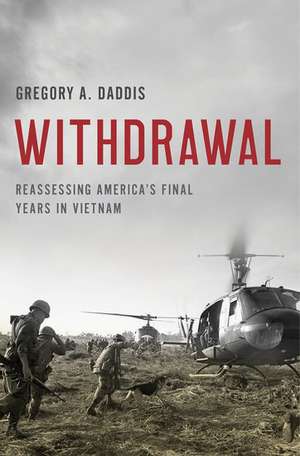
Withdrawal: Reassessing America's Final Years in Vietnam
Autor Gregory A. Daddisen Limba Engleză Hardback – 26 oct 2017
Preț: 255.04 lei
Preț vechi: 317.74 lei
-20%
Puncte Express: 383
Carte tipărită la comandă
Livrare economică 30 octombrie-04 noiembrie
Livrare prin curier în România Termenul estimat este afișat lângă disponibilitate.
Transport gratuit de la 400.00 lei Plată online sau ramburs, în funcție de opțiunile comenzii.
Retur gratuit în 14 zile Comandă securizată și suport în română.
Specificații
ISBN-13: 9780190691080
ISBN-10: 0190691085
Pagini: 320
Dimensiuni: 155 x 236 x 31 mm
Greutate: 0.57 kg
Editura: Oxford University Press
Colecția OUP USA
Locul publicării:New York, United States
ISBN-10: 0190691085
Pagini: 320
Dimensiuni: 155 x 236 x 31 mm
Greutate: 0.57 kg
Editura: Oxford University Press
Colecția OUP USA
Locul publicării:New York, United States
V-ar putea interesa
-
 The Fate of Liberty: Abraham Lincoln and Civil LibertiesMark E. Neely-16%Preț: 167.68 lei198.78 lei
 -
 The Oxford Companion to United States HistoryPaul S. Boyer-18%Preț: 426.91 lei518.58 lei
 -
 The Age of FederalismStanley Elkins-19%Preț: 185.45 lei228.03 lei
 -
 Washington's CrossingDavid Hackett Fischer-14%Preț: 110.61 lei128.33 lei
 -
 -31%Preț: 660.14 lei959.63 lei
 -
 Patterns of American JurisprudenceNeil Duxbury-28%Preț: 451.69 lei625.74 lei
 -
 Westmoreland's War: Reassessing American Strategy in VietnamGregory Daddis-28%Preț: 367.88 lei511.43 lei
 -
 Canada and the British EmpirePhillip Buckner-21%Preț: 361.34 lei457.58 lei
 -
 ReaganH. W. BrandsPreț: 170.33 lei
 -
 Drawing the LineEdwin DansonPreț: 210.10 lei
 -
 Haiti Will Not Perish: A Recent HistoryMichael Deibert-15%Preț: 196.27 lei229.85 lei
Recenzii
... the author convincingly suggests that the war was much more than a military endeavour, essentially a political conflict that must be studied as part of the 'changing global context of the larger Cold War'.
The author methodically takes apart the myths surrounding the latter years of the war....Highly recommended.
Greg Daddis revisits an overlooked and contested period in the Vietnam War with clarity and scholarly insight. His deep dive into the last years of America's war in Vietnam opens the door for today's reader to better understand our past and our own century. Like his two previous books on Vietnam, Withdrawal is an essential addition to the conversation and should not be missed.
In this revelatory book, Gregory Daddis demolishes the myth that the United States 'won' the Vietnam War militarily only to have thrown away that victory on the home front. The evidence he presents on that score is definitive and irrefutable. Yet perhaps more importantly, Daddis shows that the war was never America's to win or to lose in the first place. Vietnam's fate was a matter for the Vietnamese to decide. Apart from sowing death and destruction on a vast scale, U.S. military efforts had no bearing whatsoever on the outcome.
A major accomplishment. Far and away the best study of the military and the last years of the Vietnam War we are likely to have for some time.
Withdrawal brilliantly dismantles old and pervasive myths about the final phases of America's lost war in Vietnam. The book affirms Greg Daddis' stature as one today's most original and insightful historians of the war and deserves a broad readership among not just students of history but also policymakers and military officers.
The author methodically takes apart the myths surrounding the latter years of the war....Highly recommended.
Greg Daddis revisits an overlooked and contested period in the Vietnam War with clarity and scholarly insight. His deep dive into the last years of America's war in Vietnam opens the door for today's reader to better understand our past and our own century. Like his two previous books on Vietnam, Withdrawal is an essential addition to the conversation and should not be missed.
In this revelatory book, Gregory Daddis demolishes the myth that the United States 'won' the Vietnam War militarily only to have thrown away that victory on the home front. The evidence he presents on that score is definitive and irrefutable. Yet perhaps more importantly, Daddis shows that the war was never America's to win or to lose in the first place. Vietnam's fate was a matter for the Vietnamese to decide. Apart from sowing death and destruction on a vast scale, U.S. military efforts had no bearing whatsoever on the outcome.
A major accomplishment. Far and away the best study of the military and the last years of the Vietnam War we are likely to have for some time.
Withdrawal brilliantly dismantles old and pervasive myths about the final phases of America's lost war in Vietnam. The book affirms Greg Daddis' stature as one today's most original and insightful historians of the war and deserves a broad readership among not just students of history but also policymakers and military officers.
Notă biografică
Gregory Daddis is Associate Professor of history and director of Chapman University's MA Program in War and Society. A retired US Army colonel, he has served in both Operations Desert Storm and Iraqi Freedom. Daddis specializes in the history of the Vietnam Wars and the Cold War era.