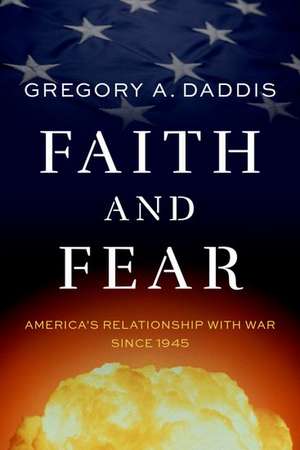
Faith and Fear: America's Relationship with War since 1945
Autor Gregory A. Daddisen Limba Engleză Hardback – 4 noi 2025
Preț: 194.92 lei
Preț vechi: 229.88 lei
-15%
Puncte Express: 292
Carte disponibilă
Livrare economică 15-20 mai
Livrare express 01-07 mai pentru 79.87 lei
Specificații
ISBN-13: 9780197804223
ISBN-10: 0197804225
Pagini: 496
Dimensiuni: 165 x 216 x 38 mm
Greutate: 0.84 kg
Editura: Oxford University Press
Colecția OUP USA
Locul publicării:New York, United States
ISBN-10: 0197804225
Pagini: 496
Dimensiuni: 165 x 216 x 38 mm
Greutate: 0.84 kg
Editura: Oxford University Press
Colecția OUP USA
Locul publicării:New York, United States
Recenzii
In this sweeping history of US war after World War II, Gregory Daddis traces the coupling of fears that global developments might undermine US security with American leaders' often misplaced faith in war as a tool to safeguard the nation. Americans retained confidence in the effectiveness of war in spite of the repeated failure of US counterinsurgency efforts and their deadly impact on foreign civilians. A sobering and accessible account of the logics driving forever war.
Ever since the US emerged as a global superpower, Americans have struggled to bend war to theirown purposes. In this brilliant and timely book, Gregory Daddis unpacks the contradictions inherent in that costly and futile effort. Faith and Fear is first-rate history and makes a vitally important contribution to understanding the predicaments facing the United States today.'
Daddis has produced a grand synthesis of America's faith and fear of war. Since the Second World War, this dilemma has dominated US foreign policy and pervaded all aspects of American life. Daddis once again dazzles readers with the scope and depth of his analysis.'
Drawing on Daddis' unique expertise as both a US Army veteran and a distinguished historian of military and cultural history, Faith and Fear brilliantly reframes Washington's Cold War-era Grand Strategy as a product of Americans' fraught emotional relationship with the concept of war. Combining diplomatic, military, and cultural history, it reveals how a simultaneous faith in war as an instrument of policy and fear of its consequences came to define both the culture of America's Cold War and its foreign policy.'
Gregory Daddis compelling argues in this impeccably researched and written tour de force that faith in and fear of war became a way for Americans to try to control the post-WWII world and their own place in it, leading to a militarized foreign policy and a society obsessed with security. This book should be required reading for every student of US foreign relations and military history.
[A] thought-provoking book that recasts how we understand the Cold War, expands our discussions of war beyond the immediate politics of deploying armed forces and raises questions about entrenched militarization in American culture.
Ever since the US emerged as a global superpower, Americans have struggled to bend war to theirown purposes. In this brilliant and timely book, Gregory Daddis unpacks the contradictions inherent in that costly and futile effort. Faith and Fear is first-rate history and makes a vitally important contribution to understanding the predicaments facing the United States today.'
Daddis has produced a grand synthesis of America's faith and fear of war. Since the Second World War, this dilemma has dominated US foreign policy and pervaded all aspects of American life. Daddis once again dazzles readers with the scope and depth of his analysis.'
Drawing on Daddis' unique expertise as both a US Army veteran and a distinguished historian of military and cultural history, Faith and Fear brilliantly reframes Washington's Cold War-era Grand Strategy as a product of Americans' fraught emotional relationship with the concept of war. Combining diplomatic, military, and cultural history, it reveals how a simultaneous faith in war as an instrument of policy and fear of its consequences came to define both the culture of America's Cold War and its foreign policy.'
Gregory Daddis compelling argues in this impeccably researched and written tour de force that faith in and fear of war became a way for Americans to try to control the post-WWII world and their own place in it, leading to a militarized foreign policy and a society obsessed with security. This book should be required reading for every student of US foreign relations and military history.
[A] thought-provoking book that recasts how we understand the Cold War, expands our discussions of war beyond the immediate politics of deploying armed forces and raises questions about entrenched militarization in American culture.
Notă biografică
Gregory A. Daddisis Professor of History and holds the Melbern G. Glasscock Endowed Chair in American History at Texas A&M University. A retired US Army colonel, he deployed to both Operations Desert Storm and Iraqi Freedom. Daddis specializes in the history of the Vietnam Wars and the Cold War era and has authored five books, includingPulp Vietnam: War and Gender in Cold War Men's Adventure MagazinesandWithdrawal: Reassessing America's Final Years in Vietnam. He also has published numerous journal articles and several op-ed pieces commenting on current military affairs, including writings inThe New York Times,The Washington Post, andThe National Interest. He is the recipient of the 2022-2023 Fulbright Distinguished Scholar Award, Pembroke College, University of Oxford.