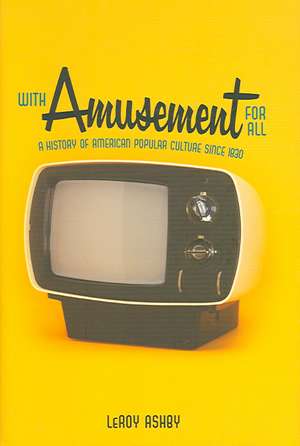
With Amusement for All
Autor Leroy Ashbyen Limba Engleză Hardback – 12 mai 2006
Structura volumului With Amusement for All este organizată cronologic și tematic pentru a oferi o sinteză vastă a culturii populare americane, începând cu anul 1830. Metodologia autorului Leroy Ashby nu se limitează la o simplă trecere în revistă a formelor de divertisment, ci utilizează industria spectacolului ca pe o lentilă prin care observăm tensiunile dintre ideologii și valori. De la succesul „oamenilor făcuți prin forțe proprii” din secolul al XIX-lea, precum P.T. Barnum, până la impactul global al unor figuri precum Oprah Winfrey sau Michael Jordan, textul demonstrează cum divertismentul reflectă și, simultan, transformă societatea. Ne-a atras atenția rigoarea cu care Ashby analizează modul în care divertismentul mainstream a cooptat și „igienizat” de-a lungul timpului culturile marginale. Un exemplu elocvent oferit în cele peste 700 de pagini este parcursul muzicii rock: de la stilul androginit al lui Elvis Presley și contra-cultura hippie a grupului The Beatles, până la transformarea sa într-un spectacol comercial prin trupe precum Kiss. Cartea este comparabilă cu The Genesis of Mass Culture de J. Springhall în ceea ce privește rigurozitatea documentării începuturilor industriei, dar este actualizată pentru a include fenomene contemporane și o analiză mult mai profundă a intersecționalității (rasă, gen, politică). În timp ce Inside the Minstrel Mask se concentrează strict pe fenomenul minstrelsy, With Amusement for All plasează aceste practici într-un context societal mai larg, explicând cum satira și stereotipurile au modelat percepțiile publice. Tonul este unul academic, dar accesibil, oferind o perspectivă critică asupra modului în care piața și morala publică au dictat evoluția a ceea ce americanii numesc „distracție”.
Preț: 498.93 lei
Preț vechi: 615.97 lei
-19%
Carte tipărită la comandă
Livrare economică 30 noiembrie-14 decembrie
Specificații
ISBN-10: 0813123976
Pagini: 712
Dimensiuni: 161 x 240 x 41 mm
Greutate: 1.13 kg
Editura: University Press of Kentucky
V-ar putea interesa
-
 Poetry: The Literary AgendaDavid Constantine-18%Preț: 153.16 lei187.56 lei
 -
 My Little French KitchenRachel Khoo-21%Preț: 155.16 lei196.35 lei
 -
 Popular CultureRaiford A Guins-27%Preț: 757.29 lei1037.37 lei
 -
 Homer Simpson Goes to WashingtonJoseph J FoyPreț: 312.29 lei
 -
 Homer Simpson Ponders PoliticsJoseph J FoyPreț: 271.10 lei
 -
 StreamingWheeler Winston Prof. Dixon-16%Preț: 539.95 lei642.80 lei
 -
 StreamingWheeler Winston DixonPreț: 154.42 lei
 -
 The Civil War in Popular CultureLawrence A KreiserPreț: 235.55 lei
 -
 Vampire Legends in Contemporary American CultureWilliam Patrick DayPreț: 260.52 lei
 -
 -27%Preț: 57.58 lei78.62 lei
 -
 The Year of Living DanishlyHelen RussellPreț: 87.05 lei
De ce să citești această carte
Această lucrare este esențială pentru studenții și cercetătorii în studii culturale sau sociologie, oferind o istorie completă a divertismentului american pe parcursul a 200 de ani. Cititorul câștigă o înțelegere profundă a modului în care cultura populară nu este doar evadare, ci un mecanism complex de control social și schimbare politică, de la epoca circului la era televiziunii și a sportului de masă.