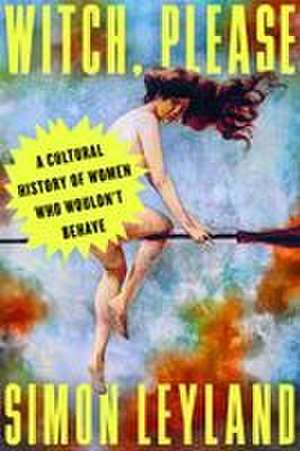
Witch, Please
Autor Simon Leylanden Limba Engleză Hardback – 6 iul 2027
Beginning in the ancient world, the book explores early female figures associated with healing, prophecy, and ritual authority, women whose proximity to knowledge was once sacred rather than suspect. It then traces the gradual transformation of such figures into increasingly ambivalent or dangerous archetypes, culminating in the early modern witch trials, where fear, law, theology, and local grievance converged to devastating effect. Here, the witch becomes less a supernatural being than a social category: a flexible accusation applied disproportionately to the poor, the marginal, the outspoken, and the inconvenient.
The narrative moves beyond persecution into cultural afterlives. In fairy tales, the witch becomes the solitary old woman at the edge of the forest, a figure used to police ideas about aging, independence, and female hunger of all kinds, literal and otherwise. In Shakespeare and later theatrical traditions, witches become aestheticised, bureaucratised, or comedic, reflecting shifting cultural needs rather than historical continuity. Across literature, art, and eventually film and television, the witch repeatedly mutates between monster, crone, seductress, and comic relief, revealing more about each era's assumptions than any stable "truth" about witchcraft itself.
The book also examines the modern reinvention of the witch. In contemporary feminism, witchcraft is reclaimed as a symbol of resistance, autonomy, and collective memory. At the same time, digital culture and wellness capitalism repackage witchcraft as aesthetic and commodity, crystals, moon rituals, and curated "enchantment" sold back to audiences as empowerment. These competing versions of the witch--radical, commercial, nostalgic, performative--sit uneasily alongside one another, underscoring the figure's continued cultural volatility.
Across these shifts, one argument remains constant: societies create witches when they need them. The witch emerges whenever female independence becomes unsettling, intelligible, or in need of explanation. She is simultaneously warning, scapegoat, fantasy, and mirror.
Blending cultural history, folklore, gender analysis, and contemporary commentary, Witch, Please offers a sharp, engrossing account of why the witch never disappears--she simply changes costume.
Preț: 179.04 lei
Precomandă
Puncte Express: 269
Carte nepublicată încă
Livrare prin curier în România Precomanda se expediază când titlul devine disponibil.
Transport gratuit de la 400.00 lei Plată online sau ramburs, în funcție de opțiunile comenzii.
Retur gratuit în 14 zile Comandă securizată și suport în română.
Doresc să fiu notificat când acest titlu va fi disponibil:
Se trimite...
Specificații
ISBN-13: 9798887983202
Pagini: 272
Dimensiuni: 153 x 229 mm
Greutate: 0.34 kg
Editura: Turner Publishing Company
Pagini: 272
Dimensiuni: 153 x 229 mm
Greutate: 0.34 kg
Editura: Turner Publishing Company
Notă biografică
Simon Leyland is a British author, historian, and professional collector of gloriously useless facts. A former City trader who exchanged financial markets for archives, libraries, and obscure footnotes, he writes narrative history with the firm belief that the past is far too entertaining to be left solely to academics.
He is the author of The Men Who Stare at Hens, A Curious Guide to London, and several other works exploring the stranger corners of history, language, and culture. His writing combines meticulous research with dry English humour, examining the peculiar habits, improbable beliefs, and magnificent absurdities that have shaped human civilisation.
Simon lives in the depths of the Norfolk countryside, where he spends an unhealthy amount of time pursuing obscure historical anecdotes, reading books that sensible people abandoned centuries ago, and convincing himself that "just one more source" is a perfectly reasonable way to spend an afternoon.
He is the author of The Men Who Stare at Hens, A Curious Guide to London, and several other works exploring the stranger corners of history, language, and culture. His writing combines meticulous research with dry English humour, examining the peculiar habits, improbable beliefs, and magnificent absurdities that have shaped human civilisation.
Simon lives in the depths of the Norfolk countryside, where he spends an unhealthy amount of time pursuing obscure historical anecdotes, reading books that sensible people abandoned centuries ago, and convincing himself that "just one more source" is a perfectly reasonable way to spend an afternoon.