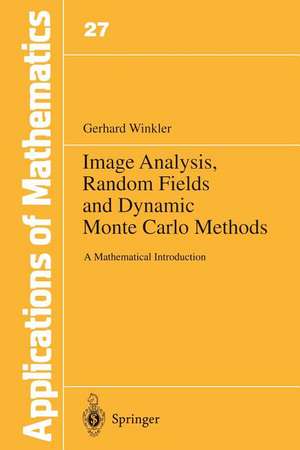
Winkler, G: Image Analysis, Random Fields and Dynamic Monte
en Limba Engleză Paperback – 19 ian 2012
Preț: 392.00 lei
Puncte Express: 588
Carte disponibilă
Livrare economică 09-23 noiembrie
Livrare prin curier în România Termenul estimat este afișat lângă disponibilitate.
Transport gratuit de la 400.00 lei Plată online sau ramburs, în funcție de opțiunile comenzii.
Retur gratuit în 14 zile Comandă securizată și suport în română.
Specificații
ISBN-13: 9783642975240
ISBN-10: 3642975240
Pagini: 340
Ilustrații: XIV, 324 p.
Dimensiuni: 155 x 235 x 19 mm
Greutate: 0.48 kg
Ediția:Softcover reprint of the original 1st ed. 1995
Editura: Springer
Locul publicării:Berlin, Heidelberg, Germany
ISBN-10: 3642975240
Pagini: 340
Ilustrații: XIV, 324 p.
Dimensiuni: 155 x 235 x 19 mm
Greutate: 0.48 kg
Ediția:Softcover reprint of the original 1st ed. 1995
Editura: Springer
Locul publicării:Berlin, Heidelberg, Germany
V-ar putea interesa
-
 The Most Human HumanBrian Christian-19%Preț: 64.51 lei79.22 lei
 -
 Understanding BeliefsNils J Nilsson-18%Preț: 77.34 lei94.68 lei
 -
 Pattern Recognition and Machine LearningChristopher M Bishop-20%Preț: 646.10 lei807.62 lei
 -
 The Elements of Statistical LearningTrevor Hastie-20%Preț: 546.54 lei683.17 lei
 -
 Text-to-Speech SynthesisPaul Taylor-14%Preț: 782.56 lei909.96 lei
 -
 Type-2 Fuzzy Logic ControlMendel-20%Preț: 768.63 lei960.78 lei
 -
 Activity LearningDiane J Cook-9%Preț: 717.08 lei788.00 lei
 -
 Practical OpenCVSamarth Brahmbhatt-20%Preț: 306.69 lei383.37 lei
 -
 Machine Learning for HackersDrew Conway-20%Preț: 258.29 lei322.85 lei
 -
 Computational IntelligenceAlexandru Floares-35%Preț: 1012.79 lei1567.33 lei
 -
 Introducing Artificial IntelligenceHenry Brighton-20%Preț: 54.25 lei67.81 lei
Public țintă
ResearchCuprins
I. Bayesian Image Analysis: Introduction.- 1. The Bayesian Paradigm.- 2. Cleaning Dirty Pictures.- 3. Random Fields.- II. The Gibbs Sampler and Simulated Annealing.- 4. Markov Chains: Limit Theorems.- 5. Sampling and Annealing.- 6. Cooling Schedules.- 7. Sampling and Annealing Revisited.- III. More on Sampling and Annealing.- 8. Metropolis Algorithms.- 9. Alternative Approaches.- 10. Parallel Algorithms.- IV. Texture Analysis.- 11. Partitioning.- 12. Texture Models and Classification.- V. Parameter Estimation.- 13. Maximum Likelihood Estimators.- 14. Spacial ML Estimation.- VI. Supplement.- 15. A Glance at Neural Networks.- 16. Mixed Applications.- VII. Appendix.- A. Simulation of Random Variables.- B. The Perron-Frobenius Theorem.- C. Concave Functions.- D. A Global Convergence Theorem for Descent Algorithms.- References.
Textul de pe ultima copertă
The book is mainly concerned with the mathematical foundations of Bayesian image analysis and its algorithms. This amounts to the study of Markov random fields and dynamic Monte Carlo algorithms like sampling, simulated annealing and stochastic gradient algorithms. The approach is introductory and elemenatry: given basic concepts from linear algebra and real analysis it is self-contained. No previous knowledge from image analysis is required. Knowledge of elementary probability theory and statistics is certainly beneficial but not absolutely necessary. The necessary background from imaging is sketched and illustrated by a number of concrete applications like restoration, texture segmentation and motion analysis.