
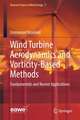
Wind Turbine Aerodynamics and Vorticity-Based Methods: Research Topics in Wind Energy, cartea 7
Autor Emmanuel Branlarden Limba Engleză Paperback – 25 iul 2018




Preț: 1621.90 lei
Preț vechi: 1977.92 lei
-18%
Carte tipărită la comandă
Livrare economică 05-19 decembrie
Specificații
ISBN-10: 3319855832
Pagini: 668
Ilustrații: XXXI, 632 p. 179 illus., 84 illus. in color.
Dimensiuni: 155 x 235 x 36 mm
Greutate: 0.92 kg
Ediția:Softcover reprint of the original 1st edition 2017
Editura: Springer
Colecția Research Topics in Wind Energy
Seria Research Topics in Wind Energy
Locul publicării:Cham, Switzerland
V-ar putea interesa
-
 -23%Preț: 1105.82 lei1436.12 lei
 -
 -18%Preț: 918.04 lei1119.56 lei
 -
 -18%Preț: 1752.38 lei2137.05 lei
 -
 Green Diesel EnginesBreda Kegl-15%Preț: 618.05 lei727.12 lei
 -
 BioH2 & BioCH4 Through Anaerobic DigestionBernardo Ruggeri-15%Preț: 640.73 lei753.79 lei
 -
 Sustainable Indoor LightingPaola Sansoni-15%Preț: 622.93 lei732.86 lei
 -
 -15%Preț: 624.75 lei735.01 lei
 -
 -18%Preț: 780.90 lei952.31 lei
 -
 -18%Preț: 927.56 lei1131.17 lei
 -
 Fuel Production from Non-Food Biomass: Corn StoverBarnabas Gikonyo-15%Preț: 601.29 lei707.39 lei
 -
 -15%Preț: 581.47 lei684.09 lei
 -
 New Microbial Technologies for Advanced Biofuels: Toward More Sustainable Production MethodsJuan Carlos Serrano-Ruiz-15%Preț: 581.47 lei684.09 lei
 -
 -15%Preț: 581.47 lei684.09 lei
 -
 Advanced Biofuels: Using Catalytic Routes for the Conversion of Biomass Platform MoleculesJuan Carlos Serrano-Ruiz-15%Preț: 581.47 lei684.09 lei
 -
 -15%Preț: 562.99 lei662.34 lei
 -
 New Biotechnologies for Increased Energy Security: The Future of FuelJuan Carlos Serrano-Ruiz-15%Preț: 581.47 lei684.09 lei
 -
 Industrial Biotechnology: Sustainable Production and Bioresource UtilizationDevarajan Thangadurai-15%Preț: 581.47 lei684.09 lei
 -
 -15%Preț: 601.29 lei707.39 lei
 -
 -15%Preț: 581.47 lei684.09 lei
 -
 Handbook of Transitions to Energy and Climate SecurityRobert LooneyPreț: 478.45 lei
 -
 High Temperature ElectrolysisMiguel Angel Laguna-Bercero-18%Preț: 1051.13 lei1281.86 lei
 -
 CO2 Refrigeration Cycle and SystemsXin-Rong Zhang-18%Preț: 1044.71 lei1274.04 lei
 -
 -18%Preț: 977.03 lei1191.51 lei
 -
 Women in PowerJill S. Tietjen-18%Preț: 883.33 lei1077.22 lei
 -
 Geoenergy Modeling III: Enhanced Geothermal SystemsNorihiro WatanabePreț: 363.61 lei
 -
 Die Photosynthese als erneuerbare EnergieVolker Hartmann-15%Preț: 420.91 lei495.19 lei
 -
 Airborne Wind EnergyUwe Ahrens-18%Preț: 936.25 lei1141.77 lei
 -
 Climate Change, Energy, Sustainability and PavementsKasthurirangan Gopalakrishnan-18%Preț: 1088.33 lei1327.24 lei
 -
 Large Scale Renewable Power GenerationJahangir Hossain-15%Preț: 628.42 lei739.32 lei
Cuprins
Caracteristici
Descriere
The book introduces the fundamentals of fluid-mechanics, momentum theories, vortex theories and vortex methods necessary for the study of rotors aerodynamics and wind-turbines aerodynamics in particular. Rotor theories are presented in a great level of details at the beginning of the book. These theories include: the blade element theory, the Kutta-Joukowski theory, the momentum theory and the blade element momentum method. A part of the book is dedicated to the description and implementation of vortex methods. The remaining of the book focuses on the study of wind turbine aerodynamics using vortex-theory analyses or vortex-methods. Examples of vortex-theory applications are: optimal rotor design, tip-loss corrections, yaw-models and dynamic inflow models. Historical derivations and recent extensions of the models are presented. The cylindrical vortex model is another example of a simple analytical vortex model presented in this book. This model leads to the development of different BEM models and it is also used to provide the analytical velocity field upstream of a turbine or a wind farm under aligned or yawed conditions. Different applications of numerical vortex methods are presented. Numerical methods are used for instance to investigate the influence of a wind turbine on the incoming turbulence. Sheared inflows and aero-elastic simulations are investigated using vortex methods for the first time. Many analytical flows are derived in details: vortex rings, vortex cylinders, Hill's vortex, vortex blobs etc. They are used throughout the book to devise simple rotor models or to validate the implementation of numerical methods. Several Matlab programs are provided to ease some of the most complex implementations.