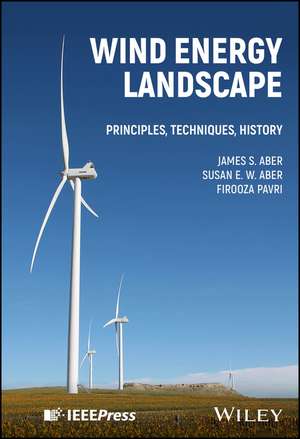
Wind Energy Landscape
Autor James S Aber, Susan E W Aber, Firooza Pavrien Limba Engleză Hardback – 15 ian 2026
Preț: 757.75 lei
Preț vechi: 832.70 lei
-9%
Puncte Express: 1137
Carte tipărită la comandă
Livrare economică 30 decembrie 26 - 13 ianuarie 27
Livrare prin curier în România Termenul estimat este afișat lângă disponibilitate.
Transport gratuit pentru acest produs Plată online sau ramburs, în funcție de opțiunile comenzii.
Retur gratuit în 14 zile Comandă securizată și suport în română.
Specificații
ISBN-13: 9781394212873
ISBN-10: 1394212879
Pagini: 304
Dimensiuni: 152 x 229 x 19 mm
Greutate: 0.58 kg
Editura: Wiley
Locul publicării:Hoboken, United States
ISBN-10: 1394212879
Pagini: 304
Dimensiuni: 152 x 229 x 19 mm
Greutate: 0.58 kg
Editura: Wiley
Locul publicării:Hoboken, United States
V-ar putea interesa
-
 Into the Clear Blue SkyRob JacksonPreț: 79.10 lei
-
 World Without EndJean-Marc JancoviciPreț: 201.15 lei
-
 Nature UnfurledConnie Y ChiangPreț: 225.47 lei
-
 AliveMadeline Schwartzman-15%Preț: 242.97 lei286.87 lei
-
 Onshore and Offshore Wind EnergyVasilis M Fthenakis-23%Preț: 707.70 lei919.09 lei
-
 Electrical Power System EssentialsPieter Schavemaker-19%Preț: 601.23 lei742.26 lei
-
 Preț: 97.67 lei
-
 Natural History of SilenceJérôme SueurPreț: 141.56 lei
-
 Advances in Energy Research: Volume 1Morena J Acosta-26%Preț: 889.14 lei1206.37 lei
-
 On ExtinctionMelanie ChallengerPreț: 141.07 lei
-
 Space to GrowMatthew WeinzierlPreț: 198.61 lei
-
 Climate InjusticeFriederike OttoPreț: 170.50 lei
-
 Intervention EarthGwynne DyerPreț: 94.36 lei
-
 Deep WaterJames BradleyPreț: 94.73 lei
-
 Six Inches of SoilMolly FosterPreț: 182.13 lei
-
 Forest EuphoriaPatricia Ononiwu KaishianPreț: 176.45 lei
-
 Wind Power TechnologyAlois Peter Schaffarczyk-19%Preț: 541.85 lei668.94 lei
Notă biografică
James S. Aber, PhD, Roe R. Cross Distinguished Emeritus Professor, Emporia State University, Kansas, USA. Professor Aber's interests and research experiences spread across energy resources, geology, landscape evolution, aerial photography, and wetland environments.
Susan E. W. Aber, PhD, is the former Director of the Science and Math Education Center and Peterson Planetarium at Emporia State University (ESU), Emporia, Kansas, USA. Dr. Aber's interests are mineralogy, gemology, and energy resources as well as maps and GIS for librarians.
Firooza Pavri, PhD, Professor of Geography and Associate Dean, Edmund S. Muskie School of Public Service, University of Southern Maine, USA. Professor Pavri's teaching and research interests include environmental change, resource and energy management, and remote sensing.
Cuprins
About the Authors xi
Wind Energy Preface xiii
Acknowledgments xix
1 History of Wind Energy 1
1.1 Introduction 1
1.2 Traditional Windmills-European and American 3
1.3 Generating Electricity-Late 1800s to Mid-1900s 9
1.4 Generating Electricity-Late 1900s 20
1.5 Wind Energy-Early Twenty-First Century 36
1.6 Summary 41
2 Windscape Methodology 45
2.1 What Is the Windscape? 45
2.2 Geospatial Analysis 46
2.3 Remote Sensing 48
2.4 Maps and GIS 54
2.5 Economic, Social Science, and Environmental Methods and Techniques 59
2.6 Summary 64
3 Converting Wind into Electricity 69
3.1 Atmosphere and Wind 69
3.2 Wind Power and Energy 80
3.3 Turbine Efficiency and Capacity 82
3.4 Electricity Grid and Interconnection 90
3.5 Integration of Wind Energy 95
3.6 Summary 97
4 Public Policy for Wind Energy 103
4.1 Introduction 103
4.2 Wind-Energy Policy Measures 104
4.3 Land-Use Decisions and Siting Policies 118
4.4 Summary 122
5 Environmental and Aesthetic Issues 131
5.1 Introduction and Risks 131
5.2 Wildlife-Birds 135
5.3 Wildlife-Bats 140
5.4 Visibility 144
5.5 Noise 150
5.6 Summary 152
6 Europe and Asia 159
6.1 Eurasian Overview 159
6.2 Denmark 160
6.3 Faroe Islands 166
6.4 Poland 169
6.5 India's Wind Geography 175
6.6 Summary 181
7 North American Case Studies 187
7.1 Introduction to the United States and Canada 187
7.2 Kansas 190
7.3 Southeastern Colorado 200
7.4 Offshore New England 206
7.5 Saskatchewan, Canada 211
7.6 Summary 214
8 Energy Production and Consumption 221
8.1 Overview 221
8.2 Fossil Fuels 223
8.3 Nuclear Energy 229
8.4 Wind Energy 232
8.5 Summary 235
9 Ideal Energy 241
9.1 Radical Middle 241
9.2 Metals 242
9.3 Wind Turbines and Health 245
9.4 Energy in Transition 247
9.5 Energy Gap 249
9.6 Summary 251
10 Windscape Summary and Conclusion 255
10.1 Wind-Industry Origins 255
10.2 Windscape 257
10.3 Wind and Other Energy Sources 259
10.4 Future of Wind Energy 260
References 260
Index 263