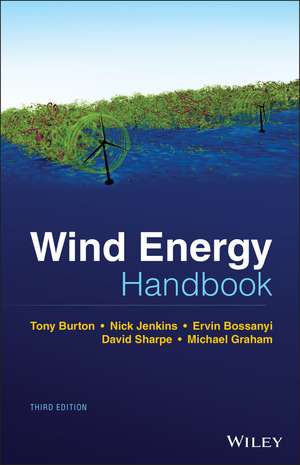
Wind Energy 3e C
Autor Tony L Burton, Nick Jenkins, Ervin Bossanyi, David Sharpe, Michael Grahamen Limba Engleză Hardback – 26 apr 2021
Considerăm că a treia ediție a volumului Wind Energy 3e C reprezintă un salt tehnologic necesar, trecând de la teoria fundamentală la soluții inginerești de ultimă oră. Un exercițiu de proiectare concret care demonstrează rigoarea acestei lucrări este implementarea noii metode PISA pentru structurile de suport de tip monopil, esențială pentru stabilitatea turbinelor în parcurile eoliene offshore. Această abordare geotehnică este completată de o analiză extinsă a dinamicii fluidelor computaționale (CFD), oferind inginerilor instrumentele necesare pentru a modela interacțiunile complexe ale aerului în condiții reale. Pe linia practică a volumului Wind Power Technology de Alois Peter Schaffarczyk, dar cu un focus mult mai pronunțat pe structurile de suport flotante și pe controlul activ al efectelor de siaj (wake control), această ediție de peste 1000 de pagini publicată de Wiley devine o referință tehnică densă. Observăm o atenție deosebită acordată durabilității componentelor: secțiunile despre proiectarea palelor au fost rescrise integral pentru a include date despre oboseala laminatelor și metode noi de testare pentru eroziunea marginii de atac. Structura narativă a manualului urmărește fluxul logic al unui proiect de infrastructură energetică, de la evaluarea resursei eoliene și variațiile diurne, până la integrarea în rețeaua electrică conform noilor coduri de rețea (Grid Codes). Recomandăm acest tratat pentru modul în care balansează arhitecturile clasice cu tehnologii emergente, precum generatoarele superconductoare sau transmisiile magnetice, oferind o perspectivă tehnică asupra viitorului energiei regenerabile.
Preț: 793.67 lei
Preț vechi: 1030.75 lei
-23%
Carte disponibilă
Livrare economică 04-18 septembrie
Livrare express 21-27 august pentru 82.94 lei
Specificații
ISBN-10: 1119451094
Pagini: 1008
Dimensiuni: 250 x 176 x 59 mm
Greutate: 1.82 kg
Ediția:3rd edition
Editura: Wiley
Locul publicării:Chichester, United Kingdom
V-ar putea interesa
-
 Learning Deep LearningMagnus Ekman-20%Preț: 414.76 lei518.45 lei
 -
 -9%Preț: 872.74 lei959.05 lei
 -
 Design-Tech: Building Science for ArchitectsJason Alread-8%Preț: 465.32 lei505.78 leiRecomandat
 -
 Wind Energy ExplainedBonnie Ram-23%Preț: 586.10 lei761.17 lei
 -
 Aerodynamics of Wind TurbinesSven Schmitz-11%Preț: 590.91 lei663.95 lei
 -
 Onshore and Offshore Wind EnergyVasilis M Fthenakis-23%Preț: 675.73 lei877.58 lei
 -
 -33%Preț: 187.55 lei279.19 lei
 -
 Introduction to Robotics, Global EditionJohn Craig-15%Preț: 566.44 lei666.41 lei
 -
 Process Machinery HandbookRobert X. Perez-23%Preț: 1918.89 lei2492.06 lei
 -
 Learn Robotics with Raspberry PiMatt Timmons-Brown-35%Preț: 113.72 lei174.92 lei
 -
 Wind Turbines: Types, Economics & DevelopmentGerard Martin-26%Preț: 1467.81 lei1996.09 lei
 -
 Wind Turbines: Types, Design & EfficiencyAnna Balmaceda-26%Preț: 613.97 lei834.92 lei
 -
 KiCad Complete Reference ManualJean-Pierre Charras-20%Preț: 175.58 lei219.47 lei
 -
 Structural Control and Fault Detection of Wind Turbine SystemsHamid Reza Karimi-18%Preț: 784.93 lei957.23 lei
 -
 Handbook of Wind Energy AerodynamicsBernhard Stoevesandt-18%Preț: 5020.36 lei6122.39 lei
 -
 Wind Power TechnologyAlois Peter Schaffarczyk-19%Preț: 541.85 lei668.94 lei
 -
 Introduction to Wind Turbine AerodynamicsAlois Peter Schaffarczyk-18%Preț: 872.46 lei1063.98 lei
 -
 Advanced Wind Turbine TechnologyWeifei Hu-24%Preț: 971.35 lei1278.09 lei
 -
 Wind Turbine Aerodynamic Performance CalculationTongguang Wang-18%Preț: 759.72 lei926.48 lei
De ce să citești această carte
Recomandăm această lucrare inginerilor și proiectanților care au nevoie de specificații tehnice actualizate pentru industria eoliană modernă. Cititorul câștigă acces la metodologii noi de calcul geotehnic și aerodinamic, esențiale pentru proiectele offshore. Este un instrument de lucru indispensabil pentru optimizarea performanței turbinelor și înțelegerea impactului de mediu la scară industrială.
Despre autor
Echipa de autori, condusă de Tony L Burton și Nick Jenkins, reunește un grup de experți de elită din mediul academic și industrial. Aceștia au contribuit decisiv la dezvoltarea standardelor internaționale în domeniul energiei regenerabile. Tony L Burton este recunoscut pentru expertiza sa în dinamica turbinelor, în timp ce co-autorii precum Ervin Bossanyi și David Sharpe aduc perspective valoroase din zona sistemelor de control și aerodinamicii avansate. Experiența lor cumulată transformă acest manual într-o autoritate în domeniu, integrând decenii de cercetare aplicată în designul componentelor și optimizarea parcurilor eoliene.