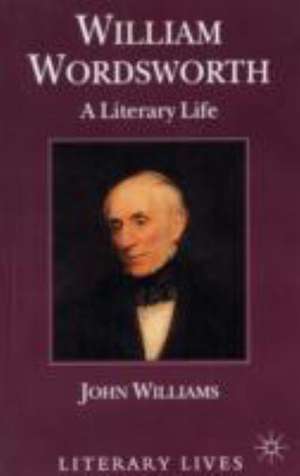
William Wordsworth
Autor John Williamsen Limba Engleză Paperback – 8 mar 1996
Preț: 341.68 lei
Puncte Express: 513
Carte tipărită la comandă
Livrare economică 27 noiembrie-11 decembrie
Livrare prin curier în România Termenul estimat este afișat lângă disponibilitate.
Transport gratuit de la 400.00 lei Plată online sau ramburs, în funcție de opțiunile comenzii.
Retur gratuit în 14 zile Comandă securizată și suport în română.
Specificații
ISBN-13: 9780333574188
ISBN-10: 0333574184
Pagini: 208
Ilustrații: IX, 208 p.
Dimensiuni: 140 x 216 x 12 mm
Greutate: 0.26 kg
Ediția:1996 edition
Editura: Palgrave Macmillan UK
Locul publicării:London, United Kingdom
ISBN-10: 0333574184
Pagini: 208
Ilustrații: IX, 208 p.
Dimensiuni: 140 x 216 x 12 mm
Greutate: 0.26 kg
Ediția:1996 edition
Editura: Palgrave Macmillan UK
Locul publicării:London, United Kingdom
V-ar putea interesa
-
 Love Life GoetheJohn ArmstrongPreț: 130.60 lei
 -
 John DonneJohn StubbsPreț: 133.69 lei
 -
 Shakespeare's Irrational EndingsD. MargoliesPreț: 388.17 lei
 -
 Teaching the Early Modern PeriodD. ConroyPreț: 387.19 lei
 -
 Swift and ScienceG. LynallPreț: 403.27 lei
 -
 The Interpretation of Samuel JohnsonJ. ClarkPreț: 405.27 lei
 -
 Preț: 399.29 lei
 -
 Preț: 370.75 lei
 -
 A Counter-History of Crime FictionMaurizio Ascari-15%Preț: 641.70 lei754.94 lei
 -
 The Poet and the KingMarc FumaroliPreț: 389.01 lei
 -
 BalzacGraham Robb-23%Preț: 120.39 lei155.37 lei
 -
 Song of the EarthJonathan Bate-34%Preț: 60.32 lei91.77 lei
 -
 Cardiff DeadJohn Williams-28%Preț: 74.04 lei102.68 lei
 -
 Wales Half WelshJohn Williams-28%Preț: 74.44 lei102.92 lei
 -
 Cardiff TrilogyJohn Williams-45%Preț: 100.26 lei182.28 lei
Cuprins
Notes on Texts and Abbreviations - Writing the Literary Life - Early Years - From France to Racedown - Alfoxden - The Making of a Modern Poet - Grasmere Poetry: Dove Cottage Life -1807-1815: The Afflictions of Life - 1814-1820: Few and Scattered Hearers - As much Peter Bell as ever - Further Reading - Index
Descriere
Descriere de la o altă ediție sau format:
From the earliest reviews of his poetry, readers were deeply divided on the merits of William Wordsworth's work. John Williams looks in detail at the major poems and discusses the critical issues that have dominated discussions of Wordsworth's compositions since they first began to appear in print after 1798.
Beginning with a fresh assessment of the controversies that developed around Lyrical Ballads, the chapters trace the evolution of both Wordsworth's poetry and his reputation through to his death in 1850. At each stage, Williams investigates the possible reasons why critics and readers responded as they did: enraged by his revolutionary 'Jacobinism' at the turn of the eighteenth century; insulted by the 'simplicity' of the Poems in Two Volumes of 1807; reassured by his commitment to Nature and his reverence for Church and State in the early Victorian period.
In the twentieth century, Wordsworth has been subjected to a series of extensive critical reappraisals. With reference to a wide range of the poetry, Williams goes on to discuss the way Wordsworth has been variously reconstructed as a consequence of the main critical and theoretical initiatives of the last one hundred years. He also examines the Wordsworth we have inherited for the twenty-first century: a poet many still feel has important things to say to the contemporary reader about human relationships, nature, the environment, and our imaginative life.
From the earliest reviews of his poetry, readers were deeply divided on the merits of William Wordsworth's work. John Williams looks in detail at the major poems and discusses the critical issues that have dominated discussions of Wordsworth's compositions since they first began to appear in print after 1798.
Beginning with a fresh assessment of the controversies that developed around Lyrical Ballads, the chapters trace the evolution of both Wordsworth's poetry and his reputation through to his death in 1850. At each stage, Williams investigates the possible reasons why critics and readers responded as they did: enraged by his revolutionary 'Jacobinism' at the turn of the eighteenth century; insulted by the 'simplicity' of the Poems in Two Volumes of 1807; reassured by his commitment to Nature and his reverence for Church and State in the early Victorian period.
In the twentieth century, Wordsworth has been subjected to a series of extensive critical reappraisals. With reference to a wide range of the poetry, Williams goes on to discuss the way Wordsworth has been variously reconstructed as a consequence of the main critical and theoretical initiatives of the last one hundred years. He also examines the Wordsworth we have inherited for the twenty-first century: a poet many still feel has important things to say to the contemporary reader about human relationships, nature, the environment, and our imaginative life.