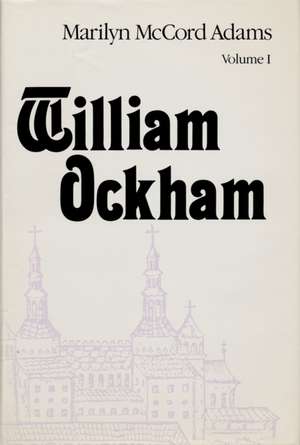
William Ockham
Autor Marilyn Adamsen Limba Engleză Paperback – 31 dec 1989
Aplicabilitatea practică a acestui volum monumental rezidă în capacitatea sa de a clarifica fundamentele logice ale gândirii medievale târzii, oferind studenților și cercetătorilor un instrument de analiză riguros pentru înțelegerea tranziției către modernitate. Subliniem faptul că William Ockham scris de Marilyn Adams nu este doar o biografie intelectuală, ci o reconstrucție sistematică a unui aparat conceptual adesea înțeles greșit. Considerăm că forța acestui text de 1422 de pagini stă în modul în care autoarea demonstrează că pozițiile lui Ockham — de la ontologie la filosofia naturii — nu sunt rupturi radicale arbitrare, ci consecințe logice ale unui sistem coerent. Apreciem rigoarea cu care Marilyn Adams demontează miturile legate de nominalismul lui Ockham, argumentând că acesta rămâne un „aristotelian franciscan” mult mai ancorat în tradiție decât s-a speculat. Stilul este dens, academic și analitic, tratând exhaustiv relația dintre libertatea divină și etică, fără a recurge la simplificări. Ca alternativă la The Cambridge Companion to Ockham pentru cursurile de istorie a filosofiei medievale, acest volum are avantajul unei profunzimi exegetice superioare, oferind o examinare mult mai detaliată a contraargumentelor față de Thomas Aquinas și Duns Scotus. În timp ce alte lucrări similare, precum Ockham Explained, servesc ca introduceri succinte, studiul de față, publicat de University of Notre Dame Press, rămâne resursa definitivă pentru cei care doresc să înțeleagă structura internă a argumentației ockhamiste în limba engleză.
Preț: 583.66 lei
Preț vechi: 686.66 lei
-15%
Carte disponibilă
Livrare economică 26 octombrie-09 noiembrie
Specificații
ISBN-10: 0268019452
Pagini: 1422
Dimensiuni: 154 x 233 x 72 mm
Greutate: 1.86 kg
Ediția:1
Editura: University of Notre Dame Press
V-ar putea interesa
-
 Oxford Studies in Medieval Philosophy, Volume 2Robert Pasnau-21%Preț: 264.06 lei333.30 lei
 -
 -31%Preț: 626.56 lei909.36 lei
 -
 Essays on Spinoza's Ethical TheoryMatthew J. Kisner-31%Preț: 742.76 lei1077.58 lei
 -
 The Oxford Handbook of Philosophy in Early Modern EuropeDesmond M. Clarke-19%Preț: 335.87 lei416.23 lei
 -
 Words and Images: An Essay on the Origin of IdeasChristopher Gauker-13%Preț: 303.90 lei347.54 lei
 -
 Joint Ventures: Mindreading, Mirroring, and Embodied CognitionAlvin I. Goldman-31%Preț: 598.51 lei865.20 lei
 -
 -31%Preț: 626.13 lei909.10 lei
 -
 Augustine and the Limits of PoliticsJean Bethke ElshtainPreț: 170.50 lei
 -
 Thomas Aquinas: A PortraitDenys TurnerPreț: 131.96 lei
 -
 On HabitClare CarlislePreț: 285.76 lei
 -
 Christ and HorrorsMarilyn McCord AdamsPreț: 344.77 lei
 -
 IrrationalityLisa BortolottiPreț: 186.57 lei
 -
 On the World and OurselvesZygmunt BaumanPreț: 151.90 lei
 -
 Aping MankindRaymond TallisPreț: 194.29 lei
 -
 The Political Philosophy of Niccolò MachiavelliFilippo Del Lucchese-17%Preț: 172.52 lei208.64 lei
De ce să citești această carte
Recomandăm această lucrare specialiștilor în filosofie medievală și teologie care caută o analiză exhaustivă, dincolo de etichetele simpliste de „nominalism”. Cititorul câștigă o înțelegere profundă a logicii și metafizicii secolului al XIV-lea, beneficiind de o cercetare care reabilitează rigoarea intelectuală a lui Ockham în fața acuzațiilor istorice de erezie sau subiectivism.
Despre autor
Marilyn McCord Adams (1943–2017) a fost o distinsă filosoafă și teoloagă americană, recunoscută la nivel internațional pentru expertiza sa în filosofia medievală și filosofia religiei. A deținut catedre prestigioase la universități de renume precum Yale, Oxford (Regius Professor of Divinity) și UNC-Chapel Hill. Specializarea sa în lucrările lui William Ockham și abordarea analitică a teologiei creștine au transformat modul în care este studiată perioada scolastică târzie. Această monografie reprezintă rodul a decenii de cercetare, fiind considerată una dintre cele mai importante contribuții ale sale la istoria ideilor.
Descriere scurtă
This landmark study offers a clear and concise account of Ockham's philosophical positions (his ontology, logic, epistemology, and natural philosophy), along with the arguments for them. It then shows how Ockham's theological disagreements with his most eminent predecessors are a logical consequence of underlying philosophical differences. According to Marilyn McCord Adams, Ockham emerges as a Franciscan Aristotelian, much more philosophically and religiously conservative than commonly supposed. Adams challenges the notions that Ockham's nominalism and ontological reductions lead to subjectivism in metaphysics, his epistemology to skepticism, his theory of causality to Humean constant conjunction or to occasionalism. Likewise, Adams rejects the notion that Ockham's philosophical doctrines lead to heretical views in theology, or that his insistence on divine freedom leads to arbitrariness and caprice in ethics. Although her primary focus is on Ockham, McAdams compares and contrasts his positions with those of Aquinas, Scotus, Henry of Ghent, among others. William Ockham constitutes an excellent initiation for philosophers into the problems and theoretical framework of the late thirteenth and early fourteenth centuries.
Recenzii
Notă biografică
Marilyn McCord Adams was a distinguished American philosopher and Episcopal priest. She taught medieval and philosophical theology at a number of schools during her career, including the University of California, Los Angeles; Yale University; and the University of Oxford. She was cofounder and president of the Society of Christian Philosophers and wrote several books, including Horrendous Evils and the Goodness of God and Christ and Horrors.