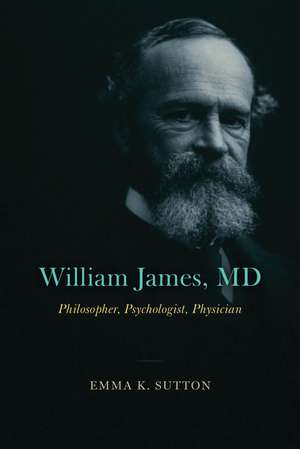
William James, MD: Philosopher, Psychologist, Physician
Autor Emma K. Suttonen Limba Engleză Paperback – 6 dec 2023
În ultimele decenii, istoria medicinei a evoluat de la o simplă cronologie a descoperirilor către o analiză profundă a modului în care conceptele medicale modelează identitatea socială și intelectuală. Găsim în această lucrare, William James, MD, o reevaluare critică a unuia dintre cei mai importanți gânditori americani, privit prin prisma profesiei sale de bază: cea de medic. Deși posteritatea l-a consacrat ca filosof și psiholog, Emma K. Sutton demonstrează că preocupările sale pentru sănătate, igienă și patologie nu au fost simple note de subsol, ci pilonii centrali ai pragmatismului său.
Notăm cu interes modul în care Sutton dezmembrează mitul „vindecării” lui James. Spre deosebire de relatările biografice clasice care prezintă crizele sale de tinerețe ca pe o etapă depășită, această ediție publicată de University of Chicago Press folosește jurnale și caiete de note nepublicate pentru a arăta un James care s-a luptat cu statutul de invalid până la finalul vieții. Cartea este structurată tematic, pornind de la metafizica suferinței și etica autodistrugerii, trecând prin fiziologia emoțiilor și ajungând la dimensiunea politică a medicinei. Aceasta din urmă este deosebit de relevantă, explorând cum James a apărat persoanele marginalizate într-o epocă dominată de idei eugeniste și de obsesia pentru corpul „normal”.
Descoperim aici o perspectivă clinică asupra lucrărilor sale fundamentale. Ca alternativă la The Essential William James de John R. Shook pentru cercetători, volumul de față are avantajul unei organizări centrate pe experiența somatică, oferind o cheie de lectură medicală acolo unde alte compendii, precum The Oxford Handbook of William James, se concentrează pe ramurile abstracte ale metafizicii. Este o resursă esențială pentru a înțelege cum biologia și patologia au dictat ritmul filosofiei americane la început de secol XX.
Preț: 196.40 lei
Preț vechi: 206.74 lei
-5%
Carte disponibilă
Livrare economică 30 octombrie-13 noiembrie
Livrare express 15-21 octombrie pentru 24.100 lei
Specificații
ISBN-10: 0226828980
Pagini: 240
Ilustrații: 10 halftones
Dimensiuni: 152 x 229 x 20 mm
Greutate: 0.37 kg
Ediția:First Edition
Editura: University of Chicago Press
Colecția University of Chicago Press
V-ar putea interesa
-
 Pragmatism and Other WritingsWilliam James-18%Preț: 64.92 lei79.64 lei
 -
 William JamesPhilip Davis-16%Preț: 145.19 lei172.49 lei
 -
 Phobia and American Literature, 1705–1937: A Therapeutic HistoryDon James McLaughlin-33%Preț: 573.03 lei849.39 lei
 -
 The Oxford Handbook of William JamesAlexander Mugar Klein-32%Preț: 799.43 lei1174.32 lei
 -
 The Varieties of Religious ExperienceWilliam James-17%Preț: 72.38 lei87.61 lei
 -
 Your Journey, Your WayHoratio Clare-5%Preț: 74.47 lei78.39 lei
 -
 Psychoanalysis and ReligionErich Fromm-5%Preț: 200.20 lei210.73 lei
 -
 The Principles of Psychology, Vol. 1William James-24%Preț: 159.97 lei209.85 lei
 -
 The Principles of Psychology, Vol. 2William James-24%Preț: 171.67 lei225.15 lei
 -
 MeditationsMarcus AureliusPreț: 33.99 lei
 -
 Our MaladyTimothy SnyderPreț: 78.71 lei
 -
 Sick Souls, Healthy MindsJohn KaagPreț: 84.13 lei
 -
 Be Not Afraid of LifeWilliam JamesPreț: 192.39 lei
 -
 CORRESPONDENCE OF WILLIAM JAMEWilliam James-23%Preț: 652.49 lei847.39 lei
 -
 The Correspondence of William James: 1895-1899William James-23%Preț: 647.53 lei840.95 lei
 -
 As a Man ThinkethJames Allen-46%Preț: 22.09 lei40.68 lei
 -
 Healing in a Changing AmericaGeorge RustPreț: 240.16 lei
 -
 The Meaning of Truth (Concise Edition)William James-12%Preț: 62.50 lei71.34 lei
 -
 Doc or Quack: Science and Anti-Science in Modern MedicineSander L. Gilman-5%Preț: 140.44 lei147.83 lei
 -
 The Divided Mind: Uncovering psychiatry's dark past and reimagining its futureProfessor Edward Bullmore-29%Preț: 103.03 lei144.79 lei
De ce să citești această carte
Această lucrare se adresează istoricilor medicinei și cercetătorilor în filosofie care doresc să descopere rădăcinile biologice ale pragmatismului. Cititorul câștigă o perspectivă nouă asupra modului în care suferința fizică și educația medicală pot genera sisteme de gândire reziliente. Este un argument convingător despre cum experiența personală a bolii a influențat definirea normalității în psihologia modernă, oferind o documentare rară prin accesul la arhivele private ale lui James.
Despre autor
Emma K. Sutton este o cercetătoare specializată în intersecția dintre istoria medicinei, psihologie și filosofie. Prin volumul William James, MD, ea aduce o contribuție semnificativă studiilor jamesiene, valorificând documente de arhivă care au fost anterior ignorate sau interpretate exclusiv prin lentilă spirituală. Abordarea sa analitică se concentrează pe contextul cultural al secolului al XIX-lea, investigând modul în care discursul medical a influențat dezvoltarea intelectuală a figurilor centrale din istoria ideilor americane.
Descriere scurtă
William James is known as a nineteenth-century philosopher, psychologist, and psychical researcher. Less well-known is how his interest in medicine influenced his life and work, driving his ambition to change the way American society conceived of itself in body, mind, and soul. William James, MD offers an account of the development and cultural significance of James’s ideas and works, and establishes, for the first time, the relevance of medical themes to his major lines of thought.
James lived at a time when old assumptions about faith and the moral and religious possibilities for human worth and redemption were increasingly displaced by a concern with the medically “normal” and the perfectibility of the body. Woven into treatises that warned against humanity’s decline, these ideas were part of the eugenics movement and reflected a growing social stigma attached to illness and invalidism, a disturbing intellectual current in which James felt personally implicated. Most chronicles of James’s life have portrayed a distressed young man, who then endured a psychological or spiritual crisis to emerge as a mature thinker who threw off his pallor of mental sickness for good. In contrast, Emma K. Sutton draws on his personal correspondence, unpublished notebooks, and diaries to show that James considered himself a genuine invalid to the end of his days. Sutton makes the compelling case that his philosophizing was not an abstract occupation but an impassioned response to his own life experiences and challenges. To ignore the medical James is to misread James altogether.
Notă biografică
Cuprins
Introduction: The Public Physician
A Dark Business
The Problem of Evil
Poisoned with Utilitarian Venom
The Ethics of Self-Destruction
Conscious Automata
2: Health and Hygiene
The Laws of Health
The Alcohol Question
Habit
Talks to Teachers
Emotions and the Body
3: Religion and Regeneration
The Science of Organic Life
The Wonder-Mongers
The Hidden Self
A Wild World
4: Energy and Endurance
Mortal Disease, Morality, and God
The Divided Self
Superhuman Life
The Energies of Men
5: Politics and Pathology
The Political James
Defending the Degenerate
Validating the Invalid
The Voice of the Sick
Therapeutic Campaigns
Conclusion: Afterlife
Fit to Live
Moral Medicine
Acknowledgments
Notes
Archival Sources
Bibliography
Index