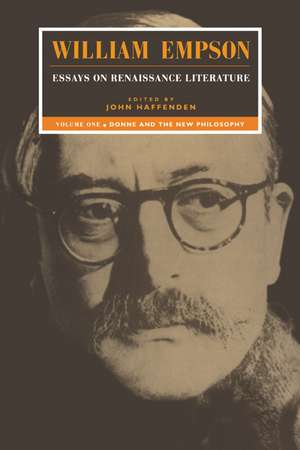
William Empson
Autor William Empson Editat de John Haffendenen Limba Engleză Paperback – 4 dec 2002
Nivelul de studiu vizat pentru acest volum este cel de licență și masterat, fiind totodată o lucrare de referință esențială pentru cercetătorii din domeniul istoriei ideilor. Ne-a atras atenția modul în care William Empson reușește să recalibreze lectura poeziei lui John Donne, plasând-o nu doar într-un vid estetic, ci în centrul efervescenței științifice a secolului al XVII-lea. Credem că valoarea acestui prim volum din seria William Empson: Essays on Renaissance Literature, publicat de Cambridge University Press, rezidă în capacitatea autorului de a demonta clișeele critice tradiționale prin argumente provocatoare și o erudiție debordantă. Spre deosebire de abordările pur teoretice din John Donne, Undone (Routledge Revivals) de Thomas Docherty, care se concentrează pe cadrele ideologice și retorice, Empson propune o lectură mult mai vie, ancorată în „Noua Filosofie” și în descoperirile empirice ale epocii. Cititorii familiarizați cu The Cambridge Companion to John Donne vor aprecia aici o voce critică singulară, mult mai puțin dispusă la compromisuri academice și mult mai atentă la nuanțele de ambiguitate intelectuală. Merită menționat că acest volum completează armonios opera critică a lui Empson, făcând trecerea de la analiza structurală din Seven Types of Ambiguity către o critică istorică și contextuală profundă. Prezența eseurilor anterior nepublicate, îngrijite meticulos de John Haffenden, oferă o imagine completă asupra modului în care William Empson a înțeles să unească rigoarea științifică cu pasiunea literară, transformând analiza textului într-o explorare a inteligenței umane în plină expansiune.
Preț: 378.15 lei
Carte tipărită la comandă
Livrare economică 20 noiembrie-04 decembrie
Specificații
ISBN-10: 0521483603
Pagini: 316
Dimensiuni: 152 x 229 x 19 mm
Greutate: 0.52 kg
Ediția:PAPERBACK.
Editura: Cambridge University Press
Locul publicării:Cambridge, United Kingdom
V-ar putea interesa
-
 Love Life GoetheJohn ArmstrongPreț: 130.60 lei
 -
 John DonneJohn StubbsPreț: 133.69 lei
 -
 Selected Letters of William EmpsonJohn Haffenden-11%Preț: 379.58 lei424.15 lei
 -
 William Empson, Volume I: Among the MandarinsJohn Haffenden-11%Preț: 392.36 lei440.09 lei
 -
 William Empson, Volume II: Against the ChristiansJohn Haffenden-10%Preț: 395.81 lei441.92 lei
 -
 The Poet and the KingMarc FumaroliPreț: 389.01 lei
 -
 BalzacGraham Robb-23%Preț: 120.39 lei155.37 lei
 -
 Song of the EarthJonathan Bate-34%Preț: 60.32 lei91.77 lei
 -
 Divine Poetry and Drama in Sixteenth-Century EnglandLily B. CampbellPreț: 273.16 lei
 -
 Preț: 374.11 lei
 -
 The Baroque Narrative of Carlos de Siguenza y GongoraKathleen RossPreț: 298.75 lei
 -
 Preț: 325.34 lei
 -
 The Marble WildernessCarolyn SpringerPreț: 334.85 lei
 -
 An Apologie for Poetrie by Sir Philip SidneyEvelyn S. ShuckburghPreț: 293.54 lei
 -
 La Venganza de TamarMolina Tirso DePreț: 321.39 lei
 -
 English Metrical PsalmsZim RivkahPreț: 359.68 lei
 -
 The Letters of T. S. Eliot Volume 5: 1930-1931John Haffenden-8%Preț: 429.03 lei466.33 lei
 -
 John Webster, Renaissance DramatistDavid Coleman-13%Preț: 156.12 lei178.64 lei
 -
 Companion to English RenaissanceHattaway-8%Preț: 448.98 lei488.02 lei
De ce să citești această carte
Această carte este o resursă fundamentală pentru studenții la filologie și istorie care doresc să înțeleagă cum descoperirile științifice au modelat poezia metafizică. Cititorul câștigă acces la o perspectivă critică rară, ce refuză interpretările convenționale în favoarea unei analize riguroase a legăturii dintre John Donne și știința modernă timpurie. Este, în esență, o lecție despre cum se citește literatura prin prisma istoriei ideilor.
Despre autor
William Empson a fost un poet și critic literar britanic de o influență covârșitoare, educat la Winchester și Magdalene College, Cambridge. Este considerat unul dintre pionierii „Noii Critici” (New Criticism), faima sa fiind consolidată de lucrări precum Seven Types of Ambiguity. Dincolo de rigoarea analitică, Empson a manifestat un interes profund pentru culturile orientale, documentat în The Face of the Buddha, și a rămas o figură centrală a literelor engleze prin capacitatea sa unică de a îmbina pasiunea poetică cu o inteligență analitică sclipitoare, trăsături vizibile și în poeziile sale din The Complete Poems.
Descriere scurtă
Cuprins
Recenzii
"Some of these passages have a sweep as grand as Empson found in Donne." Times Literary Supplement
"...an insightful look into Empson the thinker." Eugene R. Cunner, English Language Notes
"Anybody who cares about human intelligence at work with literature is in Haffenden's debt." Book Review Digest