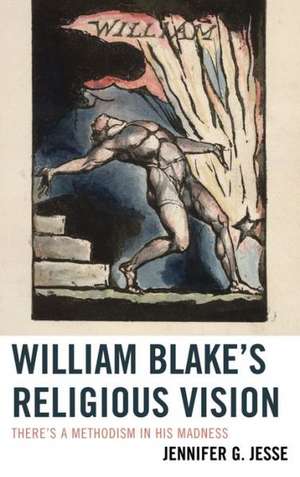
William Blake's Religious Vision: There's a Methodism in His Madness
Autor Jennifer Jesseen Limba Engleză Hardback – 14 feb 2013
Undergirding this project is Jesse's call for more rigorous attention to the dramatic character of Blake's works. She notes that scholars still typically use phrases like "Blake says" or "Blake believes," followed by some claim made by a Blakean character, without negotiating the complex narrative dynamics that might enable us to understand the rhetorical purposes of that statement, as heard by Blake's respective audiences. Jesse maintains we must expect to find reflections in Blake's works of all the theologies he engaged. The question is: what was he doing with them, and why? In order to divine what Blake meant to communicate, we must explore how those he targeted would have perceived his arguments.
Jesse concludes that by analyzing the dramatic character of Blake's works theologically through this wide-angled, audience-oriented approach, we see him orchestrating a grand rapprochement of the extreme theologies of his day into a unified vision that integrates faith and reason.
Preț: 597.20 lei
Preț vechi: 912.18 lei
-35%
Puncte Express: 896
Carte tipărită la comandă
Livrare economică 09-23 noiembrie
Livrare prin curier în România Termenul estimat este afișat lângă disponibilitate.
Transport gratuit pentru acest produs Plată online sau ramburs, în funcție de opțiunile comenzii.
Retur gratuit în 14 zile Comandă securizată și suport în română.
Specificații
ISBN-13: 9780739177907
ISBN-10: 0739177907
Pagini: 297
Ilustrații: 8 BW Photos
Dimensiuni: 161 x 235 x 29 mm
Greutate: 0.59 kg
Editura: Bloomsbury Publishing
Colecția Lexington Books
Locul publicării:New York, United States
ISBN-10: 0739177907
Pagini: 297
Ilustrații: 8 BW Photos
Dimensiuni: 161 x 235 x 29 mm
Greutate: 0.59 kg
Editura: Bloomsbury Publishing
Colecția Lexington Books
Locul publicării:New York, United States
Cuprins
Part One: Introduction
1. The Problem of Blake's Religion
2. The "rough basement": Foundational Issues
3. Urizen and Los: Diagnostic Tropes for Theological Therapy
Part Two: Reason as Definitive of Religion
4. Blake and Natural Religion
5. Rationalist Road Signs: The Bible and Creation
6. Blake and the Established Church
7. Anglican Road Signs: Christology and Atonement
Part Three: Reason as Destructive of Religion
8. Blake and the Religious Radicals
9. Radical Road Signs: Sin and the Last Judgment
Part Four: Reason as Redemptive of Religion
10. Blake and the Religious Moderates
11. Methodist Road Signs: Justification and Sanctification
Part Five: Reading Blake Theologically
12. All Religions Are One
13. Whose Madness?
1. The Problem of Blake's Religion
2. The "rough basement": Foundational Issues
3. Urizen and Los: Diagnostic Tropes for Theological Therapy
Part Two: Reason as Definitive of Religion
4. Blake and Natural Religion
5. Rationalist Road Signs: The Bible and Creation
6. Blake and the Established Church
7. Anglican Road Signs: Christology and Atonement
Part Three: Reason as Destructive of Religion
8. Blake and the Religious Radicals
9. Radical Road Signs: Sin and the Last Judgment
Part Four: Reason as Redemptive of Religion
10. Blake and the Religious Moderates
11. Methodist Road Signs: Justification and Sanctification
Part Five: Reading Blake Theologically
12. All Religions Are One
13. Whose Madness?
Recenzii
[T]his is an interesting and provocative book.. Jesse has opened up important and unexpected areas of inquiry that are likely to yield a greater understanding of Blake's polyphonic work in a heterogeneous religious milieu.
Jennifer Jesse has written an accessible introduction to William Blake. It encompasses an admirable assembly of critical learning and acumen, assessing the achievement of several generations of Blake scholars. The book will be a reference point for all those seeking a profound consideration of issues related to Blake's work and its contexts.
Jennifer Jesse has written an accessible introduction to William Blake. It encompasses an admirable assembly of critical learning and acumen, assessing the achievement of several generations of Blake scholars. The book will be a reference point for all those seeking a profound consideration of issues related to Blake's work and its contexts.