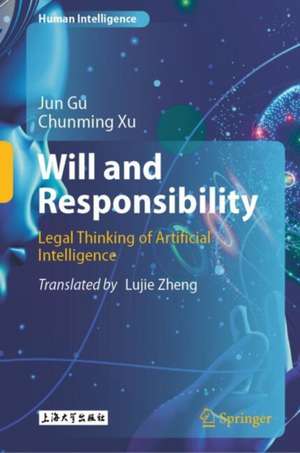
Will and Responsibility: Human Intelligence
Autor Jun Gu, Chunming Xu Traducere de Lujie Zhengen Limba Engleză Hardback – 13 aug 2024
Actualizarea adusă de ediția din 2024 a volumului Will and Responsibility marchează o tranziție necesară de la speculația teoretică la un cadru legislativ tehnic și aplicabil. Într-un peisaj dominat de avansul rapid al modelelor de limbaj și al sistemelor autonome, găsim în această lucrare o analiză riguroasă a modului în care „voința mașinii” — un concept adesea considerat contradictoriu — interacționează cu răspunderea juridică. Apreciem modul în care autorii Jun Gu și Chunming Xu depășesc dilemele etice de bază pentru a propune soluții structurale în dreptul civil și proprietatea intelectuală. Pe linia practică a volumului Robot Rules de Jacob Turner, dar cu un focus specific pe perspectivele cercetătorilor chinezi asupra autonomiei decizionale, această carte completează viziunea prezentată în lucrarea anterioară a autorilor, Human and Machines. Dacă în volumul precedent accentul cădea pe fundamentele filosofice și testul Turing, Will and Responsibility se ancorează în realitatea tehnică a roboților care intervin în actul judiciar și în creația de proprietate intelectuală. Structura celor 500 de pagini este una progresivă, pornind de la definirea conceptului de voință artificială în primele două capitole și avansând către mecanismele de implementare a responsabilității. Analiza se ramifică în direcții practice esențiale: echilibrul dintre drepturi și obligații, necesitatea unui statut constituțional pentru entitățile sintetice și protecția împotriva vătămărilor personale aplicate roboților. Găsim deosebit de util capitolul opt, care tratează regimul invențiilor generate de AI, oferind o perspectivă tehnică asupra titularului drepturilor în era post-umană. Este o resursă esențială pentru specialiștii care navighează la intersecția dintre informatică și jurisprudență.
Preț: 326.70 lei
Preț vechi: 408.37 lei
-20%
Carte disponibilă
Livrare economică 05-19 noiembrie
Specificații
ISBN-10: 9819739284
Pagini: 224
Ilustrații: Approx. 500 p. 5 illus.
Dimensiuni: 160 x 241 x 18 mm
Greutate: 0.49 kg
Ediția:2024
Editura: Springer
Colecția Human Intelligence
Seria Human Intelligence
Locul publicării:Singapore, Singapore
V-ar putea interesa
-
 Future MoralityDavid Edmonds-19%Preț: 81.20 lei99.68 lei
 -
 How To Think About AI: A Guide For The PerplexedRichard Susskind-34%Preț: 66.27 lei100.73 lei
 -
 In Robots We TrustSamuele Vinanzi-16%Preț: 147.25 lei175.17 lei
 -
 Moral AIJana Schaich BorgPreț: 78.63 lei
 -
 The LineJames BoylePreț: 200.32 lei
 -
 As If Human: Ethics and Artificial IntelligenceNigel Shadbolt-20%Preț: 98.48 lei123.10 lei
 -
 If Anyone Builds It, Everyone DiesEliezer Yudkowsky-20%Preț: 130.65 lei163.30 lei
 -
 Against the MachinePaul KingsnorthPreț: 193.57 lei
 -
 -20%Preț: 325.10 lei406.37 lei
 -
 -17%Preț: 131.39 lei157.51 lei
 -
 -41%Preț: 57.96 lei99.07 lei
 -
 Preț: 140.14 lei
 -
 Fundamental Rights for Non-Humans: Foundations, Flaws, and FuturesJohn Olusegun Adenitire-33%Preț: 583.59 lei865.80 lei
 -
 Human Rights, Robot WrongsSusie Alegre-19%Preț: 75.17 lei92.97 lei
 -
 The AI ConEmily M. BenderPreț: 151.96 lei
 -
 -18%Preț: 76.87 lei93.44 lei
 -
 Robot Rules: Regulating Artificial IntelligenceJacob TurnerPreț: 206.86 lei
 -
 Empire of AIKaren HaoPreț: 163.45 lei
De ce să citești această carte
Apreciem această lucrare pentru rigoarea cu care tratează integrarea roboților în sistemul juridic actual. Cititorul câștigă o înțelegere profundă a provocărilor legislative generate de inteligența artificială care depășește capacitățile umane în domenii specifice. Este un ghid esențial pentru juriști și dezvoltatori de AI care doresc să înțeleagă cum se pot atribui responsabilități și drepturi de proprietate unor entități non-umane, oferind soluții concrete pentru evitarea blocajelor în implementarea tehnologiei.
Despre autor
Jun Gu și Chunming Xu sunt cercetători proeminenți care contribuie la definirea cadrului etic și juridic al inteligenței artificiale din perspectiva școlii de gândire chineze. Jun Gu s-a remarcat prin analizele sale asupra interacțiunii dintre om și mașină, explorând în lucrări precum Human and Machines limitele inteligenței sintetice și fundamentele testului Turing. Chunming Xu aduce o expertiză valoroasă în domeniul proprietății intelectuale și al reglementărilor tehnologice. Împreună, aceștia au dezvoltat o viziune coerentă în cadrul seriei Human Intelligence, publicată de Springer, concentrându-se pe tranziția de la inteligența abstractă la responsabilitatea legală a sistemelor autonome.
Cuprins
Notă biografică
Chunming Xu is a professor, doctoral supervisor, and part-time lawyer. He holds a Ph.D. in Management, an LL.M. degree in Law, and a Bachelor's degree in Engineering. He used to be the Vice Dean of the Law School and the Dean of the Intellectual Property School at Shanghai University, and currently serves as a professor at the Shanghai International College of Intellectual Property at Tongji University, where he is also the director of the National Intellectual Property Training (Shanghai) Base. Additionally, he is a senior consultant and practicing lawyer at Deheng Law Office in Shanghai. Recognized as one of the first national leading talents in intellectual property, Prof. Xu is an expert in the National Intellectual Property Expert Database and serves as a specially invited consultant to the Shanghai Higher People's Court and an expert for the Ministry of Commerce's Center for Overseas Intellectual Property Rights Protection Assistance. He is an executive council member of the China Intellectual Property Law Association, the China Society of Science and Technology Law, the Vice President of the Intellectual Property Law Association of the Shanghai Law Society, and the Vice President of the Free Trade Zone Rule of Law Research Association of the Shanghai Law Society.
The translator of the book, Lujie Zheng, is a lecturer at the School of Foreign Languages at Fujian Jiangxia University. She obtained her master’s degree in Applied Linguistics for Language Teaching from the University of Southampton, UK, in 2013 and is currently pursuing a Ph.D. in Linguistics at the University of Malaya, Malaysia. She presided over 1 social science youth project, 1 research project for middle-aged and young teachers, and 1 top-tier virtual simulation course in Fujian Province, China and participated in multiple research projects at the Ministry of Education and provincial level. Lujie Zheng published 6 research articles. Her main direction of studying includes corpus linguistics, translation and English language teaching.