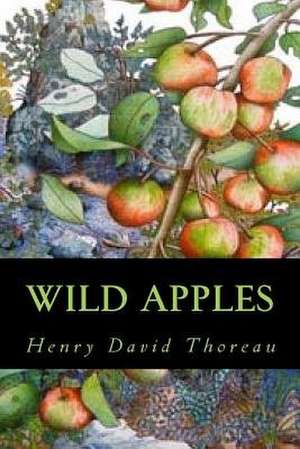
Wild Apples
Autor Henry David Thoreau Editat de Editorial, Taoen Limba Engleză Paperback
Preț: 43.88 lei
Puncte Express: 66
Carte disponibilă
Livrare economică 09-23 noiembrie
Livrare prin curier în România Termenul estimat este afișat lângă disponibilitate.
Transport gratuit de la 400.00 lei Plată online sau ramburs, în funcție de opțiunile comenzii.
Retur gratuit în 14 zile Comandă securizată și suport în română.
Specificații
ISBN-13: 9781539668251
ISBN-10: 1539668258
Pagini: 34
Dimensiuni: 152 x 229 x 2 mm
Greutate: 0.06 kg
ISBN-10: 1539668258
Pagini: 34
Dimensiuni: 152 x 229 x 2 mm
Greutate: 0.06 kg
V-ar putea interesa
-
 Walden and Civil DisobedienceHenry David ThoreauPreț: 31.92 lei
 -
 Walden and Civil DisobedienceHenry David Thoreau-18%Preț: 59.62 lei72.56 lei
 -
 WildwoodRoger Deakin-18%Preț: 64.75 lei79.15 lei
 -
 Great Ideas Where I Lived and What I Lived ForHenry Thoreau-21%Preț: 43.88 lei55.50 lei
 -
 The Portable ThoreauHenry Thoreau-18%Preț: 88.32 lei107.67 lei
 -
 Henry David Thoreau: A Very Short IntroductionLawrence Buell-20%Preț: 57.03 lei71.06 lei
 -
 Henry David Thoreau: A LifeLaura Dassow WallsPreț: 155.91 lei
 -
 Walden, Civil Disobedience and Other WritingsHenry David ThoreauPreț: 135.95 lei
 -
 Civil Disobedience and Other EssaysHenry David Thoreau-29%Preț: 17.63 lei24.96 lei
 -
 Walden, Or, Life in the WoodsHenry David Thoreau-17%Preț: 39.06 lei47.32 lei
 -
 WalkingHenry David Thoreau-19%Preț: 29.04 lei35.82 lei
 -
 Walden and Other WritingsHenry David ThoreauPreț: 38.89 lei
 -
 Walden and Civil DisobedienceHenry Thoreau D-29%Preț: 50.57 lei70.73 lei
 -
 Walden and Civil Disobedience (Special Edition)Henry Thoreau D-31%Preț: 106.03 lei154.12 lei
 -
 Walden, and on the Duty of Civil DisobedienceHenry David ThoreauPreț: 68.17 lei
 -
 Preț: 188.87 lei
 -
 Walden & Civil ObedienceHenry ClaridgePreț: 55.43 lei
 -
 Civil DisobedienceHenry David ThoreauPreț: 33.33 lei
 -
 Walden - ClassicsHenry David ThoreauPreț: 41.67 lei
Notă biografică
Henry David Thoreau (July 12, 1817 - May 6, 1862) was an American naturalist, essayist, poet, and philosopher. A leading transcendentalist, he is best known for his book Walden, a reflection upon simple living in natural surroundings, and his essay "Civil Disobedience" (originally published as "Resistance to Civil Government"), an argument for disobedience to an unjust state.Thoreau's books, articles, essays, journals, and poetry amount to more than 20 volumes. Among his lasting contributions are his writings on natural history and philosophy, in which he anticipated the methods and findings of ecology and environmental history, two sources of modern-day environmentalism. His literary style interweaves close observation of nature, personal experience, pointed rhetoric, symbolic meanings, and historical lore, while displaying a poetic sensibility, philosophical austerity, and attention to practical detail.[5] He was also deeply interested in the idea of survival in the face of hostile elements, historical change, and natural decay; at the same time he advocated abandoning waste and illusion in order to discover life's true essential needs.Thoreau was a lifelong abolitionist, delivering lectures that attacked the fugitive slave law while praising the writings of Wendell Phillips and defending the abolitionist John Brown. Thoreau's philosophy of civil disobedience later influenced the political thoughts and actions of such notable figures as Leo Tolstoy, Mahatma Gandhi, and Martin Luther King Jr.