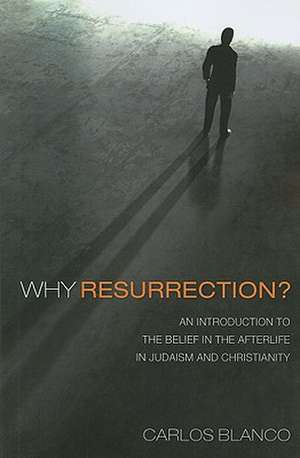
Why Resurrection?: An Introduction to the Belief in the Afterlife in Judaism and Christianity
Autor Carlos Blancoen Limba Engleză Paperback – 28 feb 2011
Preț: 201.01 lei
Puncte Express: 302
Carte tipărită la comandă
Livrare economică 25 noiembrie-09 decembrie
Livrare prin curier în România Termenul estimat este afișat lângă disponibilitate.
Transport gratuit de la 400.00 lei Plată online sau ramburs, în funcție de opțiunile comenzii.
Retur gratuit în 14 zile Comandă securizată și suport în română.
Specificații
ISBN-13: 9781608997725
ISBN-10: 1608997723
Pagini: 230
Dimensiuni: 152 x 226 x 15 mm
Greutate: 0.34 kg
Editura: Pickwick Publications
ISBN-10: 1608997723
Pagini: 230
Dimensiuni: 152 x 226 x 15 mm
Greutate: 0.34 kg
Editura: Pickwick Publications
Recenzii
'Although the book doesn't consist of many pages, its purpose, convincingly expressed in the question of the title, is not exempt from a surprising complexity. In the first place, the question is not exclusively religious and limited by a determined tradition. The question, present in all times and cultures, and deeply rooted in human aspirations, becomes a clearly philosophical question. Enlaced with issues of life, death and evil, the resurrection is a reply to the sense of the history, full of injustice, and points out a wider theme: the kingdom of God. On the one hand, it is a cardinal question of any theodicy, and the book, consequently, is written through a dialogue with the main schools of contemporary thought; on the other hand, it is not foreign to a wider reading of the apocalyptic - Judaeo-Christian - literature, and to the philosophy of religion.' Carlos Blanco, Dialogo Filosofico, Enero/Abril 2012. "Blanco provides a thorough and helpful discussion of the origins of resurrection beliefs in antiquity as a product of apocalyptic Judaism and contextualizes contemporary belief in the resurrection within the timeless questions of theodicy and the meaning of human existence. [ - ] Blanco has written an extraordinarily accessible work. While his work shows significant scholarly ability, the clear writing style makes his book applicable to both scholars and non-scholars alike. Readers interested in the concept of the resurrection and more broadly in theological discussions of death, the afterlife, and the Christian interpretation of the meaning of life find this book to be an engaging argument." J. Edwards Walters: Reviews in Religion and Theology, Vol. 19 (3), 2012. 'One of the most interesting points of this book is that Blanco doesn't limit the experience of humanity to the Judeo-Christian legacy, he rather considers it to be a legitimate aspiration of the whole humanity, shared by all religions and having been the basis of spiritual people from all times. [...] This work, suggestive and interesting, reveals a remarkable intellectual maturity and presents a solid exposition [...] its results are extremely encouraging.' Rafael Ramis Barcelo in Anuario filosofico, 45/3, 2012. 'The book is dotted with interesting digressions; continuous references to the subject of the resurrection in Judaism (Pp. 143 to 175) and Christianity, as well as interesting reflections on the concept of resurrection in atheism and agnosticism... [and] other issues such as suffering, pain and limitations, as well as that of omnipotence. [...] I hope this work of extraordinarily evocative and interesting solid intellectual maturity and exposure is not the end of his research career, but a footnote on page promising production expected of Carlos Blanco.' Rafael Ramis Barcelo, Anuario Filosofico, Volume 45, number 3, 2012 'Blanco discusses interpretations of history offered by Heidegger, Bloch, Hegel, and Pannenberg. [...] ... examines the apocalyptic conception of history, evil, and eschatology [...] examines how death is viewed within different worldviews [...] In the final chapter, Blanco attempts to answer what post-resurrection existence is like by discussing the kingdom of God.' Michael R. Licona, The Expository Times, volume 124, number 4, January 2013 "...This book provides a useful introduction to Resurrection and the reader can gain insight into the different Judaic and Christian positions... [...] This book explores 'one of the great fascinations in human history' allowing readers to make their own judgments based on the arguments given (Blanco, 2011, p.x)..." John Fretwell, Theological book review, Vol. 24, No 2, 2012.
'Although the book doesn't consist of many pages, its purpose, convincingly expressed in the question of the title, is not exempt from a surprising complexity. In the first place, the question is not exclusively religious and limited by a determined tradition. The question, present in all times and cultures, and deeply rooted in human aspirations, becomes a clearly philosophical question. Enlaced with issues of life, death and evil, the resurrection is a reply to the sense of the history, full of injustice, and points out a wider theme: the kingdom of God. On the one hand, it is a cardinal question of any theodicy, and the book, consequently, is written through a dialogue with the main schools of contemporary thought; on the other hand, it is not foreign to a wider reading of the apocalyptic - Judaeo-Christian - literature, and to the philosophy of religion.' Carlos Blanco, Dialogo Filosofico, Enero/Abril 2012. "Blanco provides a thorough and helpful discussion of the origins of resurrection beliefs in antiquity as a product of apocalyptic Judaism and contextualizes contemporary belief in the resurrection within the timeless questions of theodicy and the meaning of human existence. [ - ] Blanco has written an extraordinarily accessible work. While his work shows significant scholarly ability, the clear writing style makes his book applicable to both scholars and non-scholars alike. Readers interested in the concept of the resurrection and more broadly in theological discussions of death, the afterlife, and the Christian interpretation of the meaning of life find this book to be an engaging argument." J. Edwards Walters: Reviews in Religion and Theology, Vol. 19 (3), 2012.
'Although the book doesn't consist of many pages, its purpose, convincingly expressed in the question of the title, is not exempt from a surprising complexity. In the first place, the question is not exclusively religious and limited by a determined tradition. The question, present in all times and cultures, and deeply rooted in human aspirations, becomes a clearly philosophical question. Enlaced with issues of life, death and evil, the resurrection is a reply to the sense of the history, full of injustice, and points out a wider theme: the kingdom of God. On the one hand, it is a cardinal question of any theodicy, and the book, consequently, is written through a dialogue with the main schools of contemporary thought; on the other hand, it is not foreign to a wider reading of the apocalyptic - Judaeo-Christian - literature, and to the philosophy of religion.' Carlos Blanco, Dialogo Filosofico, Enero/Abril 2012. "Blanco provides a thorough and helpful discussion of the origins of resurrection beliefs in antiquity as a product of apocalyptic Judaism and contextualizes contemporary belief in the resurrection within the timeless questions of theodicy and the meaning of human existence. [ - ] Blanco has written an extraordinarily accessible work. While his work shows significant scholarly ability, the clear writing style makes his book applicable to both scholars and non-scholars alike. Readers interested in the concept of the resurrection and more broadly in theological discussions of death, the afterlife, and the Christian interpretation of the meaning of life find this book to be an engaging argument." J. Edwards Walters: Reviews in Religion and Theology, Vol. 19 (3), 2012. 'One of the most interesting points of this book is that Blanco doesn't limit the experience of humanity to the Judeo-Christian legacy, he rather considers it to be a legitimate aspiration of the whole humanity, shared by all religions and having been the basis of spiritual people from all times. [...] This work, suggestive and interesting, reveals a remarkable intellectual maturity and presents a solid exposition [...] its results are extremely encouraging.' Rafael Ramis Barcelo in Anuario filosofico, 45/3, 2012.
'Although the book doesn't consist of many pages, its purpose, convincingly expressed in the question of the title, is not exempt from a surprising complexity. In the first place, the question is not exclusively religious and limited by a determined tradition. The question, present in all times and cultures, and deeply rooted in human aspirations, becomes a clearly philosophical question. Enlaced with issues of life, death and evil, the resurrection is a reply to the sense of the history, full of injustice, and points out a wider theme: the kingdom of God. On the one hand, it is a cardinal question of any theodicy, and the book, consequently, is written through a dialogue with the main schools of contemporary thought; on the other hand, it is not foreign to a wider reading of the apocalyptic - Judaeo-Christian - literature, and to the philosophy of religion.' Carlos Blanco, Dialogo Filosofico, Enero/Abril 2012. "Blanco provides a thorough and helpful discussion of the origins of resurrection beliefs in antiquity as a product of apocalyptic Judaism and contextualizes contemporary belief in the resurrection within the timeless questions of theodicy and the meaning of human existence. [ - ] Blanco has written an extraordinarily accessible work. While his work shows significant scholarly ability, the clear writing style makes his book applicable to both scholars and non-scholars alike. Readers interested in the concept of the resurrection and more broadly in theological discussions of death, the afterlife, and the Christian interpretation of the meaning of life find this book to be an engaging argument." J. Edwards Walters: Reviews in Religion and Theology, Vol. 19 (3), 2012. 'One of the most interesting points of this book is that Blanco doesn't limit the experience of humanity to the Judeo-Christian legacy, he rather considers it to be a legitimate aspiration of the whole humanity, shared by all religions and having been the basis of spiritual people from all times. [...] This work, suggestive and interesting, reveals a remarkable intellectual maturity and presents a solid exposition [...] its results are extremely encouraging.' Rafael Ramis Barcelo in Anuario filosofico, 45/3, 2012. 'The book is dotted with interesting digressions; continuous references to the subject of the resurrection in Judaism (Pp. 143 to 175) and Christianity, as well as interesting reflections on the concept of resurrection in atheism and agnosticism... [and] other issues such as suffering, pain and limitations, as well as that of omnipotence. [...] I hope this work of extraordinarily evocative and interesting solid intellectual maturity and exposure is not the end of his research career, but a footnote on page promising production expected of Carlos Blanco.' Rafael Ramis Barcelo, Anuario Filosofico, Volume 45, number 3, 2012
'Although the book doesn't consist of many pages, its purpose, convincingly expressed in the question of the title, is not exempt from a surprising complexity. In the first place, the question is not exclusively religious and limited by a determined tradition. The question, present in all times and cultures, and deeply rooted in human aspirations, becomes a clearly philosophical question. Enlaced with issues of life, death and evil, the resurrection is a reply to the sense of the history, full of injustice, and points out a wider theme: the kingdom of God. On the one hand, it is a cardinal question of any theodicy, and the book, consequently, is written through a dialogue with the main schools of contemporary thought; on the other hand, it is not foreign to a wider reading of the apocalyptic - Judaeo-Christian - literature, and to the philosophy of religion.' Carlos Blanco, Dialogo Filosofico, Enero/Abril 2012. "Blanco provides a thorough and helpful discussion of the origins of resurrection beliefs in antiquity as a product of apocalyptic Judaism and contextualizes contemporary belief in the resurrection within the timeless questions of theodicy and the meaning of human existence. [ - ] Blanco has written an extraordinarily accessible work. While his work shows significant scholarly ability, the clear writing style makes his book applicable to both scholars and non-scholars alike. Readers interested in the concept of the resurrection and more broadly in theological discussions of death, the afterlife, and the Christian interpretation of the meaning of life find this book to be an engaging argument." J. Edwards Walters: Reviews in Religion and Theology, Vol. 19 (3), 2012.
'Although the book doesn't consist of many pages, its purpose, convincingly expressed in the question of the title, is not exempt from a surprising complexity. In the first place, the question is not exclusively religious and limited by a determined tradition. The question, present in all times and cultures, and deeply rooted in human aspirations, becomes a clearly philosophical question. Enlaced with issues of life, death and evil, the resurrection is a reply to the sense of the history, full of injustice, and points out a wider theme: the kingdom of God. On the one hand, it is a cardinal question of any theodicy, and the book, consequently, is written through a dialogue with the main schools of contemporary thought; on the other hand, it is not foreign to a wider reading of the apocalyptic - Judaeo-Christian - literature, and to the philosophy of religion.' Carlos Blanco, Dialogo Filosofico, Enero/Abril 2012. "Blanco provides a thorough and helpful discussion of the origins of resurrection beliefs in antiquity as a product of apocalyptic Judaism and contextualizes contemporary belief in the resurrection within the timeless questions of theodicy and the meaning of human existence. [ - ] Blanco has written an extraordinarily accessible work. While his work shows significant scholarly ability, the clear writing style makes his book applicable to both scholars and non-scholars alike. Readers interested in the concept of the resurrection and more broadly in theological discussions of death, the afterlife, and the Christian interpretation of the meaning of life find this book to be an engaging argument." J. Edwards Walters: Reviews in Religion and Theology, Vol. 19 (3), 2012. 'One of the most interesting points of this book is that Blanco doesn't limit the experience of humanity to the Judeo-Christian legacy, he rather considers it to be a legitimate aspiration of the whole humanity, shared by all religions and having been the basis of spiritual people from all times. [...] This work, suggestive and interesting, reveals a remarkable intellectual maturity and presents a solid exposition [...] its results are extremely encouraging.' Rafael Ramis Barcelo in Anuario filosofico, 45/3, 2012.
'Although the book doesn't consist of many pages, its purpose, convincingly expressed in the question of the title, is not exempt from a surprising complexity. In the first place, the question is not exclusively religious and limited by a determined tradition. The question, present in all times and cultures, and deeply rooted in human aspirations, becomes a clearly philosophical question. Enlaced with issues of life, death and evil, the resurrection is a reply to the sense of the history, full of injustice, and points out a wider theme: the kingdom of God. On the one hand, it is a cardinal question of any theodicy, and the book, consequently, is written through a dialogue with the main schools of contemporary thought; on the other hand, it is not foreign to a wider reading of the apocalyptic - Judaeo-Christian - literature, and to the philosophy of religion.' Carlos Blanco, Dialogo Filosofico, Enero/Abril 2012. "Blanco provides a thorough and helpful discussion of the origins of resurrection beliefs in antiquity as a product of apocalyptic Judaism and contextualizes contemporary belief in the resurrection within the timeless questions of theodicy and the meaning of human existence. [ - ] Blanco has written an extraordinarily accessible work. While his work shows significant scholarly ability, the clear writing style makes his book applicable to both scholars and non-scholars alike. Readers interested in the concept of the resurrection and more broadly in theological discussions of death, the afterlife, and the Christian interpretation of the meaning of life find this book to be an engaging argument." J. Edwards Walters: Reviews in Religion and Theology, Vol. 19 (3), 2012. 'One of the most interesting points of this book is that Blanco doesn't limit the experience of humanity to the Judeo-Christian legacy, he rather considers it to be a legitimate aspiration of the whole humanity, shared by all religions and having been the basis of spiritual people from all times. [...] This work, suggestive and interesting, reveals a remarkable intellectual maturity and presents a solid exposition [...] its results are extremely encouraging.' Rafael Ramis Barcelo in Anuario filosofico, 45/3, 2012. 'The book is dotted with interesting digressions; continuous references to the subject of the resurrection in Judaism (Pp. 143 to 175) and Christianity, as well as interesting reflections on the concept of resurrection in atheism and agnosticism... [and] other issues such as suffering, pain and limitations, as well as that of omnipotence. [...] I hope this work of extraordinarily evocative and interesting solid intellectual maturity and exposure is not the end of his research career, but a footnote on page promising production expected of Carlos Blanco.' Rafael Ramis Barcelo, Anuario Filosofico, Volume 45, number 3, 2012