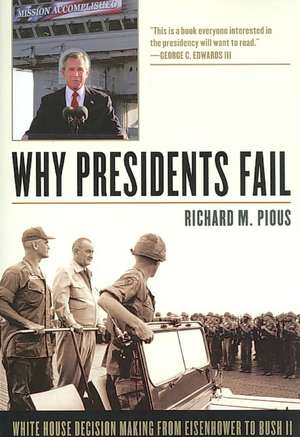
Why Presidents Fail: White House Decision Making from Eisenhower to Bush II
Autor Richard M. Piousen Limba Engleză Paperback – 17 iul 2008
Preț: 307.91 lei
Preț vechi: 391.76 lei
-21%
Puncte Express: 462
Carte tipărită la comandă
Livrare economică 08-22 decembrie
Livrare prin curier în România Termenul estimat este afișat lângă disponibilitate.
Transport gratuit de la 400.00 lei Plată online sau ramburs, în funcție de opțiunile comenzii.
Retur gratuit în 14 zile Comandă securizată și suport în română.
Specificații
ISBN-13: 9780742562851
ISBN-10: 0742562859
Pagini: 317
Dimensiuni: 156 x 233 x 20 mm
Greutate: 0.5 kg
Editura: Bloomsbury Publishing
Colecția Rowman & Littlefield
Locul publicării:New York, United States
ISBN-10: 0742562859
Pagini: 317
Dimensiuni: 156 x 233 x 20 mm
Greutate: 0.5 kg
Editura: Bloomsbury Publishing
Colecția Rowman & Littlefield
Locul publicării:New York, United States
Cuprins
Chapter 1 Introduction: Presidential Fiascoes
Chapter 2 Chapter 1. Reputation: Eisenhower and the U-2 Flights
Chapter 3 Chapter 2. Power Stakes: Kennedy and the Bay of Pigs
Chapter 4 Chapter 3. Compellence: Johnson and the Vietnam Escalation
Chapter 5 Chapter 4. Command: Ford and the Mayaguez
Chapter 6 Chapter 5. Rhetoric: Carter and the Energy Crisis
Chapter 7 Chapter 6. Prerogative: Reagan and the Iran-Contra Affair
Chapter 8 Chapter 7. Gamesmanship: Bush and the Budget
Chapter 9 Chapter 8. Program Innovation: Clinton and Health Care
Chapter 10 Chapter 9. Parallel Governance: Bush and Iraqi WMD
Chapter 11 Chapter 10. Presidents Unbound: Crises of Authority and Legitimacy
Chapter 12 Chapter 11. Risk and Resilience: Toward a White House Learning Curve
Chapter 2 Chapter 1. Reputation: Eisenhower and the U-2 Flights
Chapter 3 Chapter 2. Power Stakes: Kennedy and the Bay of Pigs
Chapter 4 Chapter 3. Compellence: Johnson and the Vietnam Escalation
Chapter 5 Chapter 4. Command: Ford and the Mayaguez
Chapter 6 Chapter 5. Rhetoric: Carter and the Energy Crisis
Chapter 7 Chapter 6. Prerogative: Reagan and the Iran-Contra Affair
Chapter 8 Chapter 7. Gamesmanship: Bush and the Budget
Chapter 9 Chapter 8. Program Innovation: Clinton and Health Care
Chapter 10 Chapter 9. Parallel Governance: Bush and Iraqi WMD
Chapter 11 Chapter 10. Presidents Unbound: Crises of Authority and Legitimacy
Chapter 12 Chapter 11. Risk and Resilience: Toward a White House Learning Curve
Recenzii
As Richard Pious traces the anatomy of presidential failures, he argues that, under conditions of high pressure and great uncertainty, presidents too often engage in "situational constitutionalism" and fail to distinguish between their personal stakes and the nation's best interests. His carefully reconstructed and detailed case studies do not present merely the conventional wisdom about some obvious presidential blunders, but include incisive analyses of the underlying dynamics of presidential failures that contain important lessons for future presidents and citizens alike.
This well-written work, which includes extensive footnotes and resources for further study, is recommended for academic libraries.
His particular lens of anaylsis deepens our understanding of how presidents come to make failed policy choices.
Pious has researched each case in great detail, yielding much information that may be new to readers, and provides a thorough bibliography. Appropriate for high school and college study, this will also have great appeal for devotees of poli-sci and presidential history.
Why Presidents Fail will engage students and educate us all. Filled with wisdom and innovative thinking, it is a volume everyone interested in the presidency will want to read.
Government executives, for their part, should be required to study this book closely and incorporate the lessons of executive failure. Highly recommended.
This well-written work, which includes extensive footnotes and resources for further study, is recommended for academic libraries.
His particular lens of anaylsis deepens our understanding of how presidents come to make failed policy choices.
Pious has researched each case in great detail, yielding much information that may be new to readers, and provides a thorough bibliography. Appropriate for high school and college study, this will also have great appeal for devotees of poli-sci and presidential history.
Why Presidents Fail will engage students and educate us all. Filled with wisdom and innovative thinking, it is a volume everyone interested in the presidency will want to read.
Government executives, for their part, should be required to study this book closely and incorporate the lessons of executive failure. Highly recommended.